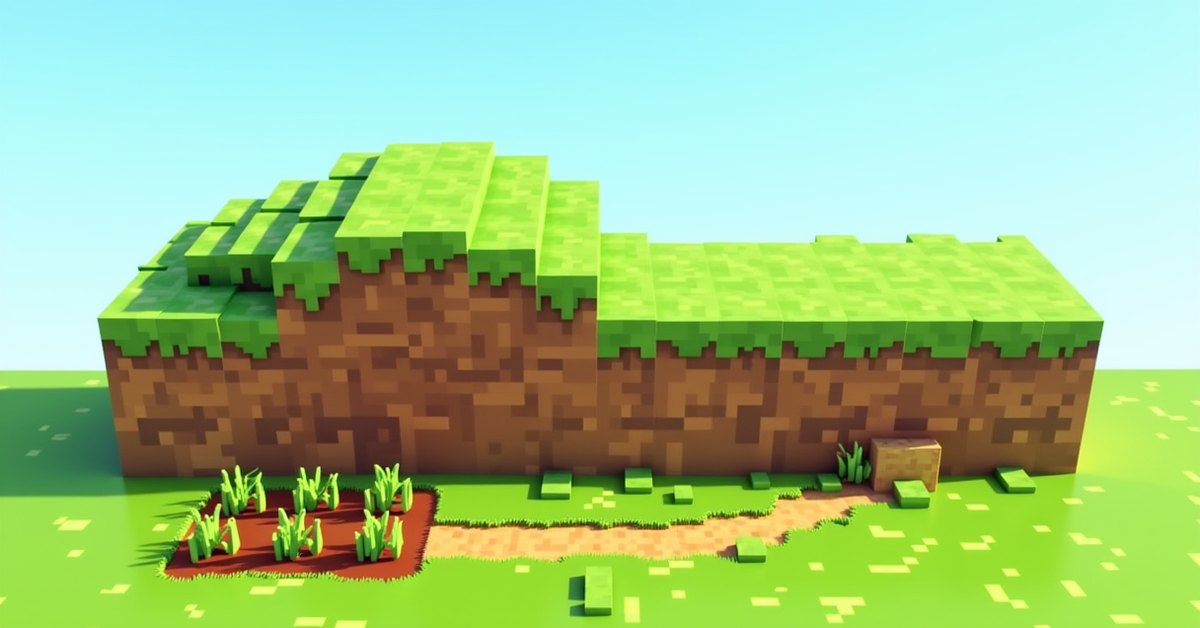
Dirt and grass blocks are the two most common blocks you will see in Minecraft. Almost every grassy hill, forest floor, and plains field is built on them. They look simple, and most of the time they are, but a few rules about how grass spreads, dies, and turns into other blocks trip up new players constantly.
This guide covers where dirt and grass blocks come from, how to mine them, how grass behaves, and how to turn dirt into farmland, dirt paths, and other useful variants. If you have ever wondered why the grass on your roof keeps dying or why a block you mined gave you plain dirt instead of grass, the answers are here.
What dirt and grass blocks are
Dirt is a plain brown block that makes up most of the ground layer in the Overworld. It sits just under the surface in nearly every biome and forms the bulk of hills and cliffs that rise above the stone below.
A grass block is a dirt block with a layer of grass growing on its top face. The top is green, with the exact shade set by the biome, the sides show a thin strip of green over brown, and the bottom is plain dirt. Underneath, it behaves like dirt. The grass is really just a surface state that can appear or disappear depending on light and on what sits above the block.
Neither block is affected by gravity, so unlike sand or gravel, dirt and grass blocks stay put when you remove the block under them.
Where dirt and grass blocks generate
Grass blocks form the top layer of most temperate Overworld biomes, including plains, forests, savannas, taigas, and swamps. Below that green surface sits a few blocks of dirt before the ground turns to stone. Some biomes swap the surface for something else, like sand in deserts, red sand in badlands, or podzol in old growth taiga, but dirt still fills the layers underneath.
Because dirt sits just below the surface almost everywhere, you rarely have to go looking for it. Digging a basement, flattening a hill, or carving out a foundation hands you more than you will usually need.
How to get dirt and grass blocks
Dirt is one of the easiest blocks to gather. Break it with your hand or any tool and it drops itself. A shovel is the fastest way to mine it, and a shovel with Efficiency clears large areas in seconds. You will pick up huge amounts of dirt just from digging foundations and leveling ground.
Grass blocks are different. If you mine a grass block with a normal tool or your hand, it drops plain dirt, not a grass block. To collect the grass block itself, you need a tool enchanted with Silk Touch. This catches a lot of builders off guard when they try to move a patch of lawn and end up with a pile of dirt instead.
You do not always need to carry grass blocks, though. Grass spreads on its own, so you can place plain dirt where you want a lawn and let nearby grass grow over it.
How grass spreads and dies
Grass spreads from a grass block to nearby dirt blocks as long as the spot is bright enough. The target dirt needs a decent light level on top, around 4 or higher, and it has to be within a short range of an existing grass block, a few blocks in each direction and one or two blocks up or down. Over time the green creeps outward to fill in exposed dirt.
Grass also dies. If you place a solid, light-blocking block directly on top of a grass block, or the light level above it drops too low, the grass withers and the block turns back into plain dirt. This is why grass under a floor, inside a cave, or beneath a slab eventually goes brown.
Bone meal used on a grass block grows tall grass and flowers on the blocks around it, which is handy for decorating or for farming seeds. Coarse dirt, by contrast, never grows grass at all, so it is the block to reach for when you want bare ground that stays bare.
Turning dirt into farmland and dirt paths
Dirt and grass blocks are the starting point for two of the most useful ground blocks in the game.
Right-click dirt, grass, or coarse dirt with a hoe and it becomes farmland, the tilled soil you plant crops on. Farmland stays moist if there is water within four blocks, and moist farmland grows crops faster. Be careful walking on it: jumping or falling onto farmland can trample it back into dirt, which uproots whatever you planted. Fencing off your fields or keeping mobs away prevents this.
Right-click dirt or grass with a shovel and you get a dirt path, the slightly lowered, flattened block you see running through villages. Dirt paths are decorative and good for marking walkways. They sit just below a full block in height, so the top is a touch lower than the blocks around them. This block was called the grass path in older versions and was renamed to dirt path in version 1.17.
Dirt variants worth knowing
Dirt is the base for a small family of related blocks. Coarse dirt is a rougher version that grass will not spread onto, which makes it good for paths and bare patches. You craft it from two dirt and two gravel arranged in a 2×2 square, and a hoe turns it back into regular dirt. Podzol is the dark brown ground found in old growth taiga and bamboo jungles. Grass will not spread onto podzol either, and you need Silk Touch to pick up the block itself.
Mycelium is the purple-speckled block covering mushroom fields. It spreads the way grass does, but it supports mushrooms rather than grass and flowers, and it also needs Silk Touch to collect. Rooted dirt shows up under azalea trees and in lush caves; use bone meal on it to grow hanging roots underneath, or a hoe to knock the roots off and leave plain dirt. Mud is made by pouring a water bottle onto a dirt block, and it can be processed into packed mud and mud bricks for building.
All of these start from or relate to ordinary dirt, so a single stack of dirt goes a long way.
Tips and common mistakes
A few things save time once you know them. Always carry a shovel for dirt work, because mining a large area by hand is slow and wears out your patience faster than your tools. If you want to keep a grass roof or a raised garden green, make sure light can reach it, since grass in the dark will die and leave you with dirt.
When you need bare ground that will not turn green, use coarse dirt instead of fighting the spread of grass. And if you are moving a lawn, remember the Silk Touch rule: without it, every grass block you break becomes dirt.
Sheep interact with grass too. A sheep that has been sheared will eat a grass block to regrow its wool, turning that block into dirt in the process. On a farm with many sheep, this slowly chews up the grass they stand on, so give them room to roam over a wider grassy area.
Frequently asked questions
Why did my grass block turn into dirt?
Either you covered it with a solid block, or the light level above it dropped too low. Grass needs light to survive. Add a light source or remove whatever is blocking the sky, and grass can spread back over it from nearby grass blocks.
How do I get a grass block instead of dirt?
Mine it with a tool enchanted with Silk Touch. Any other tool, or your hand, drops plain dirt.
Does grass spread to coarse dirt?
No. Coarse dirt is designed to block grass spread. Use a hoe on it to convert it to regular dirt first, then grass can grow over it.
How do I make grass grow faster?
You cannot speed natural grass spread with bone meal on plain dirt. Bone meal only grows tall grass and flowers when used on a block that already has grass. The fastest way to green an area is to surround the dirt with grass blocks, give it good light, and wait.
Can I plant crops on a grass block?
Not directly. Till it with a hoe first to turn it into farmland, then plant your seeds. The hoe removes the grass layer in the process.
Do dirt and grass blocks fall like sand?
No. Neither block is affected by gravity, so they stay floating if you remove the block beneath them.
Dirt and grass are the blocks you will touch most in any world, so a little knowledge about how grass spreads and how to till and shape the ground pays off on every build. Keep a shovel handy, mind the light, and reach for coarse dirt whenever you want the green to stay away.