What is the enchanting table?
The enchanting table is a utility block that lets you spend experience levels and lapis lazuli to add magical effects to tools, weapons, armor, and a few other items. You place an item in the top slot, drop in some lapis, pick one of three random enchantment options, and the item comes out improved.
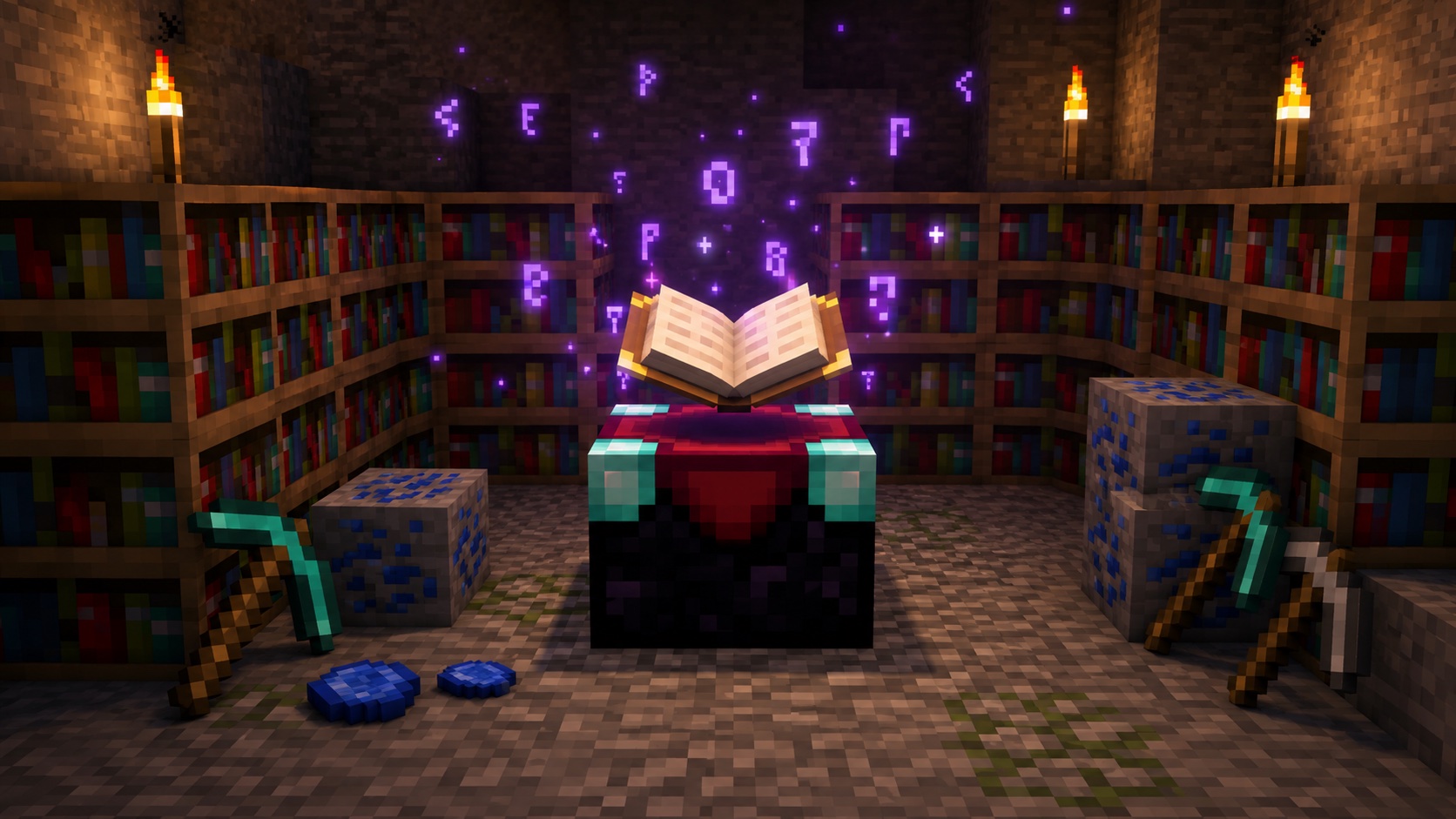
It looks like a thick book floating above an obsidian and purple base, with strange runes drifting around it. Those runes are flavor text in the Standard Galactic Alphabet and have nothing to do with the actual enchantment you get. The real result is rolled randomly from a pool weighted by your setup and the item you’re enchanting.
An enchanting table on its own caps out at low-level enchantments. Surround it with bookshelves and you unlock the full range, up to level 30 options.
How to craft an enchanting table
You need three ingredients to craft an enchanting table:
- 1 book
- 2 diamonds
- 4 blocks of obsidian
On a crafting table, place the book in the top middle slot. In the middle row, put a diamond on each side of one obsidian. Fill the entire bottom row with the remaining three obsidian.
The book itself needs 1 leather and 3 paper, so you’ll have spent some time gathering leather from cows or trading with a leatherworker villager. Obsidian needs a diamond pickaxe to mine, which means by the time you’re crafting one of these you’ve already gotten your hands on diamonds.
How enchanting works
Right-click the enchanting table to open the interface. You’ll see two input slots on the left (one for the item, one for lapis lazuli) and three enchantment options on the right.
Each option shows:
- The experience level required to see the option
- A lapis lazuli cost between 1 and 3
- One revealed enchantment, with any additional enchantments hidden until you pick
- Some Galactic Alphabet runes (decorative, ignore them)
The number on the right of each option is the experience level you must have available. The number of lapis required is shown as a small stack count. Picking an option spends levels equal to the slot number you chose (1, 2, or 3), not the displayed cost on the right.
The level shown on the right is the level you need to see the option at all. The actual level cost you pay is between 1 and 3. That’s a common point of confusion when people see “Sharpness IV, 30” and worry they’ll lose 30 full levels.
Earning the XP for enchanting
Level 30 enchantments aren’t cheap. Going from level 0 to level 30 takes about 1,395 experience points, which is roughly 80 zombies, 60 skeletons, or a single small XP farm run. Common XP sources include mob farms (zombie, skeleton, or general spawner farms), mining for ores like coal and emerald that drop XP directly, smelting ores in a furnace and collecting the XP when you take the result out, and breeding animals.
If you plan to enchant regularly, build a simple XP farm near your enchanting setup. A drowned farm in a river biome or a basic mob grinder near your base saves a lot of trips back to the table.
Bookshelves and the level 30 cap
A bare enchanting table maxes out around level 8. To reach level 30 enchantment options, you need bookshelves placed around the table in a specific pattern.
The rules:
- Place bookshelves one block away from the table, with one empty block of space between the table and each bookshelf
- Bookshelves can sit on the same level as the table or one block higher
- The block between the bookshelf and the table must be air or a transparent block like glass, carpet, or a torch
- The game counts up to 15 bookshelves. More than 15 in range gives no extra benefit
The standard setup is a 5×5 ring of bookshelves around the table with one block of clear space between the inner edge of the ring and the table itself. That arrangement places 15 bookshelves in range at floor height, which is the maximum.
If your bookshelf count drops below 15, the maximum enchantment level drops with it. One bookshelf gets you a level 2 cap, ten bookshelves get you to around level 22, and 15 unlocks the level 30 ceiling.
Crafting a bookshelf takes 6 wood planks and 3 books. That’s 9 leather and 27 paper for the books alone, which is why a paper farm or a librarian villager pays off fast once you decide to invest in enchanting.
What you can enchant
Most gear can go through the enchanting table directly:
- Swords, axes, pickaxes, shovels, and hoes
- Helmets, chestplates, leggings, and boots in any material
- Bows and crossbows
- Fishing rods and tridents
- Elytra
- Books, which become enchanted books
- Shears, flint and steel, brushes
- Carrot on a stick and warped fungus on a stick
- Mace
Shields cannot be enchanted at the table. To put Unbreaking on a shield, you combine it with an enchanted book at an anvil. The same applies for getting Mending on anything: the enchantment never rolls from a table. Mending only comes from books found through villager trading, loot chests, or fishing.
Tips and common mistakes
A few things trip people up:
- Don’t put solid blocks between bookshelves and the table. A single block of stone in the gap kills that bookshelf’s contribution.
- Stacking bookshelves three high doesn’t help. Only the first two layers (at table height and one above) get counted.
- The three options you see are locked to your XP level and the current enchantment seed. If you don’t like any of them, enchant a cheap item like a wooden sword or a book to cycle the seed and reroll.
- You don’t need to stand still while enchanting. Open the menu, walk away, come back. The options stay until you take one or change the seed.
- Carry plenty of lapis. Each enchant costs 1 to 3 lapis lazuli, and you’ll burn through a stack faster than expected on a long enchanting session.
Java vs. Bedrock differences
The mechanics are nearly identical across editions. Both versions cap at level 30, both require 15 bookshelves for the top tier, and both use lapis as fuel. The randomization seed works the same way, so the trick of enchanting cheap items to cycle options applies to both editions.
The biggest practical difference is in enchantment availability through other sources. Mending and other treasure-only enchantments are obtainable through villagers, loot, and fishing in both editions, but trade patterns and trader spawning can differ slightly between Java and Bedrock world generation, so the route you take to find Mending may not look the same on both platforms.
Frequently asked questions
How many bookshelves do you need for level 30 enchantments?
15 bookshelves placed in the correct positions. Any more gives no extra benefit, and any fewer caps you below level 30.
Why isn’t my enchanting table reading the bookshelves?
Almost always one of three things: a solid block is sitting between the table and a shelf, the shelves are too far away (more than one block of gap), or the shelves aren’t at the right height. Walk around the table and look for solid blocks blocking any of the gaps.
Can you reroll enchantment options?
Yes. The three options refresh after you take one, so enchant a cheap item like a book or a wooden tool to cycle them. Breaking and replacing a bookshelf also changes the count and rerolls the options without spending XP.
What is the language on the enchanting table?
It’s the Standard Galactic Alphabet, a substitution cipher for English originally from the Commander Keen games. The text shown is randomized and doesn’t describe the enchantment you’ll receive. Treat it as decoration.
Can the enchanting table give Mending?
No. Mending only comes from enchanted books found in loot, traded by librarians, or pulled out of the water with a fishing rod. To put Mending on gear, combine the book and the item at an anvil.
Does the enchanting table need to be on the ground?
No. Place it wherever you want as long as the bookshelves around it are positioned correctly. Some players build their setup on a raised platform to keep mobs from spawning on the floor.
What’s the cheapest enchantment from the table?
1 experience level and 1 lapis lazuli for the top option on a low-tier setup. You won’t get strong enchantments at that price, but it’s useful for spending a level to reroll the options for a more expensive item afterward.
Can you enchant the same item twice?
Not directly at the enchanting table. Once an item has any enchantment, the table won’t accept it again. To stack more enchantments on it, combine the enchanted item with an enchanted book or another enchanted item of the same type at an anvil. The anvil will also let you raise the level of existing enchantments by combining matching levels.
Worth setting up early
An enchanting table is one of the highest-impact builds you can do in the first few in-game days after finding diamonds. Even a small bookshelf circle pays off the moment you put Efficiency on a pickaxe or Protection on a chestplate. Build it once, keep some lapis on hand, and it pays dividends for the rest of the world.