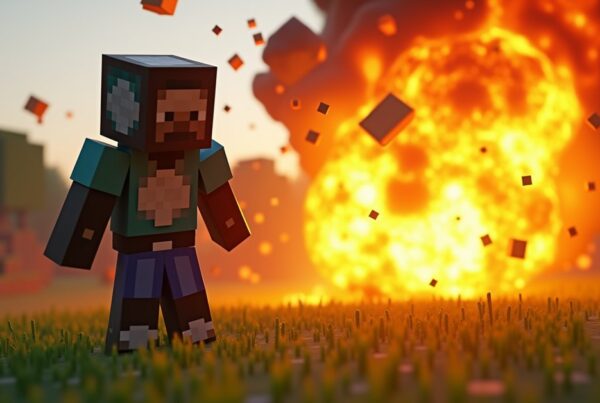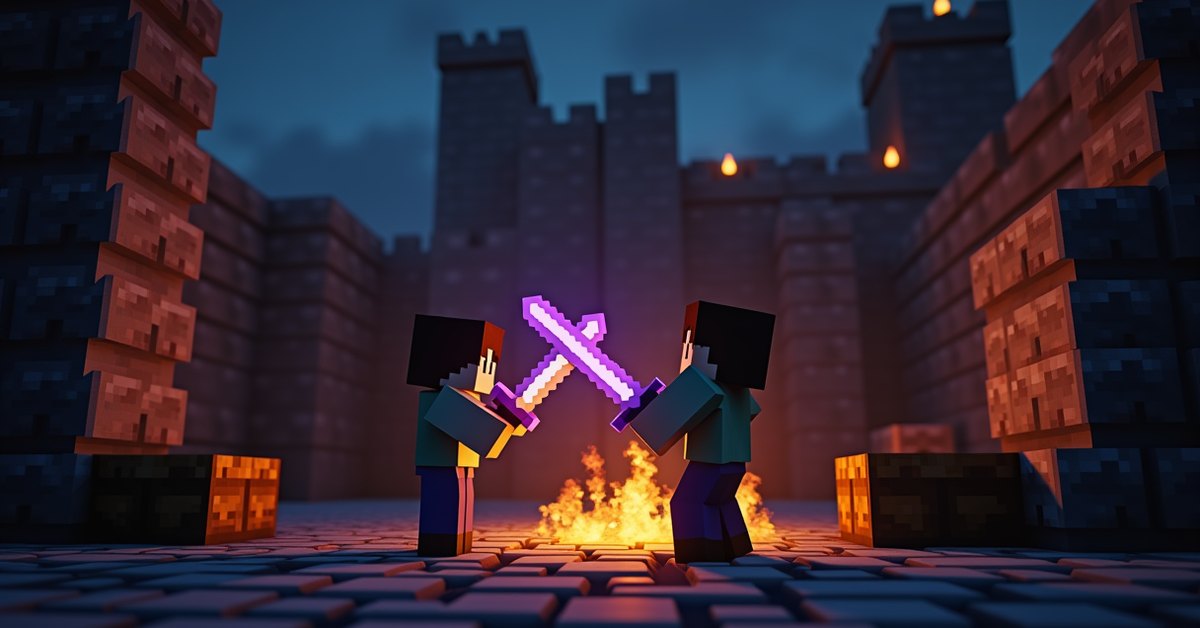
Fire Aspect is a sword enchantment that sets mobs on fire when you hit them. The burn deals extra damage over a few seconds after the swing lands, which can finish off a target you couldn’t quite kill with one hit. It also cooks food drops automatically, so a pig hit with a Fire Aspect sword drops cooked porkchops instead of raw.
It maxes out at level II, comes from enchanting tables, loot chests, and librarian trades, and works on every sword material from wood to netherite. The catch is that the fire damage doesn’t apply in every situation, and a handful of mobs ignore it entirely.
Here is what Fire Aspect actually does, how the two levels differ, and where it earns its slot on your sword.
What Fire Aspect does
When you hit a mob with a sword that has Fire Aspect, the mob catches fire. The base sword hit lands first, then the fire keeps ticking damage for a set number of seconds. The level of the enchantment controls how long the fire lasts.
The fire effect is identical to standing in a normal fire block. It deals 1 damage per fire tick, and a mob that takes fire damage flashes red and stays lit until the timer runs out, the mob dies, the mob enters water, or the mob is a type that is fire immune.
Fire Aspect only triggers on a melee hit. Throwing a sword does not exist in vanilla Minecraft, and a sword with Fire Aspect that you drop on the ground will not ignite anything. The enchantment also does not transfer to arrows. If you want flaming arrows, you need the Flame enchantment on a bow.
How to get Fire Aspect
Fire Aspect is a common enchantment, not a treasure enchantment, which means you can get it from an enchanting table. The usual ways to get it are:
- Enchanting table. Place a sword in the enchanting table and try the slots. Higher bookshelves and higher player levels increase the chance of seeing Fire Aspect II in the offered list.
- Librarian trading. A librarian villager can sell a Fire Aspect enchanted book for emeralds. If the first librarian doesn’t offer the trade you want, break the lectern, place it again, and a new villager will take the job with a fresh trade list.
- Loot chests. Enchanted books and pre-enchanted swords show up in dungeon chests, mineshaft minecarts, stronghold chests, and end city chests.
- Fishing. An enchanted book is one of the possible rare drops from fishing, and Fire Aspect is in the pool.
Once you have an enchanted book, drop it onto a sword in an anvil to apply the enchantment. Combining a book and a sword in an anvil also lets you preserve other enchantments already on the sword, which is the reason most players stockpile books rather than enchanting swords directly.
Burn duration by level
Fire Aspect has two levels, and the duration scales cleanly with the level.
Fire Aspect I sets the target on fire for 4 seconds. That works out to roughly 3 extra ticks of fire damage on top of the sword hit. Fire Aspect II sets the target on fire for 7 seconds, which is roughly 6 extra ticks of damage. The exact damage a mob takes depends on its fire resistance, armor, and whether the burn keeps running, but the level II burn deals about double the bonus damage of level I.
For comparison, the sword hit itself is unchanged by Fire Aspect. A diamond sword still deals 7 base damage with a fully charged swing whether you have Fire Aspect or not. The enchantment is purely a damage-over-time bolt-on.
What Fire Aspect can light
Hitting a mob is the headline use, but the fire from a Fire Aspect sword also interacts with a few blocks. The specific list varies by version, so test on your own world if you plan to build around it.
- TNT. Striking a TNT block with a Fire Aspect sword ignites it, the same way flint and steel does. Useful if you’re already holding the sword and don’t want to swap to a lighter.
- Campfires and candles. A Fire Aspect sword can light unlit campfires and candles on Bedrock. Java behavior has changed across updates, so verify in your own game before relying on it.
- Creating fire on the ground. A Fire Aspect sword does not place fire blocks the way flint and steel does. The fire effect only lives on the mob you hit.
If you specifically want to light terrain or build fire-based traps, flint and steel is still the right tool. Fire Aspect is for combat.
What it can’t burn
Fire damage from any source, including Fire Aspect, is ignored by fire-immune mobs. The most common ones you’ll meet are:
- Blaze
- Magma cube
- Ghast
- Wither and wither skeletons
- Strider
- Zoglin and zombified piglin
Against any of these, Fire Aspect does nothing extra. Your sword hit still lands normally, but the burn timer never starts. In the Nether, where most of that list lives, Fire Aspect is dead weight on your sword. Carry a second sword with Sharpness or Smite for trips down there.
Water also cancels the burn instantly. A skeleton you light up that then walks into a river puts itself out within a tick. Rain and waterlogged blocks do the same. If you’re fighting in or near water, Fire Aspect contributes very little.
Cooking food on the hoof
The cleanest non-combat use of Fire Aspect is cooking. If a mob dies while it is on fire, it drops the cooked version of its food drop instead of the raw one. That covers:
- Pigs drop cooked porkchops
- Cows drop cooked beef
- Chickens drop cooked chicken
- Mooshrooms drop cooked beef
- Rabbits drop cooked rabbit
- Salmon, cod, and tropical fish drop cooked versions
This skips the furnace step on small kills and saves fuel. For a serious meat farm you still want a furnace setup, since automated farms can’t safely use a Fire Aspect sword. But for a casual playthrough, walking up to a pig with a flaming sword is the laziest way to fill your hotbar with cooked porkchops.
Compatible enchantments
Fire Aspect plays well with almost every other sword enchantment. You can stack it with Sharpness, Smite, Bane of Arthropods, Knockback, Looting, Sweeping Edge (Java), Unbreaking, and Mending on the same sword.
The conflicts to watch for are between damage types. Sharpness, Smite, and Bane of Arthropods are mutually exclusive with each other in the enchanting table. Fire Aspect is not in that group, so it sits on top of whichever one you picked. A common loadout is Sharpness V plus Fire Aspect II plus Looting III plus Unbreaking III plus Mending, which is what you’ll see on most endgame swords.
Java vs Bedrock differences
The core behavior of Fire Aspect is the same on both editions. The fire ticks the same, the burn duration scales the same, and the fire-immune list is the same. Where the editions diverge:
- Sweeping Edge. Sweeping attacks on Java can carry the burn to nearby mobs if your swing connects with them. Bedrock has no Sweeping Edge enchantment, so this doesn’t apply there.
- Combat reach. Bedrock has slightly longer melee reach, which makes it a touch easier to land Fire Aspect hits on fast mobs.
- Lighting blocks. Bedrock players can light candles and campfires by hitting them with a Fire Aspect sword. On Java, you should test the version you’re playing before assuming this works.
None of those differences change the priority of the enchantment. If you’re picking enchantments for a survival sword on either edition, Fire Aspect II is a strong second damage source after Sharpness.
Tips and common mistakes
A few things that catch newer players out:
- Don’t burn your loot. Items dropped on the ground take fire damage and can despawn faster if they sit in a fire. If you Fire Aspect a mob to death over a chest of dropped gear, you may scorch the gear too. Pick up before the corpse falls into flames.
- Fire Aspect on a sword is wasted on the Wither fight. The wither itself is fire immune, and so are wither skeletons. Bring Smite V instead.
- Don’t aggro multiple mobs you can’t see. A burning mob lights up other mobs it walks past. In a cave with low visibility, you can pull a fight you didn’t plan for.
- Set animals on fire away from buildings. Wood houses, wool, and dry grass can catch from a burning mob that walks against them. Either kill the mob in a clear area or use a sword without Fire Aspect for farm chores.
- It stacks with the Fire Resistance potion the wrong way. A mob with the Fire Resistance effect won’t take burn damage. This is rare in survival, but a tipped arrow or a splash potion mistake can turn an easy kill into a stalemate.
Frequently asked questions
Is Fire Aspect worth it?
For an Overworld survival sword, yes. The 6 or so extra damage from Fire Aspect II per kill adds up across a play session, and the free cooking on animal mobs is a real time saver. For trips to the Nether, swap to a second sword without Fire Aspect, since most Nether mobs ignore it.
What is the max level of Fire Aspect?
Fire Aspect II. There is no level III in vanilla, and trying to combine two Fire Aspect II books in an anvil gives you a Fire Aspect II book back, not a level III.
Does Fire Aspect work on arrows?
No. Fire Aspect only triggers on a melee sword hit. The arrow version is the Flame enchantment, which goes on bows. A Flame arrow sets a mob on fire and behaves a lot like Fire Aspect, but the two enchantments live on different items.
Can you put Fire Aspect on an axe?
No in vanilla Java. Vanilla Bedrock allows Fire Aspect on axes through enchanting, since axes share most enchantment slots with swords on that edition. The behavior is the same on a hit either way.
Does Fire Aspect burn through armor?
The initial sword hit interacts with armor normally. The fire ticks bypass armor entirely. That makes Fire Aspect especially good against players or mobs in heavy armor, since the burn damage is a separate channel the armor doesn’t reduce.
Does Fire Aspect work in the rain?
The burn still applies, but rain extinguishes the mob almost immediately, which kills the damage-over-time benefit. Pull the fight under cover if you can.
Will Fire Aspect set a creeper off?
Hitting a creeper with a Fire Aspect sword does not detonate it on contact. The creeper still needs to be near you and run its fuse the normal way. The burn does keep damaging it while it counts down, which can kill the creeper before it explodes if you back up after the hit.
Bottom line
Fire Aspect II earns a permanent slot on an Overworld survival sword. It’s bonus damage with no real downside, plus free cooking on the side. Keep a second sword without it for the Nether and for fights near anything flammable, and you’ll get most of the upside without setting your house on fire.