What is froglight?
Froglight is a light-emitting block in Minecraft that gives off light level 15, the brightest light in the game. It looks like a smooth, glowing column with a wavy stripe pattern down each side, similar to how a log or basalt block orients along an axis.
You cannot craft froglight. You cannot mine it naturally. There is no structure that contains it. The only way to get froglight is to have a frog eat a tiny magma cube.
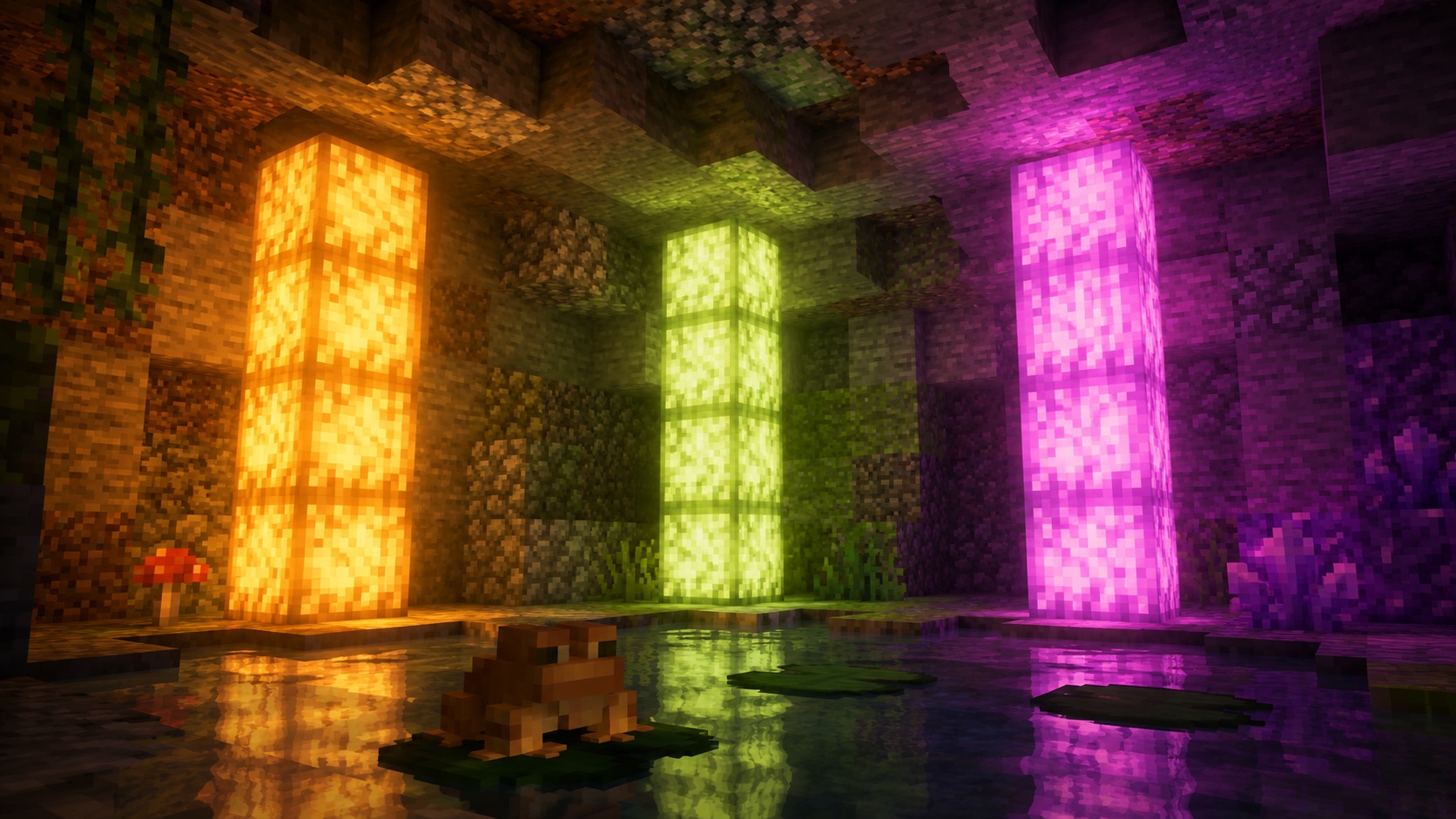
Three colors of froglight exist, one for each frog variant in the game. If you want a set of all three, you need three frogs from three different biome types and three magma cube meals. That is the whole mechanic.
The three colors of froglight
The frog variant decides the color. The frog’s body color is a useful hint, but the rule is biome-based: where the frog spawned or matured sets what color of froglight it produces.
- Ochre froglight is a warm orange-yellow. It drops from temperate frogs, which spawn in regular swamp biomes.
- Verdant froglight is a soft green. It drops from cold frogs, which spawn in cold biomes like snowy taiga, snowy plains, and snowy slopes.
- Pearlescent froglight is a pink and purple shimmer. It drops from warm frogs, which spawn in warm biomes like mangrove swamps, jungles, savannas, and deserts.
If a tadpole grows up inside a biome instead of where its parent came from, the biome at the time of growing up sets the variant. This matters if you breed frogs at home: a tadpole raised in a cold biome turns into a cold frog, no matter what the parents were.
How frogs produce froglight
The mechanic is the same on Java and Bedrock. A frog must eat a tiny magma cube. The frog uses its tongue, the magma cube dies on contact, and a single froglight block drops where the magma cube was. The frog itself takes no damage from the bite.
“Tiny” is specific. Magma cubes spawn in three sizes. Only the smallest size, the one about the size of a slime ball, counts. Larger magma cubes can fight back and the frog will not target them. To produce a tiny magma cube, you damage a larger one until it dies and splits.
The mechanic only works inside load and tick range. You have to stay close enough that the frog and the magma cube are both active. If you walk too far away, nothing happens.
Where to find magma cubes
Magma cubes only spawn in the Nether. The three best places to look:
- Basalt deltas have a high magma cube spawn rate, including some that spawn already at smaller sizes. This is the fastest natural source.
- Nether fortresses spawn magma cubes inside their structure bounding box. Numbers vary, but fortresses near basalt deltas tend to have a steady supply.
- Nether wastes have occasional magma cubes, mostly in flat open areas. Slower, but easier terrain to work in.
If natural spawns feel slow, build a platform inside a basalt delta and light or wall off the surrounding area to concentrate spawns where you want them.
How to farm froglight
The basic process has four parts: get the right frog, get the frog to the Nether, get a tiny magma cube in front of it, and collect what drops.
Step 1: get the right frog
Find a frog of the variant you want, or breed one. To breed a tadpole into a specific variant, place the growing tadpole in the right biome until it matures: temperate, cold, or warm. Breeding adult frogs uses slimeballs. Tadpoles grow faster if you feed them slimeballs too.
Step 2: get the frog to the Nether
Frogs do not survive lava or fire, and they do not naturally walk through Nether portals. Use one of these methods:
- Lead the frog through a portal with a lead.
- Put the frog in a boat and push the boat through.
- Carry a tadpole in a bucket through the portal and let it mature on the other side. Pick a Nether biome with the right temperature so the variant matches what you want.
Once on the other side, fence the frog into a small pen with a clear line of sight to the area where magma cubes will appear.
Step 3: produce tiny magma cubes
When you find a larger magma cube, hit it until it splits. Each split tier drops smaller cubes. Keep killing the medium ones until you have a tiny one near the frog. You can also build a sloped platform that funnels magma cubes toward the frog’s pen.
Step 4: collect the drops
When the frog eats, the froglight block pops into the world at the magma cube’s location. Pick it up. A hopper or a hopper minecart under the eating zone will collect it for you.
Repeat for the other two frog variants if you want all three colors. Most builders run three small farms, one per variant, instead of trying to juggle multiple frogs in one pen.
Light, placement, and behavior
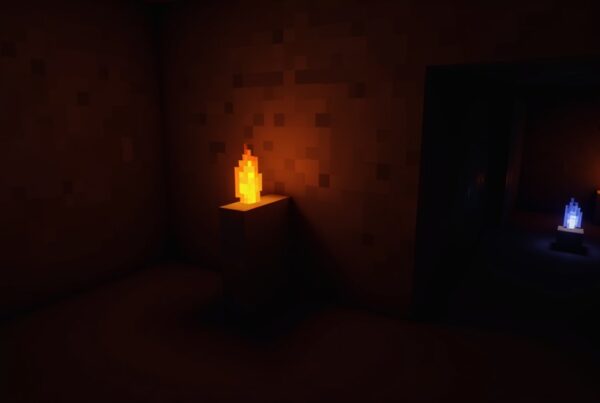
Froglight gives off light level 15. That is the same brightness as glowstone, sea lantern, jack o’ lantern, and shroomlight. It will light up a room as well as any of them.
You can place froglight on any solid block face. The block orients along the axis you place it on, like a log, so you can get a vertical column, an east-west column, or a north-south column. You cannot rotate it after placing.
Froglight is a full solid block. Mobs walk on it normally. You can place it underwater. Pistons can push and pull it, which is useful for redstone-controlled lighting where you hide the block behind a wall and reveal it on demand.
It will not melt nearby ice, it will not heat up a furnace, and it will not work as fuel. Treat it as a decorative light source and nothing else.
Mining and tools
Froglight has a hardness of 0.3, lower than dirt. Any tool breaks it quickly, and you can break it with your bare hand. There is no minimum tool tier. It always drops itself.
Silk Touch and Fortune do nothing useful here, because the block always drops as itself with no chance of bonus drops. Save your enchanted picks for ores.
Design ideas
Because the three colors are warm orange, soft green, and pink-purple, they fit different builds well:
- Ochre fits cabins, taverns, and any warm interior. It reads as candlelight at scale.
- Verdant fits jungle bases, mossy ruins, and lush cave entrances. It blends into green palettes.
- Pearlescent fits End-themed builds, magical interiors, and anything where you want a cool, slightly alien glow.
For redstone use, the smooth column texture and full light output make froglight a clean hidden light. Put one behind a piston-pulled wall and you have a switchable lamp without the noise of redstone lamps.
Common mistakes when farming froglight
A few things go wrong often enough to mention before you start:
- Wrong frog for the wrong color. Players bring a single frog to the Nether and expect to swap colors by changing biome on the spot. The variant is locked in when the frog matures. To get a different color, you need a different frog.
- Frog cannot see the magma cube. If a wall, slab, or carpet sits between them, the frog’s tongue will not fire. Keep the pen open on the side facing the magma cubes.
- Targeting larger magma cubes. A frog will not eat a medium or large one. Kill them down to tiny first, then let the frog do its work.
- Lava and fire. Frogs take damage from both. A glass roof and a fenced-in spawn floor go a long way toward keeping the frog alive while you farm.
- Ghasts. A ghast fireball can blow a hole in your setup. Either build with cobblestone or wall the area off from the sky.
Java versus Bedrock
The mechanic is identical on Java and Bedrock as of recent versions. Frog variants, biomes, magma cube targeting, drop behavior, light level, and texture all match. If you remember a difference from older versions, it has been patched.
Frequently asked questions
Can I craft froglight?
No. There is no recipe. The only source is a frog eating a tiny magma cube.
Do all frogs drop froglight?
Yes. Every frog will drop froglight after eating a tiny magma cube. The frog’s variant decides the color, but every variant works.
Does the frog need to be tame or named?
No. Frogs cannot be tamed. They eat tiny magma cubes whenever one is in range, regardless of name tag.
How do I get a tiny magma cube?
Damage a larger magma cube until it splits, and repeat with the smaller halves until only tiny ones are left. Basalt deltas are the fastest natural spawn source.
Does Fortune or Silk Touch help?
No. Froglight drops itself with no bonus, and Silk Touch is not needed because it already drops as the block.
Can I dye froglight a different color?
No. The three frog variants are the only way to choose a color. Dye does nothing on froglight.
What blocks pair well with froglight?
Smooth blocks read best next to it, since froglight itself is smooth. Polished basalt, calcite, smooth quartz, and amethyst all work. For a soft cabin look, pair ochre froglight with stripped wood and lanterns.
The short version
Froglight is a frog drop, full stop. Pick the variant you want, get a tadpole into the right biome, raise it, take the adult to the Nether, and feed it a tiny magma cube. The block that drops is the brightest light in the game, and the three colors give you a small palette to design around without needing dye.