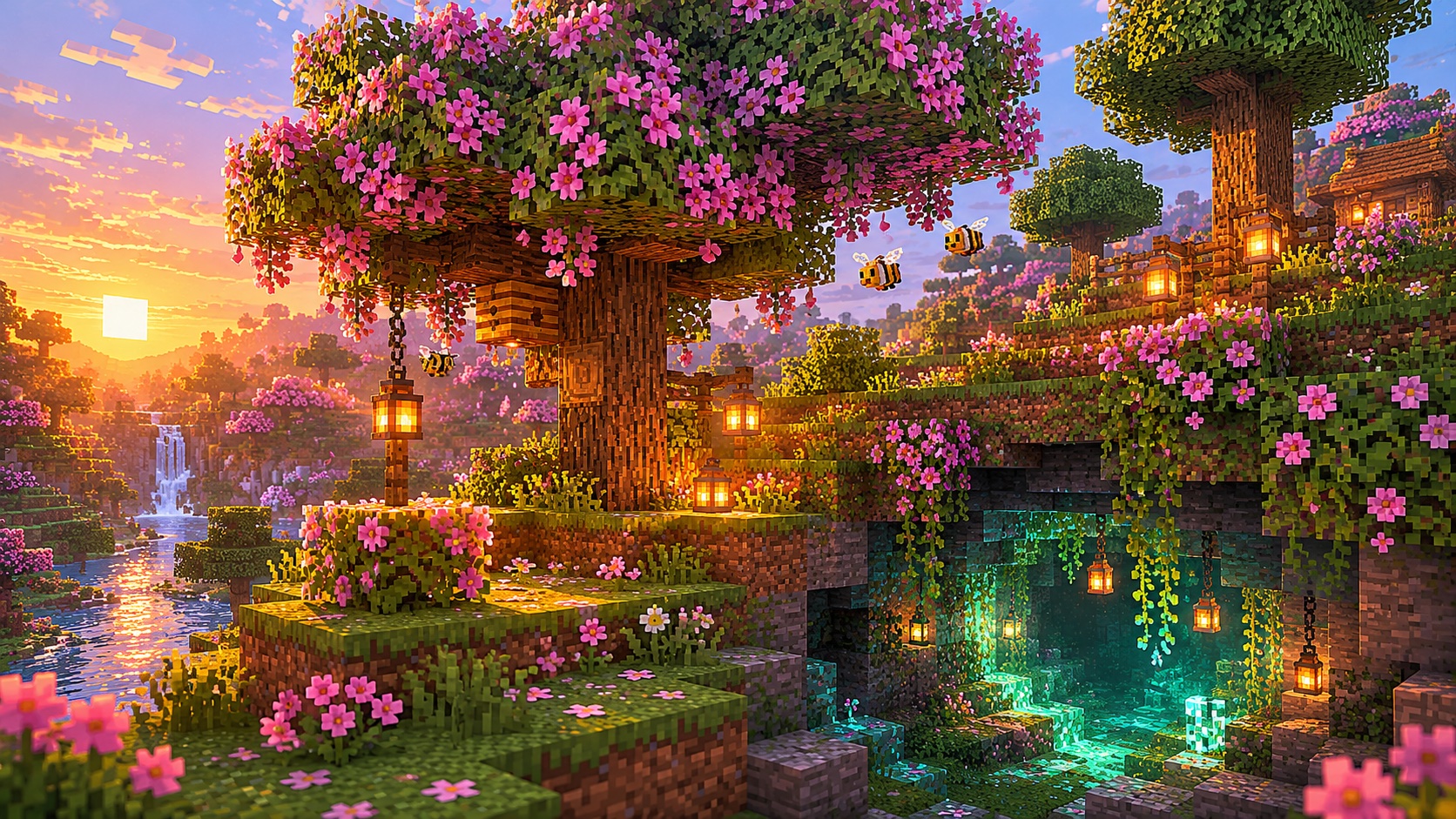
Flowering azalea is a small pink-flowered bush you can find on the surface of the overworld in Minecraft. It looks like a decorative plant, but it does real work: it tells you a lush cave is sitting underneath your feet, and you can grow it into a full tree.
If you’ve been hunting for a lush caves biome to grab moss, glow berries, or azalea wood, this is the block you want to spot. Strip-mining down from a flowering azalea is one of the most reliable ways to drop into a lush cave without wasting time on random tunneling.
This guide covers what the block is, how to find it, how to grow it into a tree, how bees interact with it, and the differences between flowering azalea and its plain green cousin.
What is flowering azalea?
Flowering azalea is a one-block-tall plant added in the 1.17 Caves and Cliffs update. It has dark green needle-shaped leaves and a cluster of pink flowers on top, so you can spot it from a distance in a forest or plains biome.
It comes in two related forms in the game:
- The flowering azalea plant, the small bush that generates on the surface.
- Flowering azalea leaves, the leaf block that makes up the canopy of a grown azalea tree.
The plant is the form you find naturally on the ground. The leaves are the form you see once you bonemeal a plant into a full tree, or when you find a wild azalea tree that grew on its own.
How to find flowering azalea
Flowering azalea generates on grass, dirt, podzol, moss, mycelium, rooted dirt, and a few related blocks, on the surface directly above a lush caves biome. The game places it like a marker over the cave below. If you see one, there is almost always a lush cave within 30 to 80 blocks below the surface, and sometimes deeper.
The non-flowering version of the plant (regular azalea) does the same job, but the flowering one is easier to see from a distance because of the pink crown. When you are exploring on foot, scan the tops of forests and grasslands for a pink dot. That is your invitation to dig down.
The plant is rare in most biomes. You will run into it more often in lush, leafy biomes like forests and jungles where lush caves are more common underground. Plains and savannas are leaner.
To collect the plant block, mine it with any tool, including bare hands. It drops itself. Shears work too, but they are not required. To collect flowering azalea leaves, you must use shears; otherwise the leaves drop sticks and possibly saplings instead.
How to grow flowering azalea into a tree
You can plant the flowering azalea bush on any block it generates on naturally: grass, dirt, podzol, moss, rooted dirt, coarse dirt, mycelium, mud, clay, and farmland. You can also place it in a flower pot for decoration, though potted plants will not grow into a tree.
To grow it, place the plant on grass or dirt and apply bone meal. Each use of bone meal has a chance to grow the plant into a full azalea tree. If it does not grow on the first try, keep using bone meal until it does. The tree it produces has:
- An oak wood trunk, usually two to four blocks tall.
- A canopy of flowering azalea leaves on top.
- Rooted dirt under the trunk, replacing the original dirt or grass block.
The rooted dirt is one of the more useful side effects of growing the tree. Use a hoe on rooted dirt to convert it back to plain dirt and pop out a hanging roots item, which is otherwise rare. Growing azalea trees on grass is the easiest renewable way to make rooted dirt.
The tree will not grow if there is a solid ceiling directly above the plant. Give it at least four or five blocks of vertical clearance and a couple of blocks of horizontal space.
What flowering azalea does in the game
Beacon for lush caves
This is the main reason most players care about flowering azalea. The block only generates above an actual lush caves biome, so it works as a free indicator that a useful cave is below. Once you see one, mine straight down (watch for lava) and you are almost guaranteed to find moss blocks, glow berries, dripleaf, spore blossoms, and clay.
Bee food
Flowering azalea counts as a flower for bees. Bees will visit the plant or the leaves, collect pollen, and carry it back to a hive or nest. That makes it useful for honey farms and for breeding bees. Important note: the regular non-flowering azalea does not count as a flower for bees, only the flowering version does.
Flowering azalea is one of the only flower sources that doubles as a tree, so it is a clean way to set up a bee farm that produces honey and gives you wood at the same time. Place a few azalea trees in a fenced area, drop a hive in the middle, and you have both inputs in one footprint.
Composting
The flowering azalea plant has a 65 percent chance to add a level to a composter when used as compost. Flowering azalea leaves have a 30 percent chance. If you have a stack of leaves you do not need, run them through a composter for bone meal.
Decoration
The plant can be placed in a flower pot. Inside a pot it keeps its flowers and never grows, which makes it a nice tabletop bush for builds. The leaves work as a normal leaf block in builds and can be sheared back into the leaf block at any time.
Flowering azalea leaves
Flowering azalea leaves are the leaf block that forms the canopy of an azalea tree. They behave like other leaf blocks in most ways, with one big difference: they have flowers on them, so they double as a bee-friendly flower source.
Properties to know:
- Shears drop the leaf block. No shears means the leaves drop nothing most of the time, with a small chance to drop a flowering azalea plant or sticks.
- They decay if they are not connected to a log within a few blocks, same as oak leaves.
- They block sunlight, so crops will not grow under a thick canopy unless you space the leaves out.
- They are flammable. Keep them away from lava and fire if you are building with them.
For builders, flowering azalea leaves are one of the few leaf blocks with a pink tint, which makes them a good choice for pink-blossom builds and a nice complement to cherry leaves if you mix the two.
Tips and common mistakes
A few things players miss when they first run into this block:
- You do not need silk touch or fortune to harvest the plant. Bare hands work. The shears requirement only applies to the leaves.
- If you only want the bush for decoration, do not apply bone meal once you place it. It will not grow on its own, but bone meal is the trigger, so just leave it alone.
- Bone meal does not always work the first time. Stack bone meal in your hotbar before trying to grow a small azalea grove.
- Don’t bother strip-mining for lush caves when you can find flowering azalea or its plain green version on the surface. The plants are by far the fastest signal.
- If you place a flowering azalea on farmland, the tree will still grow on that tile. That is sometimes useful for builds where you want a small tree next to a farm.
- Regular azalea works as a cave marker too, but only flowering azalea attracts bees. If you are setting up a bee farm, make sure you have the flowering version, not the plain one.
Frequently asked questions
Does flowering azalea always mean a lush cave is below?
Yes, that is exactly what it marks. The world generator places the plant on the surface directly above a lush caves biome, so finding one is the strongest signal you can get without breaking ground.
Can you craft flowering azalea?
No. You can only get it by finding it in the world, by collecting saplings that occasionally drop from flowering azalea leaves, or by trading with a wandering trader who sometimes sells azaleas.
Do bees pollinate flowering azalea?
Yes. Bees treat both the plant and the leaves as flowers. They will fly to either, collect pollen, and carry it back to a hive. Honey level in the hive goes up normally. The non-flowering azalea does not work for this.
Will flowering azalea grow into a tree without bone meal?
Not naturally. The plant does not grow on random ticks the way a sapling does. You have to use bone meal on it for it to turn into a full tree.
Can you put flowering azalea in a flower pot?
Yes. The pot keeps the small flowering bush as decoration. It will not grow once it is potted, even with bone meal.
What blocks can you place flowering azalea on?
Grass, dirt, podzol, mycelium, rooted dirt, coarse dirt, moss block, mud, clay, and farmland. It will not stay on stone, sand, or gravel.
Do flowering azalea leaves drop saplings?
Yes, but only when broken without shears. The drop rate is low, so do not count on it as a steady supply. Using shears gives you the leaves themselves with no sapling chance, which is usually the right call for building. If you want saplings, break leaves bare-handed and let the random drops add up over time.
Worth it for the cave finder alone
Flowering azalea is one of the highest-value cosmetic blocks in the game because it doubles as a free map to lush caves. Even if you do not care about pink trees or bee farms, walking the surface and marking every flowering azalea you spot will save you hours of random tunneling later. Mark them on a map, come back when you need moss or glow berries, and dig straight down.