What is a honey block?
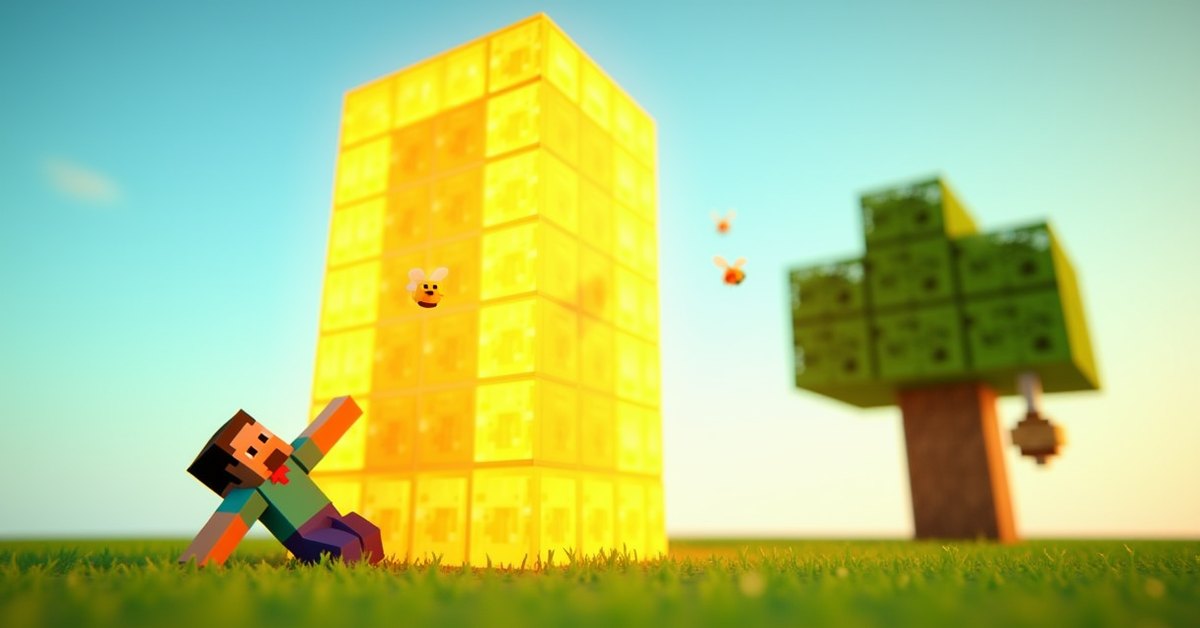
A honey block is a translucent yellow block that acts like a soft, sticky cushion. It was added in the 1.15 update, the same release that brought bees into the game. Honey blocks behave differently from almost every other block in Minecraft. They slow players down, cancel most fall damage, and stick to neighboring blocks when pushed by a piston. That mix of properties is why honey blocks show up in parkour maps, redstone elevators, and bee farm builds.
If you have ever stepped on one and watched your character slow to a crawl, you already saw the simplest version of the effect. The deeper behavior, especially around pistons and side-sliding, is where the block becomes useful for serious builds.
How to craft a honey block
You craft a honey block with four honey bottles arranged in a 2×2 pattern in a crafting grid. The 2×2 inventory grid works fine, so you do not need a crafting table. The recipe returns four empty glass bottles, so the glass is not lost.
To get honey bottles, fill an empty glass bottle from a beehive or bee nest at honey level 5, which is the highest fill stage. Each interaction returns one bottle. You need four bottles for one honey block, which means four full hive harvests.
There is no smelting alternative, no trade option with villagers, and no loot-chest source. If you want honey blocks, you raise bees.
How a honey block behaves
The block’s behavior breaks into three parts: walking on top of it, sliding down its sides, and what happens when a piston pushes it.
Walking and jumping on top
When you stand on a honey block, your movement speed drops to roughly 40 percent of normal. Your jump height is reduced as well: you can still jump, but you barely clear half a block. Mobs and other entities are slowed the same way. That makes honey a handy tool for slowing skeletons and zombies that are chasing you, especially around a base entrance or a doorway.
Sliding down the sides
If you press against the side of a honey block while falling, your character latches on and slides down. The slide is slow, roughly the same speed as climbing down a ladder, only without the input. You do not need to hold a key to stay attached. Gravity does the work, and walking away from the block ends the slide.
The slide ignores corners cleanly. If two honey blocks are stacked vertically, you slide down both as a single column. If only the lower block is honey, you fall normally until you hit the honey, then the slide engages.
Fall damage
Landing on the top face of a honey block reduces fall damage by 80 percent. Sliding down the side cancels the fall almost entirely. You can drop from the build limit onto a honey wall and walk away with full hearts, as long as you make contact with the side before you hit the ground.
This is the property that makes honey blocks practical as emergency landings in tall builds, especially in skyblock maps and parkour courses where players need a reliable bail-out.
Honey blocks and pistons
The piston rules are where honey gets interesting. Pistons and sticky pistons can push and pull honey blocks like any normal movable block. The twist is that when a piston pushes a honey block, it also moves any entity sitting on top of it or stuck to its sides. That includes players, mobs, items, and other blocks that happen to be touching it.
A honey block also drags adjacent blocks along with it when it moves, the way a slime block does. If a honey block has a stone block stuck to it through a chain of other honey blocks, pushing the honey moves the stone too. This is the foundation for flying machines, push-pull bridges, and most of the modern Minecraft tech builds you see online.
What honey does not stick to
Honey blocks stick to most blocks, with one big exception: they do not stick to slime blocks. That separation is the whole reason honey was added. Before honey, slime was the only block that pulled neighbors along when pushed, which made certain machines impossible to build. With honey, you can chain a honey side and a slime side that ignore each other. That opens up flying machines that drop riders, sliding doors that split apart cleanly, and other designs that need a controlled break in the chain.
Honey block vs. slime block
Honey and slime look like cousins on paper. Both are translucent. Both stick to neighboring blocks when pushed. Both are bouncy-adjacent. The differences matter more than the similarities.
| Property | Honey block | Slime block |
|---|---|---|
| Bounce | No bounce, you stop on impact. | Bounces players and mobs. |
| Fall damage | Reduces by 80% on top, 100% on slide. | Cancels fall damage entirely. |
| Slows movement | Yes, about 40%. | No. |
| Sticks to other blocks | Yes, but not to slime. | Yes, but not to honey. |
| Side interaction | Slide down slowly. | No climb or slide mechanic. |
The short version: slime bounces you up, honey slows you down. They are built to work together in piston designs because they ignore each other.
Practical uses
A line of honey blocks across a doorway slows anything that walks through, which makes melee combat easier and gives turrets or arrow dispensers more time to fire. A single honey block at the bottom of a long drop saves the player from any fall, and a vertical column of honey blocks lets the player slide down safely from any height.
In redstone, honey blocks are the second pillar of the flying machine. Builders attach payloads to a honey side, slime to another side, and drop the payload mid-flight by separating the two with a non-sticky block. Most modern cart bases, mob transporters, and observer-driven engines rely on this trick.
Outside of redstone, players use honey blocks for parkour puzzles (timing a wall-slide before a jump) and for tidy storage of surplus honey bottles in bee farms.
Tips and common mistakes
- Honey blocks slow you on top, not the entities around you. If you place them to slow a mob, the mob has to actually walk over the block.
- You can break out of a slide by walking sideways, not by jumping. Jumping while attached to a honey block is weak and rarely useful.
- Sticky pistons can pull honey blocks, but plain pistons can only push them. If you need to retract a honey block, use a sticky piston.
- Honey blocks are partially transparent for redstone signals, so wiring can leak through them in some cases. Test your circuit before committing to a build.
- Bees do not interact with honey blocks the way some players expect. Honey blocks do not calm bees or attract them. For bee handling, work with hives and campfires, not honey blocks.
Frequently asked questions
Are honey blocks renewable?
Yes. Bees produce honey continuously as long as flowers are nearby and you do not destroy hives or kill the bees. With a working bee farm you can craft as many honey blocks as you want.
Do honey blocks burn or get destroyed?
Honey blocks do not catch fire from normal sources, but they are destroyed by lava and by explosions. Treat them like wood when you place them near hazards: usually fine, occasionally lost.
Can mobs stand on honey blocks?
Yes, and mobs are slowed the same way the player is. Skeletons still shoot, zombies still pathfind, but their movement is sluggish. Honey is a soft trap rather than a hard one.
Why won’t my flying machine work with honey blocks?
The most common reason is that honey blocks are touching slime blocks somewhere in the chain. Honey and slime do not stick to each other, so the structure breaks apart on the first push. Check every face of every block in the design and confirm the honey and slime are separated by a non-sticky block wherever the chain has to break.
Do honey blocks slow minecarts?
Minecarts run on rails, so the rail material under the honey is what determines speed. The honey itself does not slow vehicles directly.
What is the difference between a honey block and a honeycomb block?
Honeycomb blocks are decorative and have none of the special movement or piston properties. They are crafted from honeycomb pieces, not honey bottles, and behave like a normal solid block: no slide, no slowdown, no sticky behavior.
A small note on versions: honey blocks have been in the game since Java 1.15 and Bedrock 1.14.0, and the core behavior is the same on both editions. If you find a tutorial from before that, the block will not exist in the world or in the creative inventory, and the recipe will not be available.
One last note
Honey blocks pay off when you build with them, not around them. The slow, the slide, and the sticky-but-not-to-slime behavior are all there to give designers a second tool that works in opposition to slime. The fastest way to learn what they can do is to put a honey block next to a slime block in creative mode and start pushing things with a piston. You will see the difference inside a minute.