What Knockback does
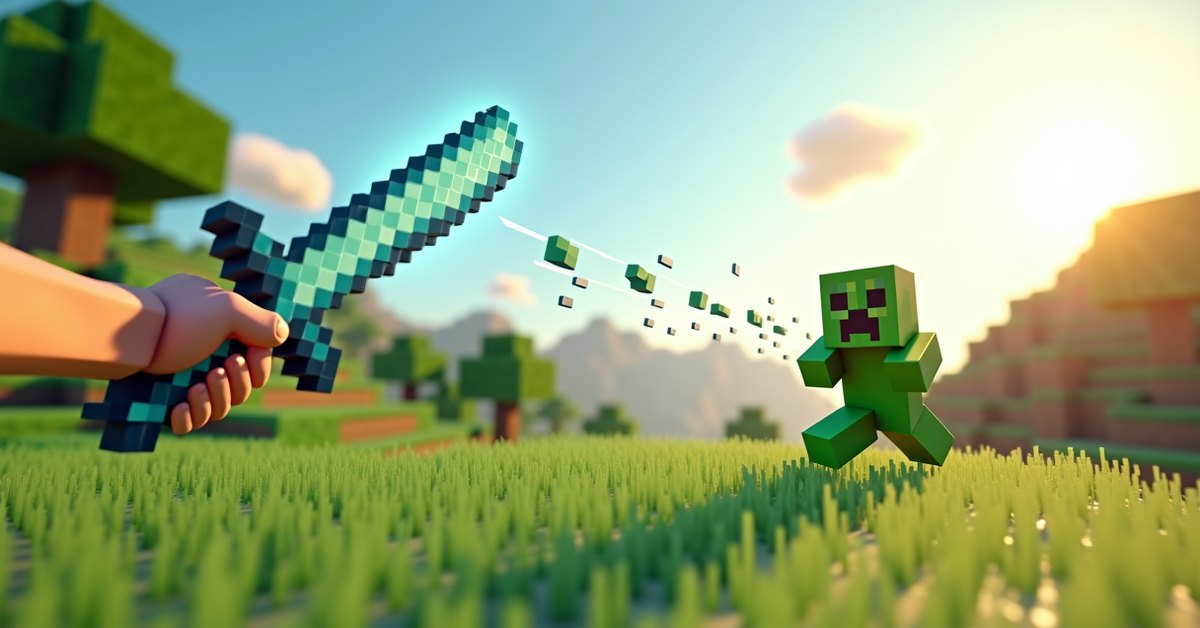
Knockback is a sword enchantment that adds extra horizontal push to your melee hits. When you hit a mob, the game already applies a small amount of knockback by default. Knockback piles more on top of that, sending the target further away with each strike.
It does not increase the damage you deal. The whole point is positioning: pushing creepers away before they detonate, shoving skeletons back so they can’t melee you, sending zombies off a cliff, or buying space when you’re being swarmed.
Knockback is one of the simplest enchantments to understand and one of the easiest to misuse. A high-level Knockback sword can shove mobs into bad places (lava pits, ravines, off your own farm) faster than you can recover them, so it’s worth knowing where it shines and where a plain Sharpness sword is the better call.
Knockback levels and how strong they are
Knockback has two enchantment-table levels: Knockback I and Knockback II. Each level adds roughly three blocks of horizontal distance to the hit, on top of the base knockback you’d get from any normal attack.
A Knockback II sword can launch a zombie six or seven blocks back from a standing hit. A sprint hit on top of that adds another bump of knockback (sprint hits add about a block of extra push), so a sprinting Knockback II swing can send mobs further than you might expect.
You can technically push Knockback higher than II using /enchant or by editing a book with commands, up to level 255. The vanilla enchanting table and anvil cap at II. Anything above II in survival isn’t possible without commands.
How to get Knockback
Enchanting table
Place a sword in an enchanting table along with lapis lazuli and pay the XP cost. Knockback shows up as a primary enchantment for swords, so the table can roll it at level I or II depending on the bookshelf count and the slot you pick. With a full 15 bookshelves around the table, Knockback II is achievable on a single roll, though Sharpness, Smite, and Looting compete for the same slot.
If the table isn’t offering Knockback and you really want it, enchant something cheap (a book or a stone sword) to cycle the available enchantments. The list refreshes after each enchantment is used.
Books from villager trades
Librarian villagers sell enchanted books, and Knockback shows up in their trade pool. The price ranges from 5 to 19 emeralds for a Knockback I or II book, depending on the level and the librarian. If you have an unemployed villager near a lectern, you can reset the trades by breaking and replacing the lectern until you get a Knockback offer at a price you like.
Loot chests and fishing
Knockback books appear in dungeon, stronghold, and mineshaft chests as random loot. Fishing with a Luck of the Sea rod can also pull enchanted books, though the odds for any specific enchantment are low. If you’ve got time and a good fishing setup, it’s a passive way to stock up on books.
Which weapons accept Knockback
In vanilla Minecraft, Knockback can only be applied to swords. That covers the full range of materials: wooden, stone, iron, golden, diamond, and netherite. A wooden sword with Knockback II works just as well at pushing mobs as a netherite sword with the same enchantment. The push distance is tied to the enchantment level, not the sword material.
Axes don’t get Knockback through normal enchanting, even though they can carry Sharpness, Smite, and Bane of Arthropods. The Mace, added in 1.21, uses Density and Wind Burst for its smash mechanics instead of standard knockback enchanting.
The closest equivalent for ranged combat is Punch, which goes on bows. Punch adds knockback to arrows and follows similar mechanics: two levels, each adding roughly three blocks of push. Crossbows do not accept Punch; they have Piercing and Quick Charge instead.
How Knockback interacts with sprint and critical hits
Sprinting before you swing adds extra knockback to the attack on top of whatever the enchantment gives you. The order matters: you have to be actively sprinting at the moment of the hit, not just running up to the mob. A sprint hit with a plain sword pushes mobs about a block further than a standing hit. A sprint hit with Knockback II pushes them further still.
Critical hits don’t add extra knockback. Crits multiply damage, not push distance. So if you’re trying to maximize how far a mob flies, sprint hits stack with Knockback. Crit hits stack with damage, which is a separate calculation.
One quirk worth knowing: the attack cooldown affects knockback on Java. If you swing before your attack indicator is full, you get the weak-hit version of the strike, which deals reduced damage and applies almost no knockback at all. Wait for the cooldown bar to fill before swinging if you want the full Knockback effect.
Best uses for Knockback
The textbook use is the “creeper shover”: a stone or iron sword with Knockback II that you swap to whenever a creeper gets too close. One sprint hit sends the creeper far enough back that it can’t reach you before it detonates, or far enough that the explosion misses you entirely.
Skeletons are another obvious target. They have decent melee in a pinch, but their pathfinding gets confused when they’re constantly being shoved backward, and a Knockback sword keeps them outside of clean bowshot lines.
Knockback is also useful for crowd control. If you’re swarmed at night, a Knockback sword gives you a few extra blocks of breathing room with every swing, which is sometimes the difference between getting out alive and getting cornered.
In PVP, Knockback is one of the most contested enchantments. Two players with Knockback II swords end up shoving each other around the arena. The trade-off is that you’re not putting Sharpness on the same blade, so your damage per hit is lower. A common loadout is Sharpness V on the main sword, with a Knockback II side sword for fights where positioning matters more than damage.
When Knockback is the wrong choice
Knockback can backfire. Pushing a mob into a lava pit or off a cliff sometimes destroys their drops before you can collect them. If you’re farming zombies for rotten flesh or skeletons for bones, a plain Sharpness sword is usually a better fit.
Knockback also makes it harder to clean up tight crowds, because mobs scatter instead of clumping. If your strategy depends on hitting multiple mobs in one swing with Sweeping Edge, Knockback works against you.
Some mobs can’t be knocked back at all. The Ender Dragon ignores knockback completely. The Wither and the Warden also resist it (the Wither has full knockback resistance; the Warden takes very little knockback per hit). Iron golems and ravagers take reduced knockback because of their high knockback resistance stat.
Compatible and incompatible enchantments
Knockback combines with every other sword enchantment. You can stack it with Sharpness (or Smite, or Bane of Arthropods, though only one of those three at a time), Looting, Fire Aspect, Sweeping Edge, Unbreaking, and Mending on the same blade. There’s no slot conflict with Knockback itself.
The only real cost is the prior-work penalty on the anvil. Combining a Sharpness V book and a Knockback II book onto the same sword runs that penalty up fast, so plan your enchantment order if you’re going for a max-roll sword. Apply the cheaper books first and save Mending for last.
Java vs Bedrock
The core behavior of Knockback is the same on Java and Bedrock. Two enchantment-table levels, both push mobs back, both go on swords. The push distance per level is the same within rounding.
The main difference is the attack cooldown. Bedrock doesn’t use the same 1.9-style cooldown system as Java, so weak hits aren’t really a thing on Bedrock and the cadence of Knockback feels faster. Sprint hits still add bonus knockback on both editions.
Frequently asked questions
What is the max level for Knockback?
In survival, the max is Knockback II. You can get there from the enchanting table or by combining two Knockback I books on an anvil. Commands can push the level up to 255, but at that point a single hit launches the mob across the world and despawns it.
Can you put Knockback on an axe?
Not in vanilla survival. Axes accept Sharpness, Smite, and Bane of Arthropods through enchanting, but the table won’t roll Knockback for them. Commands can force it on, though that’s an edge case rather than normal play.
Does Knockback work on the Ender Dragon?
No. The Ender Dragon is immune to knockback. The Wither is also fully resistant, and the Warden takes only a small amount of knockback per hit because of its high resistance stat.
Does Knockback increase damage?
No. Knockback only affects how far a mob is pushed back when you hit it. For more damage, use Sharpness for a flat boost, Smite against undead, or Bane of Arthropods against spiders and silverfish.
Does Knockback stack with sprint hits?
Yes. Sprint hits add their own knockback on top of the enchantment, so a sprinting swing with Knockback II is the longest push you can land in vanilla survival.
Is Knockback the same as Punch?
They’re the same idea applied to different weapons. Knockback goes on swords and works on melee hits. Punch goes on bows and works on arrows. Crossbows can’t use Punch; they have Piercing and Quick Charge instead.
Will Knockback push creepers away before they explode?
Often, yes. A sprint hit with Knockback II usually pushes a creeper out of detonation range. The timing isn’t always reliable on a creeper that’s already started hissing, so it’s safer to interrupt them earlier rather than counting on Knockback as your only line of defense.
Closing thought
Knockback isn’t a damage enchantment, so it’s easy to skip in favor of Sharpness V. The players who keep a Knockback sword in their hotbar tend to be the ones who don’t get caught. They shove creepers off before the fuse runs out, and they buy themselves an extra half-second when things go wrong. If you’ve ever lost a base to a creeper that got two blocks too close, a stone sword with Knockback II in your offhand is worth the lapis.