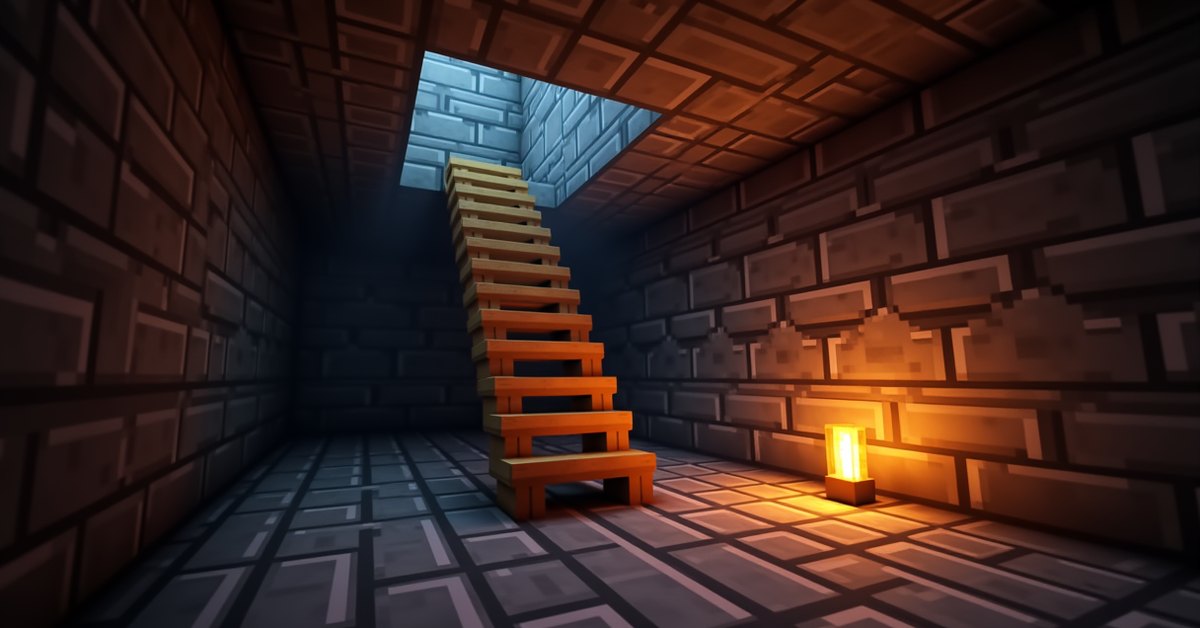
Ladders are how you move up and down in Minecraft without wasting blocks or building stairs. You craft them from sticks, place them against the side of a solid block, and climb. That’s the short version, and for most players it’s enough.
A few things about ladders aren’t obvious until you’ve used them in a real build, though. They block fall damage. They can be waterlogged. They’re flammable. Mobs use them. The rest of this article covers the crafting recipe, placement rules, climbing mechanics, and the build patterns where ladders quietly do most of the work.
What is a ladder in Minecraft?
A ladder is a climbing block crafted from sticks. Place one against a solid wall and any player or mob next to it can climb up or down by walking or jumping into the block.
Ladders are one of the oldest blocks in the game and one of the cheapest forms of vertical transport. A single stack of 64 ladders costs about 150 sticks, which works out to roughly 80 planks, or fewer than 20 logs. That’s around four or five oak trees.
In the creative inventory, ladders are grouped with other transport blocks.
How to craft a ladder
The recipe takes 7 sticks in a crafting table and produces 3 ladders.
Place the sticks on a 3×3 grid like this:
- Top row: stick, empty, stick
- Middle row: stick, stick, stick
- Bottom row: stick, empty, stick
The shape mirrors the look of the finished item, which makes it easy to remember without checking a recipe book. Sticks come from planks (2 planks make 4 sticks), so a stack and a half of planks gives you over a stack of ladders in about a minute.
Sticks all look identical regardless of which wood they came from, and ladders only have one visual variant. There’s no oak ladder vs. birch ladder distinction.
Where to find ladders without crafting
Ladders generate in several structures, so you can sometimes grab a few before ever setting up a crafting table:
- Village houses with attics or second floors
- Mineshafts, where they run up the support pillars
- Some shipwrecks
- The upper floors of woodland mansions
- Pillager outposts, on the central tower
No villager sells ladders directly, so trading isn’t a shortcut. Crafting is almost always faster, and unless you’re early-game and low on wood, it’s not worth detouring to a structure just to harvest a few.
How to place a ladder
A ladder needs a solid block on one side to attach to. Stand near the wall, point at the side face, and use your interact button (right-click on PC). The face you target becomes the back of the ladder.
Most full blocks work as a support: stone, wood planks, dirt, sand, terracotta, concrete, and almost every other natural or crafted block. Glass works. Slabs work if the slab covers the upper or lower half of a full block, depending on the orientation. Stairs and leaves are inconsistent, so test the surface before committing to a long ladder column.
To make a long vertical run, place ladders one above the other on the same wall. As long as a wall sits behind each ladder, the column behaves as a single climb. There’s no built-in limit to how tall a ladder column can be.
A ladder cannot stand on its own without a wall behind it. If you break the supporting block, the ladder pops off as an item. You can break the wall behind the bottom ladder to drop the whole column in one motion, which is sometimes useful when cleaning up a build.
Climbing speed and movement
You climb a ladder by walking or jumping into it while holding the forward key. Climbing speed is about 2.35 blocks per second going up. That’s slower than walking on flat ground, but the math still favors ladders over stairs in tight builds because you save horizontal space.
Descending is slightly faster than climbing. You can also let go of the controls entirely and slide down at a controlled rate, which is slower than free-fall but fast enough for most descents.
Sneak (shift) on a ladder freezes you in place. This is how you pause halfway up a climb to wait out a mob, line up a shot with a bow, or check your inventory without falling. Releasing sneak resumes the climb.
You can also strafe sideways onto a ladder, attach to it, then jump off in another direction. This is the basis for several parkour tricks and for getting out of ladder columns into adjacent rooms.
Fall damage and ladders
A ladder cancels fall damage the moment your hitbox enters the block. Your downward velocity resets to a controlled slide, and the fall counter resets to zero. If you survive a long drop by catching a ladder halfway down, you take no damage at all when you land at the bottom.
If you’re falling next to a wall, place a ladder mid-fall and you’ll catch yourself on it. Players use this trick to save themselves from cliffs and ravines. It works as long as you have a ladder in your hotbar and the wall has a usable block face.
The protection only applies while you’re inside the ladder block itself. Walking off the top of a ladder gives no protection on the way down, so always extend the ladder to the ground if you want a safe exit.
Waterlogging, fire, and other quirks
Ladders can be waterlogged in versions 1.13 and later. Right-click a ladder with a water bucket and the block now holds water alongside the ladder. The ladder still works, and you can swim through the water while it stays in the column. This is useful for water elevators, drowned farms, and underwater base entrances.
Ladders are flammable. Fire spreads to them readily, and they don’t drop anything when they burn. Keep them away from open fire, lava, and campfires. A single torch nearby is fine; an active blaze spawner or a magma block one step over is not.
You can break a ladder with bare fists, an axe, or any tool. An axe is fastest, but the time difference is small enough that it doesn’t matter unless you’re tearing down a long column. Ladders always drop themselves as an item, no Silk Touch needed.
Common build uses
Ladders show up in a lot of compact builds:
- Tall mine shafts where stairs would waste blocks and steepen the climb
- Hidden access into attics, basements, and storage rooms behind a painting or a trapdoor
- Decorative library walls where ladders read as shelf access
- Backup climbing routes inside water elevators, in case the bubble column breaks
- Vertical farm walls, since most mobs use ladders the same way players do
The decorative angle gets overlooked. A short row of ladders on a plank wall behind a few bookshelves makes a room read like a workshop or a study, even if no one ever climbs them. Ladders also pair well with trapdoors: open a trapdoor over the top of a ladder column and the trapdoor visually extends the ladder one block higher, which sells the illusion that the climb continues into the ceiling.
Tips and common mistakes
A few things trip up new players:
- Forgetting that ladders need a wall behind them. Free-standing ladders aren’t a thing in vanilla Minecraft. Use scaffolding when you need a temporary climb with no wall support.
- Placing a ladder on the wrong block face. Look at the side of the block, not the corner, and the ladder will snap into place.
- Running a ladder column too close to a furnace, fireplace, or smoker. Fire spreads farther than most players expect.
- Building a ladder column without a roof. Mobs can drop down a ladder column at night if the top is open to the sky, so cap your shafts.
Java vs. Bedrock differences
Ladders behave nearly identically across editions, but a few small things differ:
- Climbing animations and footstep sounds are slightly different between the two.
- Bedrock allows ladders to be placed on a few unusual block faces that Java rejects, mostly involving slabs and stairs at non-standard orientations.
- The exact climbing speed values differ by a few hundredths of a block per second.
For practical purposes, any ladder build in one edition works the same in the other.
Frequently asked questions
Do ladders need to be placed on a wall?
Yes. A ladder needs a solid block face directly behind it. Without a wall, it can’t be placed, and breaking the supporting block pops the ladder off.
Can mobs climb ladders?
Most can. Zombies, skeletons, villagers, and many others will climb when their pathfinding decides to. This matters for mob farms and walled bases, where an unprotected ladder gives hostile mobs a way up.
Do ladders prevent fall damage?
If your hitbox passes through a ladder during a fall, the fall resets and you survive. Fall damage is canceled the instant you make contact with the ladder block.
How fast do you climb a ladder?
About 2.35 blocks per second going up, slightly faster going down. Sneaking on a ladder freezes you in place.
Can you waterlog a ladder?
Yes, in versions 1.13 and later. Right-click the ladder with a water bucket and water fills the block alongside the ladder. The ladder still works, and you can swim through the water.
Can you place a ladder on a ceiling?
No. A ladder only attaches to vertical block faces. For a ceiling climb, use scaffolding or stack ladders vertically along a wall instead.
Do ladders burn?
Yes. Ladders are flammable, so keep them away from fire, lava, and campfires.
Ladders aren’t fancy, but they’re one of the most reliable tools in the game. They cost almost nothing, they work the same way they have for over a decade, and they fit into builds where stairs would eat too much space. If you’ve been avoiding them in favor of scaffolding or trapdoor elevators, try a plain ladder column on your next mine. You’ll be surprised how often the simpler block is the right one.