What the lantern does
The lantern is a small block that gives off light when you place it. It hangs from blocks above, sits on top of blocks below, and looks like a little metal cage with a flame inside. Since version 1.14, it has been the cleanest way to light up a base without strewing torches everywhere.
A regular lantern emits a light level of 15, the maximum in the game. That makes it as bright as a torch, glowstone, or sea pickle stack, but with a much tidier silhouette. It also has a slim hitbox, so you can walk under one hanging from the ceiling without bumping your head.
How to craft a lantern
The recipe is straightforward. You need 8 iron nuggets and 1 torch, arranged in a crafting table like this:
- Top row: iron nugget, iron nugget, iron nugget
- Middle row: iron nugget, torch, iron nugget
- Bottom row: iron nugget, iron nugget, iron nugget
Each iron ingot crafts into 9 iron nuggets, so a single ingot plus a torch covers one lantern with one nugget to spare. If you start with iron ore, you can make about a dozen lanterns per stack of ingots without thinking about it.
Torches themselves are cheap. One stick plus one piece of coal or charcoal gives you 4. The bottleneck is the iron, which is why early-game players often stick with plain torches and only switch to lanterns once they have a steady supply from a farm or a deep branch mine.
Where to find lanterns without crafting
You can find lanterns generated in the world, which is useful if you spot a village before you have a furnace. Common spots include:
- Snowy tundra and taiga villages, hanging from posts and house overhangs
- Plains and savanna villages on certain house variants
- Pillager outposts at the top of the tower
- Trail ruins, where they sometimes turn up in support structures
You can mine a lantern with any tool, including your fist. It always drops itself, so there is no penalty for breaking one and moving it.
Light levels and mob spawning
Lighting is the main reason to place a lantern, and the numbers behave differently between Java and Bedrock.
On Java Edition, hostile mobs only spawn at light level 0 in the overworld. One lantern covers a generous area on flat ground, but as soon as the light value drops to zero anywhere in a cave or corner, mobs can spawn. Two or three lanterns spread out usually beats a single bright spot for keeping a base mob-free.
On Bedrock Edition, mobs can still spawn at light level 7 or below, so you need more coverage. A good rule on Bedrock is to place a lantern every 7 blocks if you are lighting a long corridor, and to fill corners with a second light source if the layout is anything other than a straight line.
In both editions, the lantern itself takes up so little space that you can hang one inside a 1-block-deep ceiling alcove. That works well in stone brick or deepslate builds where a torch on the wall would look out of place.
Soul lantern: how it differs
The soul lantern is a variant introduced alongside the Nether update. It uses the same crafting grid as a regular lantern, but with a soul torch in the middle instead of a normal torch. The soul torch recipe is a stick plus a piece of coal or charcoal plus a block of soul sand or soul soil, and it gives you 4 soul torches.
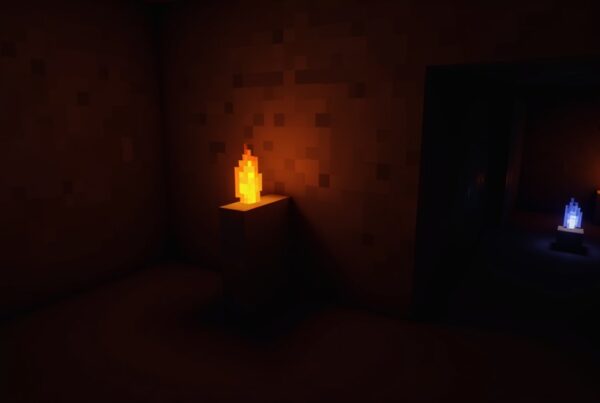
The soul lantern produces a light level of 10 instead of 15. The blue flame looks great in Nether-themed builds and ancient city dressings, but it does not light up as much area.
Two things make the soul lantern worth carrying even with its weaker light:
- Piglins are afraid of soul flames. Place a soul lantern near a Nether portal and piglins will keep their distance, which is handy when you cross over with valuable gold gear.
- Soul light gives a colder, more horror-tinged mood. For builds like haunted ruins or abandoned outposts, dropping in a few soul lanterns sells the look.
Placement, hanging, and waterlogging
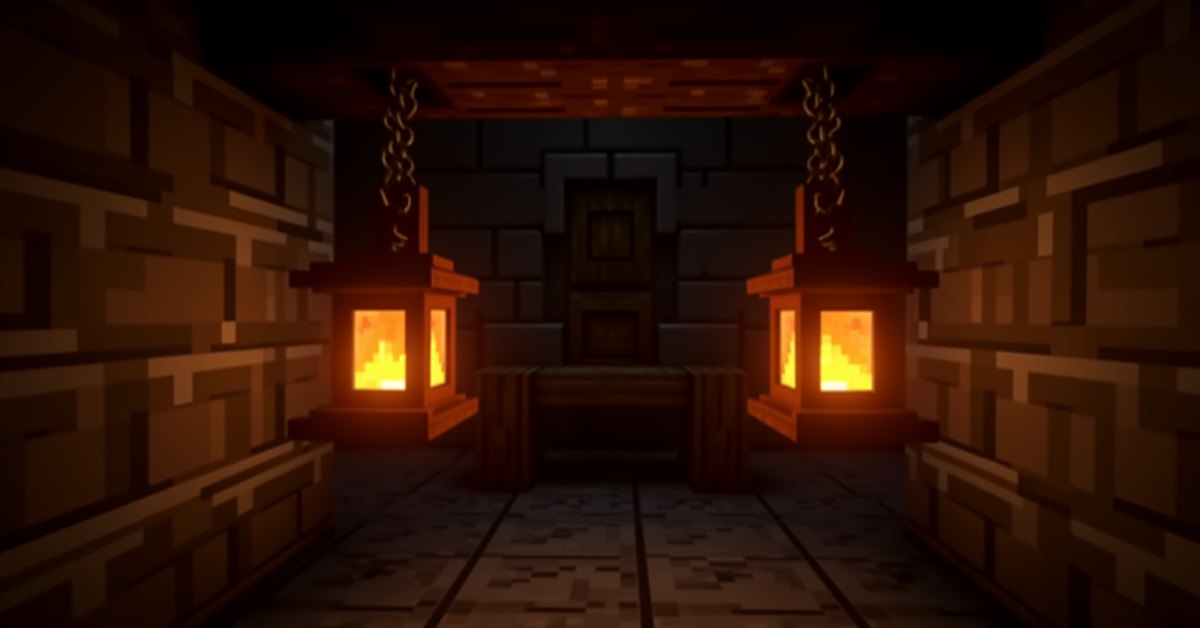
You can place a lantern in two ways. Right-click the top of a block to stand the lantern on a small base. Right-click the underside of a block to hang the lantern by a chain. The chain is purely visual on the lantern itself, but you can also place separate chain blocks above to extend the hanging look as far as you want.
Lanterns can be waterlogged. If you place water on a square that already holds a lantern, or place the lantern into a water source, the water stays put and the lantern keeps burning. Underwater bases, glowing reef builds, and water-filled atriums all benefit from this.
A lantern does not melt ice or snow blocks, even though its light level is high. That makes it the right pick for igloos and snow forts where torches would slowly destroy the floor.
Common mistakes and tips
A few things players miss when they first start using lanterns:
- Lanterns do not need a chain block above to hang. Any solid block works as the anchor.
- They do not transmit a redstone signal, so they cannot replace redstone wire.
- They cannot sit on a fence the way a torch can. The fence does not have the right hitbox.
- For redstone-controlled lighting, use a redstone lamp instead. Lanterns are always-on.
- A soul lantern under a portal blocks piglin spawning above it on the Nether side, since piglins avoid the area.
For decoration, lanterns work especially well in three spots: street lamp tops over fences, recessed alcoves in stone walls, and on the ends of trapdoors used as wall sconces. The hitbox is small enough that the lantern usually reads as part of the fitting rather than a separate block.
Java vs. Bedrock differences
Most of what is on this page applies to both editions. The main practical difference is the mob spawning threshold: light level 0 on Java, light level 7 or below on Bedrock. Plan your placements with that in mind if you switch between the two.
One small Bedrock note: the offhand slot accepts lanterns, which lets you carry one without committing your main hand. Java does not allow lanterns in the offhand. It is a minor thing, but it makes mining caves on Bedrock a little smoother.
Frequently asked questions
Can you craft a lantern without a torch?
No. The torch in the middle of the crafting grid is what gives the lantern its flame. A soul torch produces a soul lantern instead, but the recipe always needs a torch of some kind plus 8 iron nuggets.
Do lanterns burn out?
No, lanterns never burn out. Once placed, a lantern stays lit forever unless a player or piston removes it.
Can mobs spawn under a lantern?
It depends on the light level at that exact square. On Java, mobs need a square of light level 0, so a single lantern usually clears a flat area. On Bedrock, anything 7 or lower can spawn mobs, so corners just outside the lantern’s range can still produce enemies.
Can you put a lantern underwater?
Yes. Lanterns waterlog, so they keep glowing inside a water column. Right-click a lantern into a water block, or place water against an existing lantern, and the two coexist.
Do lanterns melt ice or snow?
No. The light level is high, but lanterns do not transmit heat to nearby blocks. They are the safe choice in any cold-themed build where torches would slowly thaw the floor.
How far does a lantern’s light reach?
A regular lantern emits a light level of 15 at its own square. The light drops by 1 for each block out, so the lantern lights every square within 14 blocks before light decays past zero, with the exact shape depending on opaque blocks in the way. A soul lantern starts at 10 and drops the same way.
Is there a way to dim a lantern?
Not directly. The lantern always produces its full light level when placed. If you want a dimmer look, swap in a soul lantern, a candle, or a redstone lamp wired to a low signal.
A few build ideas
If you are stuck on where to use lanterns next, here are a handful of layouts that pay off:
- Hang a row of three lanterns from chains over a kitchen island in a survival house. The light covers the workspace and the chains tie back to the ceiling beams.
- In a stone-brick cathedral or church build, hang a soul lantern at the end of each pew aisle. The blue glow reads as something between a candle and a votive, which fits the setting.
- Set lanterns on top of oak fences spaced 6 blocks apart along a path. That gives you a clean street-lamp line and clears mob spawning between fence posts.
- For a Nether outpost, alternate regular lanterns and soul lanterns along the entry path. The mixed light reads as a warning gradient and the soul flames keep piglins away from the bridge.
Lanterns are the kind of block that pulls double duty: they handle the actual work of lighting, and they finish a build that would otherwise look bare. Once you have a steady iron supply, there are very few situations where a torch is the better pick.