What a lightning rod is
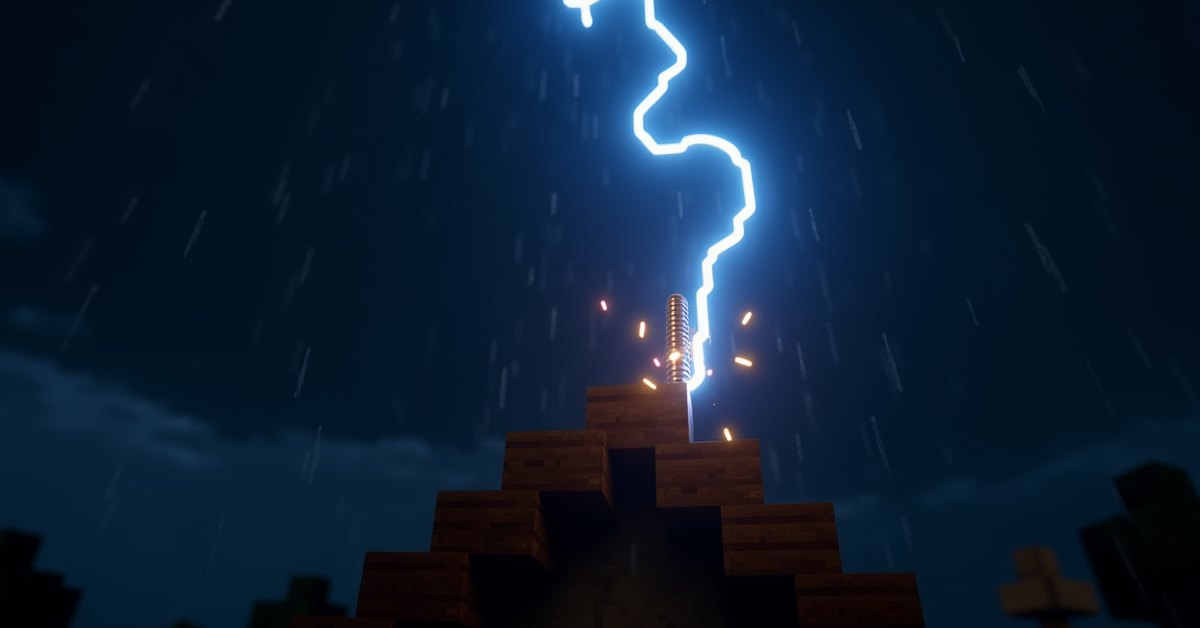
The lightning rod is a copper block that pulls lightning strikes toward itself during thunderstorms. Place one on or near your build, and lightning that would have hit a nearby block hits the rod instead. The rod takes the strike, fires off a redstone pulse, and nothing catches fire.
It was added in version 1.17, the first half of the Caves and Cliffs update, alongside the rest of the copper family. If you’ve ever lost a wooden roof or a wheat field to a stray bolt, this is the block that solves the problem.
How to craft a lightning rod
You need three copper ingots and a crafting table. Place the ingots in a vertical line in the middle column of the crafting grid. That gives you one lightning rod per craft.
Copper ingots come from smelting raw copper in a furnace or blast furnace. Raw copper drops when you mine copper ore with a stone pickaxe or better. Copper ore shows up in stone biomes between roughly Y=-16 and Y=112, with the highest concentration around Y=48. It’s also more common in dripstone caves, so if you find one of those, you’re set on copper for a while.
One craft yields one rod. Covering a large build with multiple rods burns through copper fast, but copper is plentiful once you’ve found a decent vein, so it’s not a real bottleneck.
How to place a lightning rod
The rod can be placed on any side of any solid block. Top, bottom, or any of the four sides all work, and the rod points away from the block it’s attached to, the way a torch does.
For lightning protection, place the rod where it has open sky above it. A rod tucked under a solid roof will not take strikes, since the game treats it as covered. Mount it at or near the highest point of the structure you want to protect.
The rod can also be waterlogged. Right-clicking a water bucket onto a placed rod fills its space with water, and an empty bucket drains it back out. A waterlogged rod still attracts strikes as long as its tip is exposed to sky.
How the lightning rod works in a thunderstorm
During a thunderstorm, the game picks random spots to strike with lightning. If one of those spots falls inside the rod’s attraction zone, the strike is redirected to the rod’s tip instead of hitting the original location.
That redirect is the whole point of the block. A normal lightning strike on a wooden block can set the block on fire, and the fire can spread. A strike on the rod produces a redstone pulse and the visual and audio of a regular bolt, but no fire and no block damage. The rod itself does not wear out, so a single rod can take an unlimited number of hits over the lifetime of a world.
Java and Bedrock use different attraction zones around the rod. The shape and size are not identical between versions, so a rod that comfortably covers a small castle on Java may not cover the same area on Bedrock. If you play Bedrock and you want to be safe, place rods more densely than you would on Java. For very large builds, multiple rods spaced across the roof line is the safer call on either version.
One thing the rod will not do: it won’t protect from a strike that lands outside its attraction zone, even by a block. If your build is wide, one rod in the center may leave the corners exposed.
The redstone signal
When a lightning rod is struck, it emits a redstone signal of power 15 for 8 game ticks (a little under half a second). That signal can drive any redstone contraption: a piston door that opens during storms, a note block that chimes when lightning hits, an alarm wired to a beacon, or whatever else you can think to wire up.
The pulse works through the block the rod is attached to. Pick it up with a comparator, redstone dust, or any other redstone component placed next to or behind that block. Treat it like any short pulse: extend it with a repeater on a longer tick setting if your contraption needs a longer signal.
Using a lightning rod with a channeling trident
This is where the rod turns from a safety block into a redstone toy. A trident enchanted with Channeling will summon a lightning bolt at any entity it hits during a thunderstorm. Throw that trident at a lightning rod, and the rod takes the bolt and gives you the redstone pulse with no need for actual weather randomness (you still need a thunderstorm to be active, but you control when the strike happens).
That combination is the foundation of trident-based lightning contraptions. The standard setup: a dispenser flicking a Channeling trident at a rod, with the rod’s redstone pulse feeding back into the dispenser to fire again. From there you can spawn charged creepers (if a creeper happens to be in the strike area), trigger storm-only doors, or just rack up lightning sound effects.
Lightning rod tips and common mistakes
A few things players miss the first time around:
- The rod has to be exposed to open sky. A glass roof above it blocks the attraction, since glass counts as a sky-blocker for weather mechanics. A sealed greenhouse with a rod inside is not going to behave the way you’d hope.
- One rod in the dead center of a long build is not enough. The attraction zone is a region around the rod, not an infinite cone, so a 60-block long roof needs more than one rod.
- Charged creepers still happen. If a regular creeper is sitting next to the rod when lightning hits, the creeper becomes a charged creeper, which has a much bigger blast radius. Don’t stand next to a rod during a thunderstorm.
- Iron will not substitute for copper. The recipe is copper-only, and there are no upgraded versions (no iron rod, no netherite rod).
- The rod itself never breaks. Players sometimes try to repair lightning rods on an anvil; it’s not necessary, because the rod has no durability bar.
Java and Bedrock differences
The recipe and the redstone pulse work the same on both editions. The piece that varies is the attraction zone. Bedrock’s attraction area around a rod is smaller than Java’s, so a build that’s protected by a single rod on Java may need two or three rods on Bedrock to cover the same footprint.
If you regularly play both editions and you’ve built the same structure on each, plan rod placement separately for each world. Don’t assume that what worked on Java will keep your Bedrock build safe.
Frequently asked questions
Do lightning rods break?
No. Lightning rods don’t have durability and never wear out, no matter how many times they’re struck. You can leave one on a roof for the entire life of a world without ever replacing it.
Do lightning rods need to be on top of a build?
They don’t have to be at the very top, but they do need open sky directly above them. A rod under a solid roof won’t take strikes. The most reliable placement is at the highest exposed point of the structure you want to protect.
Can you craft a lightning rod with iron?
No. The only valid recipe is three copper ingots stacked vertically. Iron, gold, and netherite versions don’t exist in vanilla Minecraft.
Does a lightning rod protect everything around it?
It protects everything within its attraction zone, which is a region around the rod (smaller on Bedrock than on Java). For a large build, plan multiple rods rather than trusting one to cover the whole area.
Can a lightning rod still attract lightning if it’s underwater?
A waterlogged rod still works as long as its tip is exposed to sky. If the rod is fully submerged with water blocks above it, the attraction becomes unreliable. Place it so the tip pokes above the surface if you want consistent protection.
Can a lightning rod cause a charged creeper?
Yes, indirectly. The rod takes the strike, but if a creeper is within a couple of blocks of the strike point, that creeper still gets electrified into a charged creeper. The rod protects blocks, not nearby mobs.
How long is the redstone pulse from a lightning rod?
About 8 game ticks (roughly 0.4 seconds) at power 15. If a contraption needs a longer signal, run the pulse through a repeater set to a longer delay, or feed it into a T flip-flop to latch a state.
The short version
Put a lightning rod on top of your build, point the tip at the open sky, and your wooden roofs stop burning down. Bedrock players: use more rods than you think you need. Anyone with a Channeling trident: a rod is the second half of the recipe for a lightning farm.