What mangrove roots are
Mangrove roots are the tangled wooden blocks that grow around the base of mangrove trees in Minecraft. Mojang added them in version 1.19, the Wild Update, alongside mangrove swamps, frogs, and the deep dark.
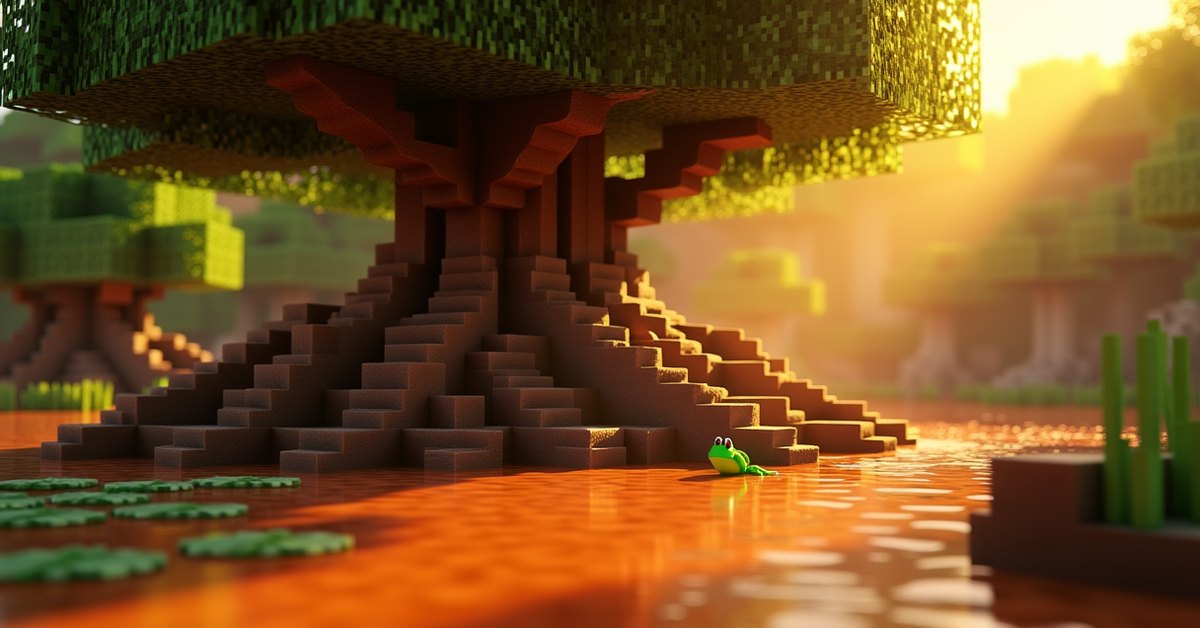
They look like a mess of bark-covered tendrils crossing over each other. Unlike a normal wood block, light passes through them and water flows through the gaps. That makes them one of the more interesting building blocks in the game, and one of the few wood-family blocks that can be waterlogged.
If you’ve found a mangrove swamp and noticed the trees growing out of weird sprawling block clusters, those clusters are mangrove roots.
Where to find mangrove roots
Mangrove roots only generate naturally in the mangrove swamp biome. Mangrove swamps are warm, shallow swamps full of mangrove trees, mud, and frogs. The biome was added with mangrove roots in the 1.19 update.
You can find mangrove swamps by exploring near jungles and regular swamps, usually in warmer climates. They generate as distinctive orange-leafed clusters that stand out against the surrounding terrain.
Inside the biome, you’ll see roots in two places:
- Around the base of every full-grown mangrove tree, spreading outward in a tangle.
- Mixed with mud to form muddy mangrove roots, which sit underneath and around the tree bases.
How to get mangrove roots
Mangrove roots break with any tool, but an axe is the fastest. You can also break them by hand and they’ll still drop the block, which makes them easy to collect early on.
Their hardness sits at 0.7, similar to other wood-family blocks. They count as wood for fuel and a few other purposes, although they aren’t strictly logs and they don’t drop a stripped variant.
You can stock up on roots a few ways:
- Break them straight out of the mangrove swamp. Easiest method, and you’ll usually get more than you need from a single tree’s root cluster.
- Grow a mangrove tree from a propagule. When the tree matures, roots generate around its base, and you can break the extras.
- Trade or share with another player on the same world.
If you want a steady supply at your base, the propagule route is the cleanest. Propagules drop from mangrove leaves and grow much faster than oak or birch saplings. Plant one in mud or dirt, give it space, and a full mangrove tree (with roots) appears within seconds.
Mangrove roots mechanics and behavior
Mangrove roots behave differently from a normal wood log. The mechanics that matter when you’re building or surviving:
Light passes through
Mangrove roots are not a full opaque cube. Light passes through them on all sides. You can stack roots and still have torches, glowstone, or sunlight reach blocks behind or below them.
They can be waterlogged
You can right-click a mangrove root block with a water bucket, and water fills the open spaces inside it. The block stays in place and water flows through and around it. This makes roots one of the best blocks in the game for underwater builds.
Mobs and pathfinding
Mobs treat mangrove roots like a solid block for collision. You can walk on top of them, and zombies, skeletons, and creepers cannot path through them. Small mobs like silverfish still can’t fit through the gaps in the texture.
Flammable
Mangrove roots burn. If you build with them near a lava source or in the Nether, expect them to catch fire and spread flame to neighboring wood. Treat them the same way you’d treat oak planks for fire safety.
Fuel value
You can put mangrove roots in a furnace as fuel. They smelt 1.5 items per block, the same as other wood-family blocks. Not the most efficient fuel in the game, but useful in a pinch if you’re standing in a swamp with no coal.
Muddy mangrove roots, the related block
Muddy mangrove roots are the mud-covered version of regular roots. They generate naturally in the mangrove swamp, mixed in with regular roots and mud, and they have a darker, dirtier look than the regular block.
To craft them yourself, you need mud and mangrove roots:
- Get a glass bottle of water (or a water bucket).
- Right-click a block of dirt or coarse dirt with a water bottle. This turns it into mud.
- Open a crafting table.
- Place mud above mangrove roots in a vertical 2-tile column. The output is muddy mangrove roots.
Muddy mangrove roots are a full opaque cube, so light does not pass through them, and they cannot be waterlogged. If you want the “water flows through” effect, stick with regular roots. If you want the look of swamp ground or a darker accent block, muddy roots fit the bill.
Building with mangrove roots
The combination of “light passes through” and “can be waterlogged” makes regular mangrove roots an underrated building block. A few ideas that work well in survival:
Underwater bases
Most blocks block water. Mangrove roots don’t, which means you can build a frame underwater and the inside of your base stays open and visible without complicated water-removal tricks. You can also place torches or sea lanterns behind the roots and the light reaches through.
Decorative archways and lattice
The texture is naturally complex, so a single row of roots reads as a lattice or an old wooden fence. Use them in cottage builds, ruins, or any structure where you want texture without using fence blocks.
Swampy biome additions
If you build in a regular swamp or a forest near water, mixing in mangrove roots with vines, cobblestone, and oak gives the build a wild, overgrown feel. Roots blend especially well with mud, dirt, and moss.
Aquariums and glass tunnels
For aquariums, you can use roots at the corners or edges in place of glass. Water flows through, fish can swim past, and the visual still reads as a contained space. They also pair well with sea pickles and kelp for a more natural-looking display.
Java vs. Bedrock differences
Mangrove roots behave nearly identically across Java and Bedrock. Both editions added the block in the 1.19 update with the same crafting recipe, the same biome generation, and the same waterlogging behavior.
One small difference: on Bedrock, the texture rendering can look slightly different on some devices because of the platform’s renderer. On Java, the texture stays consistent across systems. Functionally, the two editions match.
Tips and common mistakes
A few things players get wrong with mangrove roots:
- They assume roots block light. They don’t. If you’ve placed a torch and a wall of roots is between you and the dark area, the light still reaches.
- They try to compost roots. Roots cannot go in a composter.
- They confuse the two variants. Regular roots are translucent and waterloggable; muddy roots are solid and opaque. Pick the one that fits your build.
- They cut down the whole tree without saving propagules. Propagules drop from leaves randomly, but you can also harvest them off the tree’s hanging propagule stems before chopping. Save a few for replanting.
- They place roots near lava. Roots burn. If your build is in the Nether or near a lava feature, use stone or a non-flammable swap.
Frequently asked questions
Can you walk through mangrove roots?
No. Roots have full collision, so they act as a solid block for movement. You can stand on top of them and you can’t pass through.
Can mangrove roots be crafted into planks?
No. Only mangrove logs can be turned into mangrove planks. Roots are a separate block, even though they share the wood family visually and as fuel.
Do mangrove roots grow back after I break them?
Not automatically. Once you break a root block, that location stays empty until you grow a new mangrove tree there. Plant a propagule on dirt or mud nearby with a little space, and a fresh tree (with new roots) grows in.
Can mangrove roots be waterlogged?
Yes. Right-click roots with a water bucket and water fills the block. Mobs still treat it as solid, but water flows around it freely.
Do mangrove roots count as wood for crafting?
For fuel in a furnace, yes. For crafting recipes that require wood logs (like a crafting table or sticks), no, since roots aren’t a log. Use mangrove logs for those recipes.
Can you use bone meal on mangrove roots?
Yes, but only when a propagule is planted on top. Bone meal on a propagule speeds up its growth into a full tree. Bone meal on the roots block itself has no effect.
What’s the difference between regular and muddy mangrove roots?
Regular roots are translucent (light and water pass through) and can be waterlogged. Muddy roots are solid and opaque, and they cannot be waterlogged. You craft muddy roots by combining mud with regular roots in a crafting table.
The takeaway
Mangrove roots are the kind of block that rewards builders who like texture and water. If you’ve never tried using them outside their home biome, drop a few into your next overgrown ruin, shoreline base, or aquarium and see how the lattice plays against stone and moss.