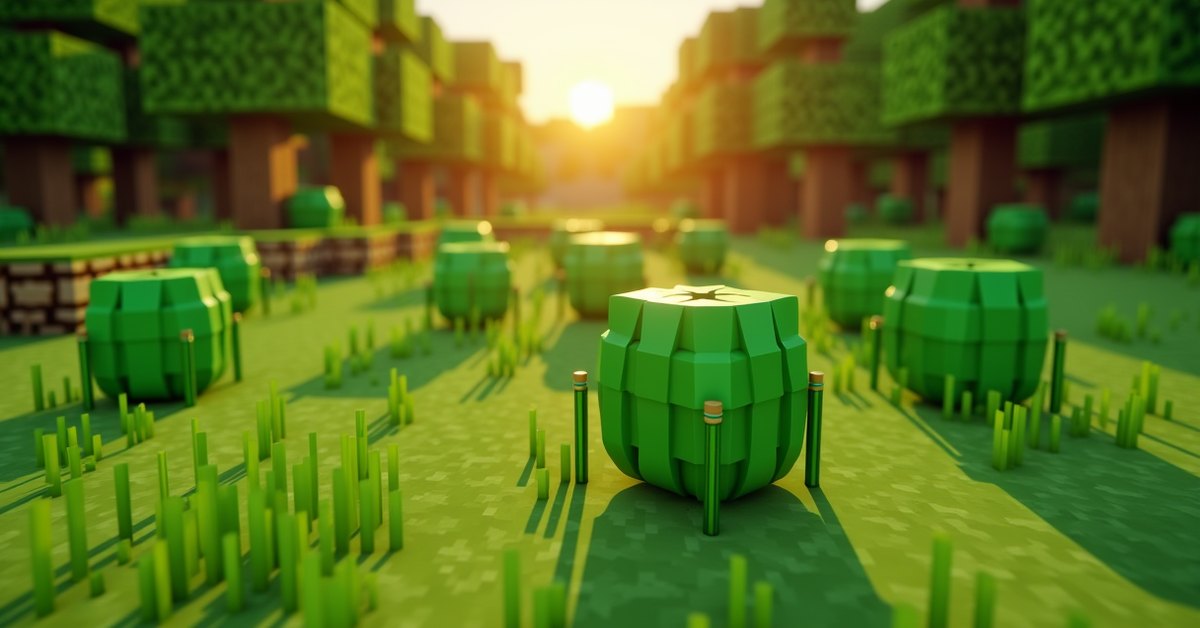
What a melon is in Minecraft
A melon is a green crop block that yields melon slices when broken. You’ll see them growing wild in jungle biomes, and you can plant your own farm with melon seeds. Each block drops between 3 and 7 slices, sometimes more with a Fortune-enchanted tool.
Melons sit on the food and farming side of the game. They aren’t the strongest hunger restorer, but they’re easy to mass-produce once you have a working farm, which makes them a steady food source in the mid and late game.
Where to find melons
Wild melons grow in jungle biomes. They show up scattered on grass, usually with a stem attached to one side. Sparse jungle and bamboo jungle biomes both work. They’re not super common, so it can take a few minutes of exploring before you spot a patch.
Outside jungles, you can find melon seeds in chest loot. Once you have a single seed, you don’t need to find another wild melon ever again.
Chest loot
Melon seeds appear in:
- Mineshaft chest minecarts
- Dungeon chests
- Woodland mansion chests
The drop rate isn’t high. If you’re stuck without a jungle nearby, raiding a mineshaft is the most reliable bet because there are usually multiple chest minecarts to check.
How to farm melons
Melon farming runs on stems, not the melon block itself. You plant a melon seed on tilled farmland, the seed grows into a stem over several stages, and then the stem produces a melon block on an adjacent dirt, grass, podzol, mycelium, or farmland tile.
What the stem needs
For a stem to actually produce a melon, it needs:
- Farmland under the stem itself
- Hydrated farmland (water within four blocks) for faster growth
- A free adjacent block in one of the four cardinal directions, made of dirt, grass, podzol, mycelium, or farmland
- A light level of 9 or higher
If all four sides of the stem are blocked or unsuitable, the stem will grow to full size and then sit there doing nothing. This is the most common reason new players say their melon farm “isn’t working.” Always leave at least one adjacent tile open for the melon to spawn into.
Growth speed
A stem goes through 8 growth stages before it can produce a melon. Each stage advances on a random tick, so growth times vary, but a typical fully-hydrated farm produces a new melon every 10 to 30 minutes per stem in real time. Bone meal advances stem growth, but it does not directly spawn the melon block itself. Once the stem is at stage 7, you wait for a random tick to pop the melon out.
Farm layouts
Two layouts get used most often. A single-row farm is a row of farmland with stems and a parallel row of dirt or grass next to it for melons to spawn on. It’s easy to harvest and easy to scale up. A checkerboard farm uses alternating columns of farmland and dirt. It doubles the density per square meter at the cost of slightly slower watering.
Automated versions use observers on the spawn tiles to detect a new melon, then push it into a piston that breaks the block and drops the slices onto a hopper line. These work in both Java and Bedrock, though wiring details differ slightly.
What melon slices do
Eating a melon slice restores 2 hunger points (one shank icon) and 1.2 saturation. That’s modest. For context, a steak restores 8 hunger and 12.8 saturation, so one steak is roughly four melon slices’ worth of hunger plus a lot more saturation.
Melons make the most sense as a bulk crop when you want a passive food source and don’t want to manage animal breeding. A 20-stem farm will keep one player fed indefinitely once it’s running.
Crafting recipes
A few useful recipes use melon as an input. Nine melon slices in a 3×3 grid produce one melon block, which is the simplest way to compact slices for storage. A single melon slice in the crafting grid yields one melon seed, which is handy when you’re starting a new farm and only have slices on hand. One melon slice plus 8 gold nuggets in a 3×3 grid (slice in the center, nuggets around it) makes one glistering melon slice, used in brewing.
Glistering melon and potions
The glistering melon slice is the brewing ingredient for the Potion of Healing. Add a glistering melon slice to an awkward potion in a brewing stand, and you get a Potion of Healing that restores 4 health (2 hearts) on use.
If gold is the limiter, you can save resources by using gold nuggets from piglin bartering or nether ingot trades rather than smelting raw gold. A glistering melon costs 8 nuggets, which is just under one gold ingot, so the math isn’t punishing once you have a basic gold supply.
Trades and villagers
Farmer villagers buy melons from players. The exact trade slot varies by villager level, but novice and apprentice farmers will take melon slices for emeralds in most worlds. This makes a melon farm one of the easier early emerald sources, since you can run a stack of slices into a single trade cycle.
Farmer villagers will also harvest mature crops, including melons grown on village farmland. If you set up a farm near a village, expect them to break melons on their own. They won’t replant melon seeds, so you still need to handle replanting yourself or build a redstone harvester.
Tips and common mistakes
- Use a tool with Fortune III to maximize slice drops. Fortune III can yield up to 9 slices per block.
- Don’t put farmland on both sides of the stem if you only need one melon per cycle. The extra hydration helps growth, but you’ll waste tiles.
- Bone meal does not pop the melon block out. It only grows the stem. Don’t waste bone meal hoping for an instant melon.
- Light level 9 minimum. If you’re farming underground, place torches close enough that no farmland tile drops below light level 9.
- Trampling: jumping on farmland turns it back into dirt. Build a half-slab walkway or a fence around your farm if you walk through it often.
- Composting: melon slices can go into a composter to make bone meal. Useful if you have a glut of slices and don’t want to throw them out.
Java vs. Bedrock differences
The melon mechanics are nearly identical across editions, but a few small differences come up. In Bedrock, bone meal on a stem can occasionally spawn the melon directly if conditions are met. In Java, it only grows the stem. Java and Bedrock both use a gametick-based random tick, but the default tick speed values differ slightly between updates, so real-world growth times will feel close but not identical. Trade tables also get tweaked between editions. Farmer melon trades exist in both, but exact prices and required levels can change with patches.
Frequently asked questions
Can you eat a whole melon block?
No. You break the melon block first, which gives you slices, and then you eat the slices individually. You cannot place a melon block in your hand and right-click to eat it.
How many slices does a melon block drop?
3 to 7 slices with a plain tool, more with Fortune. Fortune III can push the drop up to 9 slices per block.
Do melons stack in the inventory?
Melon slices stack to 64. Melon blocks also stack to 64.
Why is my melon farm not producing melons?
Almost always, it’s one of two reasons: no free adjacent block for the melon to spawn into, or light level too low. Check both before tearing the farm up.
Can pigs or other mobs eat melon?
No. Melon slices are a player-only food in Minecraft. Pigs eat carrots, beetroots, and potatoes. Other passive mobs have their own breeding items, but none of them use melon.
Can you make a melon farm fully automatic?
Yes. Observer-piston designs detect a new melon block, break it, and feed the slices into hopper lines. These work in both editions, though wiring details are slightly different. Look up a current design for whichever version you’re playing, since redstone behavior changes occasionally between updates.
What’s the difference between melon and glistering melon?
A regular melon slice is food. A glistering melon slice is a brewing ingredient that won’t restore hunger. The glistering version uses 8 gold nuggets to turn a single slice into a potion ingredient.
Does the stem die after the melon spawns?
No. Once a stem produces a melon, the stem stays in place and is ready to produce another melon on the next random tick that finds an empty adjacent block. You don’t need to replant after each harvest. That’s why a single seed and a strip of farmland can keep producing melons forever, as long as you keep clearing the spawn tile.
Will melons grow in the Nether or the End?
You can plant the seeds in either dimension if you bring farmland in with you. Stems need light level 9 or higher, and the spawn tile still has to be a valid block. The mechanics don’t change between dimensions, so a sealed underground farm in the Nether works the same way it would in the Overworld, as long as the lighting is set up correctly.
Final thought
Melons are unglamorous, and that’s the point. They take one seed and a row of farmland to bootstrap, they scale up easily, and they trade in for emeralds. If you’ve already got a wheat farm and want a second crop that pays for itself, melons are the most forgiving option in the game.