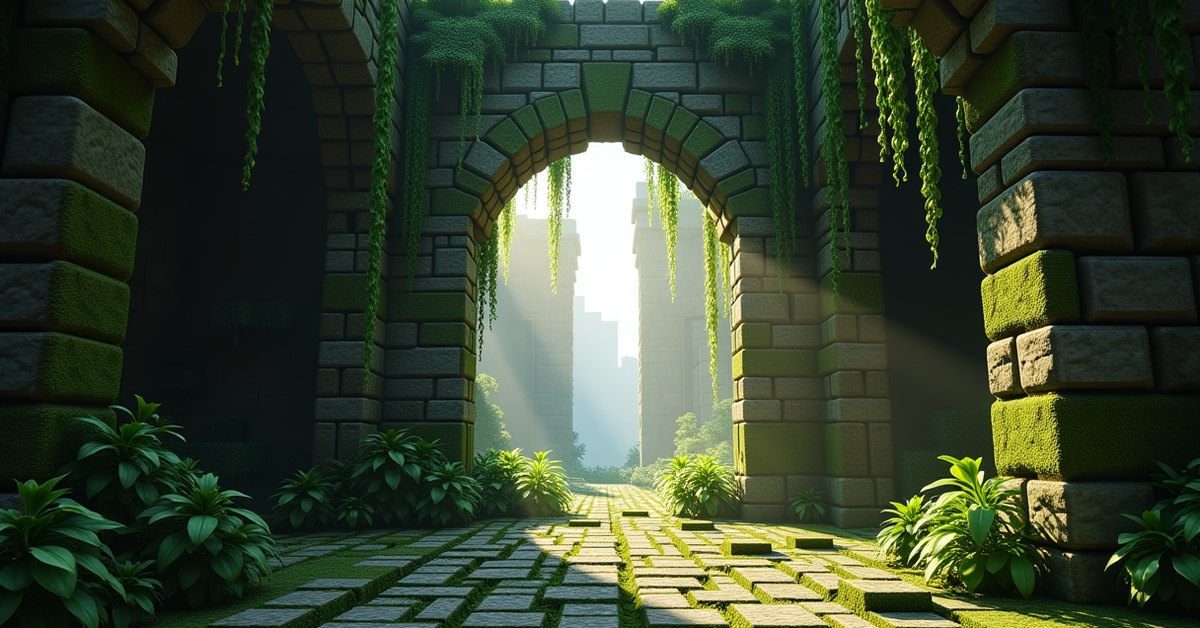
What are mossy stone bricks?
Mossy stone bricks are a variant of the regular stone bricks block, with patches of moss growing across the surface. They have the same shape, sound, and material properties as stone bricks, but a darker, greener look that suits ruins, old castles, dungeons, and any build that needs a sense of age.
The block has been in the game since the Adventure Update. It belongs to the stone bricks family, which also includes regular stone bricks, cracked stone bricks, and chiseled stone bricks. All four variants share crafting and building behavior, so anything you can do with stone bricks (stairs, slabs, walls) you can also do with the mossy version.
Where to find mossy stone bricks
You can find mossy stone bricks in a few structures generated by the game:
- Strongholds. These late-game structures contain the End portal and are scattered around the world. Mossy stone bricks appear in the corridors and rooms alongside regular stone bricks, cracked stone bricks, and the rarer infested versions.
- Jungle pyramids (jungle temples). Found in jungle biomes, these small temples are built mostly from cobblestone and mossy cobblestone, with mossy stone bricks used as accent blocks.
- Trail ruins. Added in 1.20, these buried archaeological sites occasionally contain mossy stone bricks among their stone-brick floors.
If you only need a handful for decoration, mining them out of one of these structures is faster than crafting. If you need a stack or more, crafting is the way.
Of the three sources, strongholds are the most productive. A single stronghold can contain several stacks of mossy stone bricks across its corridors, especially in the rooms near the staircase and around the portal frame. If you have already located a stronghold and are not ready to walk into the End, a short mining trip is the quickest large stack you will get without setting up any farms.
How to craft mossy stone bricks
There are two recipes that produce mossy stone bricks, and the right one depends on which version of the game you are playing.
Crafting with moss block (1.17 and later)
The newer recipe uses a moss block:
- 1 stone bricks
- 1 moss block
Place them anywhere in a crafting grid. You get one mossy stone bricks per craft. Moss blocks come from bone-mealing moss in the lush caves biome or trading with a wandering trader. A single moss block produces a single mossy stone bricks, so stock up on moss first if you have a large build in mind.
If you are starting from scratch, the moss block recipe is usually the easier of the two to scale. Bone meal on a moss patch in lush caves produces a small burst of new moss blocks at once, and one trip to a lush cave with a few stacks of bone meal can supply a full build. Wandering traders also sell moss blocks for emeralds, and one trader will sometimes spawn with multiple moss-block trades stacked together.
Crafting with vines (all versions)
The older recipe uses vines and still works in current versions:
- 1 stone bricks
- 1 vine
Vines grow on the sides of trees in jungle and swamp biomes. They spread on their own once placed, so a small wall of vines is enough to produce a steady supply. Use shears to collect vines; breaking them by hand drops nothing.
The practical setup for the vine recipe is a short stone wall near your base with a single vine placed near the top. Vines grow downward and outward at a slow but steady pace. One column of vines, kept trimmed every couple of in-game days, easily supplies more vines than a moderate building project needs.
Both recipes give the same result, so pick whichever input is easier to gather in your world.
Mining and tool behavior
Mossy stone bricks behave the same as regular stone bricks when mined.
- Minimum tool: wooden pickaxe. Breaking the block with anything weaker drops nothing.
- Hardness: 1.5
- Blast resistance: 6 (the same as stone bricks, plenty for general survival builds but not creeper-proof at point-blank range)
- Drops itself when mined with a correct pickaxe
There is one quirk worth knowing. In strongholds you will occasionally see infested stone bricks: blocks that look identical to the regular kind but spawn silverfish when broken. Infested versions exist for stone bricks, mossy stone bricks, cracked stone bricks, and chiseled stone bricks. They mine faster than the normal version, which is the actual tell. If a block crumbles unusually quickly, expect a silverfish.
Stairs, slabs, and walls
Mossy stone bricks have the usual building variants:
- Mossy stone brick stairs. Craft with 6 mossy stone bricks arranged in a stair pattern. You get four stairs per craft, or one per block in a stonecutter.
- Mossy stone brick slabs. Three mossy stone bricks in a row produces six slabs in a crafting table, or two in a stonecutter.
- Mossy stone brick walls. Six mossy stone bricks in two rows of three produces six walls, or one per block in a stonecutter.
The stonecutter is the better choice if you care about efficiency on stairs. For slabs and walls, the crafting grid produces more output per input.
What mossy stone bricks are good for
The block fills a specific role in builds: it is the most natural way to suggest age and overgrowth without using actual moss or vegetation.
A few practical uses:
- Mixing mossy and regular stone bricks at roughly a 1:3 ratio gives walls a weathered look without losing the clean line of the original block.
- Pairing them with cracked stone bricks and a few cobwebs makes a convincing abandoned dungeon.
- Building floors out of stone brick slabs with random mossy and cracked blocks scattered through breaks up flatness without adding clutter.
- Using mossy stone brick walls along a path mimics old retaining walls that have weathered over time.
In jungle and swamp builds, the green tint helps the block sit naturally in the surrounding biome. In snowy or desert builds, the contrast is sharper and the block reads more as imported masonry than as overgrown ruins.
Java vs. Bedrock differences
Mossy stone bricks behave the same way across both editions for the things players use most: crafting, mining, blast resistance, drops, and structure generation. Both recipes (stone bricks plus moss block, and stone bricks plus vine) work in both editions.
The differences you will notice come from the systems mossy stone bricks sit inside, not the block itself. Bone meal growth on moss blocks behaves slightly differently between editions in terms of spread radius, and stonecutter behavior in Bedrock allows recipe access through a few extra interactions. For the brick itself, you can treat the two editions as interchangeable.
Frequently asked questions
Can mossy stone bricks be made from silverfish?
No. Silverfish produce infested stone, cobblestone, and the four stone brick variants only when those blocks already exist in the world (mostly in strongholds). You cannot generate new mossy stone bricks from silverfish.
Do moss blocks spread to mossy stone bricks?
No. Moss block spread turns dirt, grass blocks, podzol, stone, cobblestone, and a few related blocks into moss block. It does not affect stone bricks or any of its variants, including mossy stone bricks.
Can I get mossy stone bricks from villager trades?
Stone mason villagers sell various stone-family blocks at certain tiers, but mossy stone bricks specifically are not a reliable trade. Wandering traders sometimes carry moss blocks, which you can then craft into mossy stone bricks at home.
What is the fastest way to get a lot of mossy stone bricks?
Set up a cobblestone generator, smelt cobblestone to stone, and craft stone bricks. Then either run a small moss block farm (using bone meal on moss in lush caves) or grow a vine wall. Combine in a crafting grid. A stonecutter speeds up conversion to stairs, slabs, or walls if that is your final shape.
Do mossy stone bricks burn?
No. They share fire properties with stone bricks: not flammable, not destroyed by fire or lava contact. Safe for nether-adjacent builds.
Are mossy stone bricks waterloggable?
The base block is not waterloggable. The slab, stair, and wall versions are, which is useful for fountains, aqueducts, and underwater ruins.
Will pistons push mossy stone bricks?
Yes. Mossy stone bricks have no piston-blocking properties. They can be pushed and pulled normally, which makes them safe to use in vertical doors, hidden entrances, and other piston builds.
Do mossy stone bricks change or decay over time?
No. Once placed, mossy stone bricks stay exactly as they are. The moss patches do not spread to neighboring blocks, and the texture does not change with weather, light level, or proximity to plants. What you place is what you keep.
Can mossy stone bricks generate naturally outside of structures?
Not in the overworld at large. The block is structure-only on the natural-generation side, so you will see it in strongholds, jungle pyramids, and trail ruins, but never in random caves, hilltops, or villages. If you find a single mossy stone bricks block out in the wild, it is almost certainly part of a partial trail-ruins generation buried nearby.
Bottom line
If you build a lot, mossy stone bricks are one of the cheapest ways to add character to a structure. The crafting recipes are simple, the supply chain is renewable once you have a moss block source or a vine wall, and the variants (stair, slab, wall) cover almost any shape you need. Worth keeping a few stacks on hand for any long-term world.