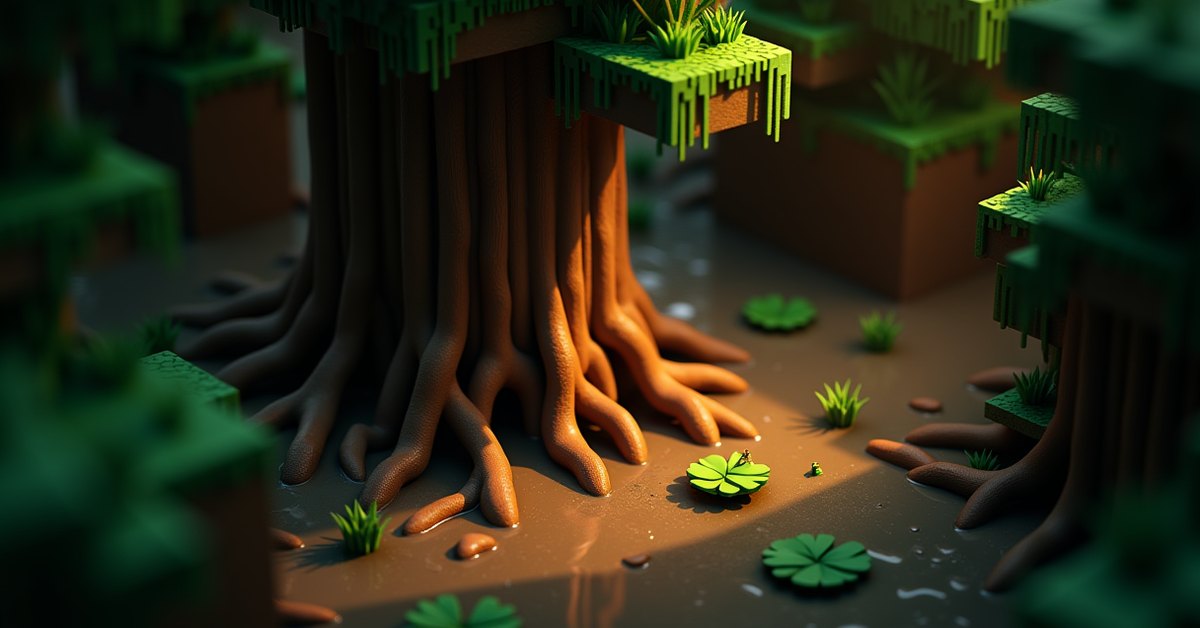
What muddy mangrove roots are
Muddy mangrove roots are a block in Minecraft that look exactly like the name says: wet, dark mud with twisted root shapes running through it. They were added in the 1.19 update (the Wild Update) in June 2022, alongside the mangrove swamp biome, the mud block, and the mangrove tree itself.
The block is fully solid. That matters, because regular mangrove roots (without the mud) have a partial hitbox that mobs and players can squeeze past in some setups. Muddy mangrove roots act like any normal block. They work in builds, redstone setups, and farms without weird interactions.
The texture is a warm dark brown with visible root strands woven through wet earth. From a distance the block reads almost black, which is useful to know when planning color contrast in a build. Up close, you can pick out individual root lines that catch the light a little differently than the mud around them. The block is also opaque, so it blocks light, supports redstone dust, and counts as a full cube for most game logic.
Where to find muddy mangrove roots
The only biome that generates muddy mangrove roots naturally is the mangrove swamp. You’ll know you’re in one when you see tall mangrove trees with their roots dangling into shallow muddy water. Walk around the base of those trees and you’ll find muddy mangrove roots packed into the ground.
Mangrove swamps spawn in warm regions next to other warm biomes like jungles or savannas. If you can’t find one, the easiest move is to head to a jungle and follow the coastline. They aren’t rare, but they aren’t everywhere either.
Inside a mangrove swamp, look at the ground near the trunk of any mangrove tree. The exposed roots above ground are regular mangrove roots. The roots that fade into the wet earth at the base are muddy mangrove roots. Sometimes you’ll see them stacked several blocks deep, especially around large mangrove trees.
How to break and collect muddy mangrove roots
You can break muddy mangrove roots with your bare fist, and they will still drop the block. There’s no minimum tool tier. That said, a hoe is the fastest tool, because the game treats this block like dirt-family material.
Rough break-speed order:
- Hoe: fastest, especially netherite or diamond.
- Shovel: works, but slower than a hoe.
- Axe: works, slower again.
- Fist or other tools: works, slow.
Silk Touch is not required, because the block drops itself by default. Fortune does not change the drop. One block in, one block out.
How to craft muddy mangrove roots
If you’re not near a swamp but you have the parts, you can craft muddy mangrove roots in any crafting grid. Combine one mangrove roots block with one mud block, in any arrangement, and you get one muddy mangrove roots block. The recipe is shapeless, so positions inside the grid don’t matter.
Mud comes from using a water bottle on a dirt block. Mangrove roots come from breaking a mangrove tree’s root sections, or from growing a tree from a mangrove propagule and harvesting the roots that form around it. Once you’ve got both, you can stay stocked up on muddy mangrove roots indefinitely without trekking back to a swamp.
What muddy mangrove roots are good for
This block has three honest uses: building, mob pathing, and palette work.
Building material
Muddy mangrove roots have a distinctive look that fits any organic, swampy, or overgrown build. The texture reads as decay and natural growth, which makes it useful for ruins, witch huts, abandoned villages, and root systems under fantasy trees. Pair it with mud, mud bricks, packed mud, regular mangrove roots, and mangrove planks for a coherent palette.
Because it’s a full solid block, you can place anything on top of it: rails, redstone components, beds, banners, signs, fences, and doors. Regular mangrove roots can’t take most of these.
Mob farms and pathing
Since this block behaves like a solid block, mobs path across it normally. That is worth knowing if you’re using regular mangrove roots in a farm: mobs treat those as different for AI purposes and won’t path onto them the same way. If you want consistent mob pathing in a swamp-themed build, use muddy mangrove roots, not the dry kind.
Carpet and slab combos
Place a moss carpet on top of muddy mangrove roots and you get a believable forest floor. Add frogspawn in nearby water and the swamp look is sold. For wider palettes, dark oak slabs, azalea bushes, and big drip leaves play well with the block’s color and texture.
How muddy mangrove roots compare to mud
Both blocks were added in 1.19, both come from mangrove swamps, and both have that wet, dark look. They are easy to confuse. Here’s the practical difference.
Mud is a soft block. Stepping on it slows you slightly, and stacked mud above you sinks your hitbox a little. Muddy mangrove roots don’t slow you, don’t sink your hitbox, and feel like normal terrain underfoot. The mud block also has its own mechanics, like converting dirt with a water bottle, while muddy mangrove roots don’t do anything special when you interact with them.
If you want the swampy look but you need a floor you can walk and build on without quirks, muddy mangrove roots are the better pick. If you want the slow-stepping effect for puzzle builds or atmosphere, regular mud is the better pick.
Survival tips for the mangrove swamp
If you’re heading into a mangrove swamp specifically to harvest these blocks, a few things help.
- Bring a boat. The biome is shallow water mixed with land, and a boat moves faster than wading.
- Carry a hoe. You’ll mine roots and mud faster, and you can till any dirt you find for a temporary farm.
- Watch for witches. Witch huts can generate in mangrove swamps, and witches throw harmful potions at you on sight.
- Collect mangrove propagules. These are the saplings that hang from mangrove trees. You can replant them later in any wet soil to grow your own mangroves.
- Grab mud, packed mud, and mud bricks while you’re there. The whole set works together in builds, and you’ll save a trip later.
Java vs. Bedrock differences
For muddy mangrove roots specifically, the block behaves the same on both editions. Same texture, same break speeds with each tool, same drop, same biome generation, same crafting recipe. If you build in one edition and import to the other through a level converter, the block lands cleanly on the other side.
Frequently asked questions
What is the fastest way to mine muddy mangrove roots?
Use a hoe. A diamond or netherite hoe will break each block in a fraction of a second. If you have an Efficiency enchantment on top, you’ll clear large patches almost as fast as the animation can play.
Do muddy mangrove roots burn?
No. They are not flammable, so fire and lava won’t destroy them the way they would destroy oak planks or wool.
Can you walk through muddy mangrove roots?
No. Unlike regular mangrove roots, which have a partial hitbox that lets some entities slip through, muddy mangrove roots are a full solid block. You walk on them, not through them.
Do mobs spawn on muddy mangrove roots?
Yes. Hostile mobs can spawn on them at night, same as on any solid opaque block at low light levels. If you’re building a base in a swamp, light the area to prevent that.
Are muddy mangrove roots renewable?
Yes. You can craft them from mud and mangrove roots, and both inputs are renewable. Mud comes from using a water bottle on dirt, and mangrove roots come from growing mangrove trees out of propagules. As long as you have at least one mangrove tree growing, the supply chain never stops.
What block looks similar but isn’t muddy mangrove roots?
The closest visual cousin is the regular mangrove roots block. It has the same root pattern but no mud filling the gaps. People often grab the wrong one in survival because the textures sit near each other in inventory and look similar at a glance. Hover over the block name in your inventory if you aren’t sure which is which.
What version added muddy mangrove roots?
Java 1.19 and Bedrock 1.19.0, both released in June 2022 as part of the Wild Update. The same update added the mangrove swamp biome, the frog mob, the warden, and the deep dark.
Build ideas to try with muddy mangrove roots
If you’re stuck for ideas, try one of these. A sunken temple ruin where roots break through stone and mud spills onto the floor. A witch’s garden where vines, frogspawn, mud, and roots crowd a small clearing. A treehouse path that descends through layered mud and roots into a hidden cellar. The block is at its best when it looks like nature is reclaiming a structure, so lean into messy, asymmetric layouts and avoid grid-perfect placement.