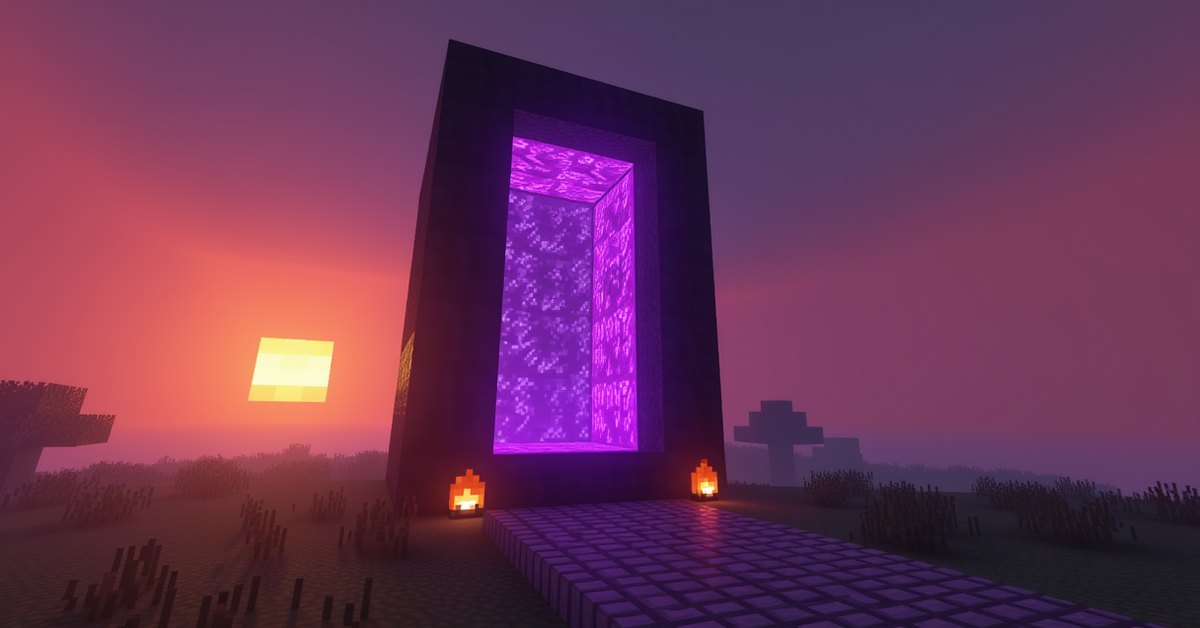
A nether portal is a player-built block structure that opens a gateway to the Nether. Once activated, walking into the portal block transports you to a matching portal in the other dimension. The mechanics behind that simple action are more involved than they look: portals link to each other based on coordinates, distances scale by a factor of 8 between dimensions, and the game generates new portals on the fly when no match exists.
If you have ever stepped through a portal and ended up far from where you expected, that is the linking algorithm at work. This guide covers how nether portals are built, how they activate, how they pair up between dimensions, and the cooldowns and quirks that catch players off guard.
Everything below applies to current Java and Bedrock editions unless noted otherwise.
What is a nether portal?
A nether portal is a frame of obsidian containing a field of portal blocks (the purple, swirling, transparent-looking blocks you see inside). The frame holds the structure; the portal blocks do the actual teleporting. You only ever build the frame yourself. The portal blocks appear automatically when the frame is activated with fire.
Portal blocks use the in-game ID minecraft:nether_portal. They have no mining time in survival and cannot be broken with any tool. To remove a portal, you remove one of the obsidian frame blocks; the portal field collapses with it.
Portals are always vertical and always oriented along one of the two horizontal axes (north to south, or east to west). You cannot build a horizontal nether portal in survival.
How to build and activate a portal
The minimum frame is 4 blocks wide by 5 blocks tall on the outside, which makes the interior 2 wide by 3 tall. The maximum frame is 23 by 23 on the outside (21 by 21 inside). Anything larger and the portal blocks will not fill the frame.
Frame corners are optional. The game only checks the four sides of the frame for obsidian, so you can leave the corners empty or fill them with any other block. A minimum frame without corners uses 10 obsidian. With corners, it uses 14.
To activate the portal, use flint and steel or a fire charge on the bottom interior surface of the frame. Any source of fire inside the frame works, including a fire spread from a burning wooden block placed inside. Once lit, the frame fills with portal blocks and the portal is live.
A portal stays active until something breaks the frame or extinguishes the portal blocks. Water flowing into the portal will not deactivate it, but breaking an obsidian frame block will.
How portals link between dimensions
This is the part most players get tripped up by. When you step through a portal, the game decides where you come out using these steps:
- The game takes your current coordinates and converts them. Overworld to Nether divides X and Z by 8. Nether to Overworld multiplies X and Z by 8. The Y coordinate is not scaled.
- With the target position calculated, the game searches a box 128 blocks in each horizontal direction around the target (a 256 by 256 search area) for an existing portal in the destination dimension.
- If it finds one, you arrive at the closest portal block inside that search area.
- If it finds nothing, the game places a new portal at or near the target coordinates and you arrive there.
That search radius is where most “my portal sent me to the wrong place” complaints come from. If your Overworld portal is at (800, 64, 800), the matching Nether coordinate is (100, 64, 100). The game then looks within 128 blocks of (100, 64, 100) for any existing Nether portal. If you already have one at (50, 64, 50), that is within range and the game will link to it instead of generating a fresh portal closer to (100, 64, 100).
For Nether highway projects or long-distance travel networks, players usually space portals at least 1,024 Overworld blocks apart (128 Nether blocks) to guarantee each pair gets its own private link.
Coordinate scaling, with examples
The 8:1 ratio is the headline feature of Nether travel. Every block you walk in the Nether moves you 8 blocks in the Overworld.
A few worked examples to make this concrete:
- Overworld (5000, 64, 0) becomes Nether (625, 64, 0).
- Nether (200, 64, 200) becomes Overworld (1600, 64, 1600).
- A 200-block walk in the Nether covers 1,600 blocks in the Overworld.
The Y coordinate is not scaled. If your Overworld portal sits at Y=64, the Nether portal generates as close to Y=64 as the terrain allows. The game will shift it up or down to find a spot that fits, but it does not apply the 8x factor to vertical position.
Cooldowns and player interactions
When you enter a portal, you do not teleport instantly. You stand inside the swirl for 4 seconds (80 game ticks) before the teleport fires. Walking back out during that window cancels the teleport. This is useful when you accidentally fall into a portal you did not mean to enter.
After teleporting, players get a brief immunity to the portal block at the destination so they do not immediately bounce back. In Java Edition, the player portal cooldown is controlled by the gamerule portal_cooldown, which defaults to 0 ticks. You can still re-enter a portal right away, but you will get a nausea effect for a few seconds. In Bedrock, the behavior is similar but managed separately.
Mobs work differently. A mob walking into a portal triggers a teleport like a player, but the mob cooldown is 15 seconds (300 ticks). Mobs also do not generate new portals at the destination. If no portal exists at the target coordinates, the teleport behavior depends on edition: in Java the mob typically stays put or fails to teleport cleanly, while Bedrock handles unlinked mob teleports inconsistently across versions.
You can drag mobs through portals on a lead. The lead breaks during the teleport, but the mob arrives in the destination dimension.
Mob behavior at portal blocks
Portal blocks have a few interactions worth knowing:
- Zombified piglins occasionally spawn from a portal block in the Overworld on Java Edition. The chance is small and scales with difficulty. This does not happen on Bedrock.
- Most hostile mobs path away from portals. Endermen will not teleport through on their own; they need to be pushed in.
- Items dropped onto a portal block teleport just like a player or mob. They wait the 4-second activation, then move to the matching coordinates on the other side. Item entities can pile up at a Nether-side portal if you funnel a lot through.
- Boss mobs (the Ender Dragon, the Wither) cannot pass through nether portals at all.
Java versus Bedrock differences
The core portal mechanics are the same on both editions: same frame sizes, same 8:1 coordinate scaling, same 128-block search radius, same activation method. The differences are around the edges.
Player cooldown is exposed as the gamerule portal_cooldown in Java. Bedrock has an internal cooldown but no equivalent gamerule.
Zombified piglin spawning from portal blocks only happens on Java.
The teleport sound is slightly different between editions. Functionally, neither sound affects gameplay.
A portal you build on Java will behave the same as a portal you build on Bedrock if the frame is identical. Worlds converted between the two editions retain working portals.
Common mistakes and tips
Skip the corners. They do nothing, and the obsidian is better spent on a second portal.
Do not build the Nether-side portal directly in lava or on the edge of a cliff. Ghasts and stray lava can easily kill you the moment you arrive, and a knockback can push you off your platform before you can react.
If you want a guaranteed link between two specific portals, build the Nether-side portal first at the exact target coordinates, then build the Overworld portal at the matching location. The game always pairs to existing portals before generating new ones.
Wall in your Nether-side portal with a small obsidian or cobblestone shelter. It blocks ghast line of sight and gives you a safe arrival point.
Carry flint and steel or a fire charge on every Nether trip. If a fight or a mob attack breaks a frame block, the portal collapses and you need to rebuild and re-light it to get home.
If you are setting up a portal network, plan it on graph paper or a map before placing obsidian. The 8:1 ratio is easy to get wrong in the moment, and rebuilding a misplaced portal is more annoying than planning the math up front.
Frequently asked questions
What is the smallest nether portal you can build?
4 blocks wide by 5 blocks tall on the outside, which is 2 by 3 on the inside. That uses 10 obsidian if you leave the corners empty, or 14 if you fill them in.
Does the corner of a nether portal frame need to be obsidian?
No. Corners can be any block, or no block at all. Only the four sides of the frame have to be obsidian.
How far apart should I space portals so they do not link to each other?
At least 1,024 blocks apart in the Overworld, which works out to 128 blocks apart in the Nether. That puts them outside the 128-block search radius the game uses when linking.
Why did my nether portal send me to the wrong place?
The game linked your portal to an existing portal in the other dimension that was within 128 blocks of the calculated target. To force a specific pairing, build the destination portal at the exact target coordinates before you make the trip.
Can you break a nether portal block in survival?
Not directly. Portal blocks have no valid mining tool in survival. To remove a portal, break one of the obsidian frame blocks and the portal field will collapse.
Can mobs travel through nether portals?
Yes, with caveats. Most mobs can teleport if pushed or led into the portal, but they do not generate new portals at the destination. If no portal exists on the other side, the teleport may fail.
What is the maximum size of a nether portal?
23 by 23 blocks on the outside, which is 21 by 21 on the inside. Build it any larger and the portal blocks will not fill the frame.
Wrap-up
The linking algorithm is the part that catches most players the first time they try a long trip. Plan portal spacing before you place obsidian, lock in the pairing by building the Nether side first when it matters, and you can avoid almost every “wrong portal” story other players run into.