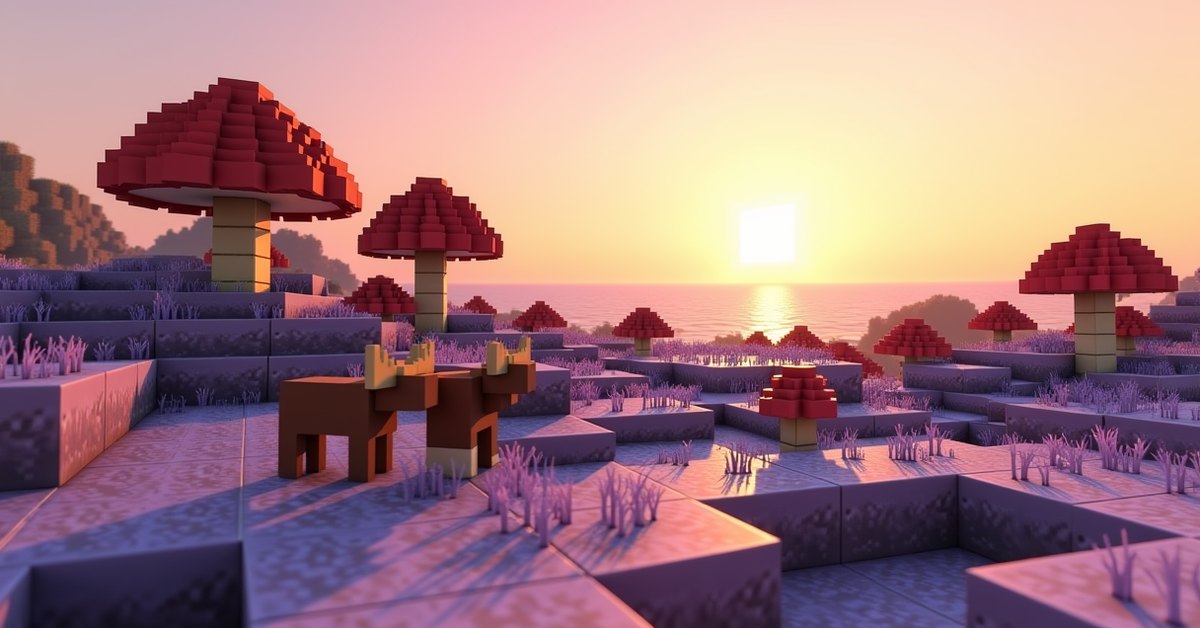
Mycelium is the purple-grey block that covers the ground in Minecraft’s mushroom fields biome. It looks like dirt that’s been overtaken by fungus, with tiny spore particles drifting up from the surface. Players hunt for it because it’s the easiest place to grow mushrooms in the overworld and it gives mushroom-themed builds their distinct look.
The catch is that you can’t pick it up without the right enchantment, and it’s tied to one of the rarest biomes in the game. This guide covers where to find it, how to mine it, how to spread it back home, and what makes it different from grass and podzol.
If you’ve ever placed a mushroom in your base and watched it pop right off the ground, mycelium is what you actually wanted under it.
What mycelium is
Mycelium is a variant of dirt that only generates naturally in the mushroom fields biome. The top surface has a textured, blotchy appearance and emits small particles. The sides and bottom of the block look like regular dirt, which is why mycelium walls in caves can be easy to miss from below.
It behaves like a grass block in some ways and not in others. It spreads to adjacent dirt blocks, dies when buried, and can be walked on like any solid block. Unlike grass, mushrooms grow on it freely at any light level, and almost no hostile mobs spawn on its surface.
You’ll only find mycelium generating in mushroom fields and mushroom field shores. Both are rare biomes that usually appear as small islands in the ocean. If you’ve seen a giant red mushroom dotting an island in the distance from a boat trip, that’s the place.
How to get mycelium
Mining mycelium with any tool drops a dirt block, not mycelium. To collect the actual block, you need a tool enchanted with Silk Touch.
A shovel breaks mycelium fastest, but any tool works. Bare hands work too, just slowly. Use Silk Touch on the shovel and the block drops as mycelium that you can place anywhere.
A few other ways to get it:
- Wandering traders occasionally sell mycelium for emeralds, though it’s not a common offer.
- A creative inventory has it listed under building blocks.
- The ground in any mushroom-themed structure is mycelium, but you still need Silk Touch to collect it.
If you don’t have Silk Touch yet, save the trip. Enchant a shovel at an enchanting table or trade for the book with a librarian villager, then come back when you’re ready.
How mycelium spreads
Mycelium spreads to nearby dirt blocks the way grass does, with a few tweaks. The mechanics:
- The source mycelium block needs a light level of at least 9 on the block directly above it.
- The dirt block it’s trying to spread to must also have a light level of at least 4 above it.
- That target dirt block must have air or a transparent block directly above it. Buried dirt won’t convert.
- Spread radius is one block horizontally and within a small vertical range, similar to grass.
Mycelium can outcompete grass. If you place a single mycelium block next to a grass field with the right lighting, it will slowly take over. This is the trick for building a mushroom field at home: bring back a small piece, plant it on dirt, give it light, and let it spread.
If a solid block gets placed on top of mycelium, the mycelium dies and reverts to dirt. The same is true if the light level above the block drops below 4. To keep a mycelium floor intact, don’t cover it and don’t let it sit in the dark.
Growing mushrooms on mycelium
The reason most players want mycelium is mushroom farming. Red and brown mushrooms have strict light rules on normal blocks: they need a light level below 12 to survive, and they spread slowly even when conditions are right.
On mycelium, those rules relax. Mushrooms stay alive at any light level on mycelium and podzol. They still spread slowly, but you don’t have to keep the area dark, which makes a surface-level mushroom farm practical.
For a basic farm:
- Place mycelium in a flat patch.
- Plant a few red or brown mushrooms.
- Wait. They’ll spread to nearby mycelium blocks over time.
- Harvest with your hand or a tool. Use shears if you want a whole block from a giant mushroom.
To force a giant mushroom, place a small mushroom on mycelium and use bone meal. The block directly above needs to be clear, and the area around it needs space for the cap to expand. A giant mushroom drops several regular mushrooms when broken with an axe.
Mob spawning on mycelium
Hostile mobs treat mycelium almost like a no-spawn surface. In Java Edition, no hostile mobs spawn on mycelium during normal generation, which is what makes mushroom fields the safest biome in the overworld. You can sleep outside without monsters showing up at night, assuming the biome isn’t bordering one that does spawn them.
Mooshrooms, the red-and-white cow variant, spawn only on mycelium in mushroom fields. They don’t spawn elsewhere even if you plant mycelium in another biome. The block matters for some behaviors, but the biome ultimately determines what spawns there.
A few mobs can still appear in mycelium areas:
- Bats spawn underground regardless of surface block.
- Slimes spawn in slime chunks under any surface, mycelium included.
- Mobs wander in from neighboring biomes when those biomes border a mushroom field.
Bedrock Edition follows the same general rule with minor spawn cap differences. Mushroom fields stay one of the calmest biomes to camp in across both versions.
Tips and common mistakes
- Mining mycelium without Silk Touch gives you dirt. Check your shovel’s enchantments before chopping it up. Losing a stack to a forgotten shovel swap happens to almost everyone the first time.
- Mycelium dies when you cover it. If you’re laying a stone path next to a mycelium floor, leave a one-block buffer or the edge pieces will revert to dirt.
- A hoe doesn’t till mycelium into farmland directly. Break the block, place dirt where the mycelium was, then till the dirt.
- Mycelium is not the same as podzol. Both let mushrooms grow at any light, but podzol doesn’t spread and is found in old growth and giant tree taiga biomes. If you only want mushroom-friendly ground and don’t care about spread, podzol is easier to harvest.
- Carry coarse dirt as a buffer. Mycelium won’t convert coarse dirt, so a strip of it works as a permanent border against creeping mycelium.
Java vs. Bedrock differences
The block works almost identically across editions. The practical differences are small:
- Spread can run slightly slower in Bedrock at low random tick rates.
- Mob spawn caps for mushroom fields are tuned differently, so passive mob density may feel different.
- Particles render at slightly different rates depending on the particle settings each edition uses.
None of this changes how you use the block. The mining, spreading, and mushroom rules are the same in both editions.
Frequently asked questions
Can mycelium spread to coarse dirt?
No. Mycelium only spreads to regular dirt. Coarse dirt resists conversion, so use it as a barrier if you want to limit mycelium creep around a base or path.
Does mycelium grow back if I mine it?
Not on its own. If you mine a mycelium block, the spot becomes air or whatever was underneath. Adjacent mycelium will eventually re-spread into a dirt block placed in that hole, but it won’t refill the hole itself.
Will mycelium kill the grass in my yard?
If a mycelium block sits next to a grass block and the lighting allows, mycelium will convert that grass to mycelium over time. Keep the two separated with a non-dirt block like stone or path if you want both.
Can I make a mycelium farm?
There’s no farm in the usual sense, because mycelium drops dirt without Silk Touch. The practical move is to plant one piece in an area with dirt and let it spread, then mine new blocks with a Silk Touch shovel as you need them.
Do mushrooms grow faster on mycelium than on dirt?
Mushrooms don’t grow noticeably faster on mycelium. The difference is that mycelium lets them survive and spread at any light level. Dirt requires low light, which limits where mushrooms can be placed.
Can I use mycelium in builds outside mushroom fields?
Yes. Mycelium works as a decorative block anywhere in the world. The limits are lighting (it dies in the dark) and coverage (it dies if a solid block is placed above it). Keep it lit and uncovered and it stays put.
What’s the easiest way to find a mushroom fields biome?
By boat. Mushroom fields almost always generate as small islands surrounded by ocean. Sail along the edges of large oceans on an exploration trip and watch for giant red mushrooms on the horizon. A map made at a cartographer’s table also helps you scan large stretches of ocean.
What to do next
If you have a Silk Touch shovel, the practical step is to find a mushroom fields biome on an exploration trip and bring back a few stacks. A single block is enough to seed a farm, but a stack lets you build with it. If you’re still working toward Silk Touch, focus on a fishing rod or library trade first, then come back. Mycelium isn’t going anywhere.