What is the nether wart block?
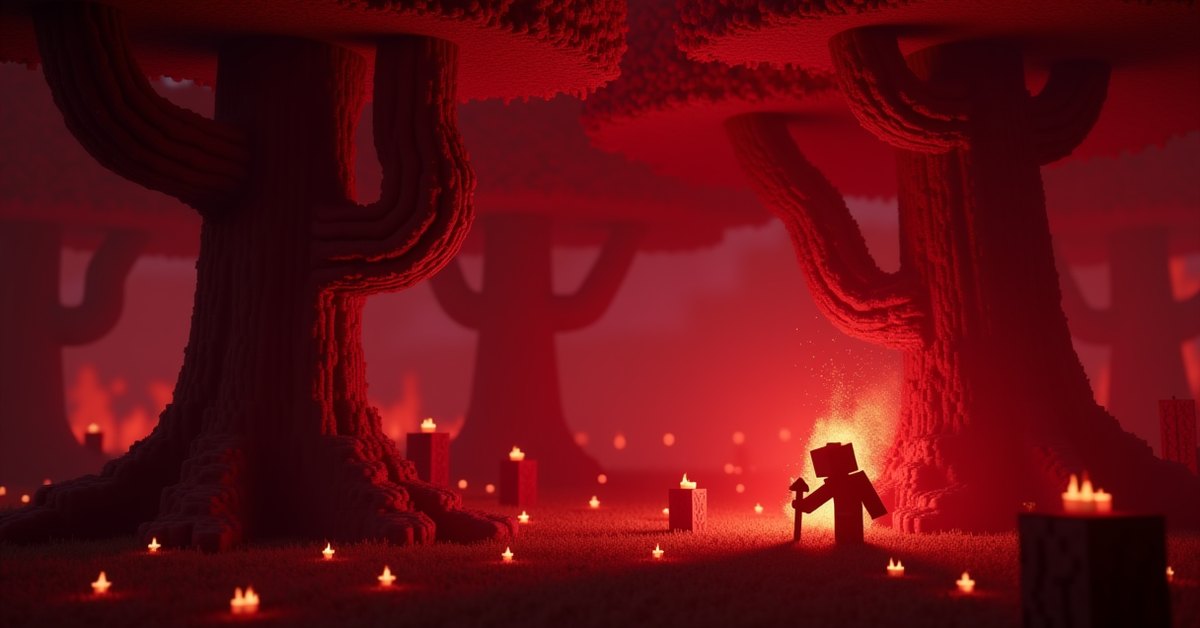
The nether wart block is a decorative block in Minecraft made from compacted nether wart. It has a dense, clumpy red texture that looks like a giant ball of overgrown vegetation, and it shows up most often in the Nether as the “leafy” part of large crimson trees.
Even though the name has “nether wart” in it, the block does not grow nether wart and does not act like a crop. It is a storage and decoration block, similar to how iron blocks store iron ingots or hay bales store wheat.
If you have a stack of nether warts collected from nether fortresses or your own soul sand farm, a nether wart block is the simplest way to compress them down for storage or to use them in a build that needs a strong red color.
Visually, you can tell a nether wart block apart from netherrack or red wool at a glance. The texture has irregular bumps and shading that read as wet, organic vegetation rather than rock or fabric. That detail is part of why builders reach for it instead of red concrete when they want a more “alive” look on a wall or roof.
How to craft the nether wart block
Crafting is simple. Fill all nine slots of a crafting table with nether wart. The result is one nether wart block.
You can reverse the recipe as well. Place a single nether wart block in the crafting grid and you get nine nether warts back. There is no loss in either direction, which makes the block a clean way to store excess wart between trips to the Nether.
You cannot craft a nether wart block from any other ingredient. Only the wart item works, and you need exactly nine.
What you need
- 9 nether warts
- 1 crafting table
If you don’t have a nether wart farm yet, the fastest way to get a stack is to raid soul sand patches in a nether fortress. Each plant gives 2 to 4 warts when harvested at full growth.
Where to find nether wart blocks in the Nether
Nether wart blocks generate naturally inside crimson forests, one of the biomes added with the Nether Update in version 1.16. The biome is filled with crimson nylium on the floor and huge crimson “trees” that have crimson stem trunks topped with thick clusters of nether wart blocks. These clusters can run dozens of blocks across at the canopy, with shroomlights scattered through them.
If you find a crimson forest, you basically have an infinite supply. A few minutes with a hoe will fill several stacks. Bring a fire-resistance potion or stay alert for hoglins, since the biome is dense with mobs.
You can also find smaller pockets of the block in bastion remnants, especially in the treasure-room style. Those are rare, so the crimson forest is the practical source for most players.
Outside the Nether, the block does not generate naturally. Anything you place in the Overworld or the End has to be brought in by hand or crafted from wart.
Mining and tool efficiency
A hoe is the right tool for nether wart blocks. With any tier of hoe, the block breaks fast enough to mine in bulk without slowdown. With a diamond or netherite hoe, you can instamine entire trees in seconds.
You can also break the block with your bare hand or any other tool, but the mining time is noticeably slower. Without a hoe, expect roughly one second per block. With a netherite hoe and Efficiency V, you can clear hundreds in a single farming trip.
The block always drops itself when mined, no matter the tool. There is no need for Silk Touch. There is also no Fortune bonus.
Stats at a glance
- Hardness: 1
- Blast resistance: 1
- Best tool: hoe (any tier)
- Renewable: yes (via crafting from nether wart)
- Stackable: yes, up to 64
Mechanics and properties
The nether wart block has a few quiet quirks that are useful to know before you build with it.
It is not flammable. You can place it next to lava or in a burning section of the Nether without losing the block to fire. That makes it safer to use as a decorative element in the Nether than wool or wood.
Pistons can push and pull it normally, so it works in moving builds and redstone contraptions.
The block produces a soft, muffled sound when broken or stepped on, closer to wool than to stone. If you walk across a wide platform of nether wart blocks, your footsteps are noticeably quieter than they would be on netherrack.
It cannot be used as a beacon base. The valid materials for beacon bases are iron, gold, diamond, emerald, and netherite blocks. Wart blocks of either color are not on the list.
It does not catch fire, so it is also safe to place next to a campfire or soul campfire.
The block does not emit any light on its own. If you want a glow effect in a build that uses nether wart blocks, embed shroomlights, glowstone, or sea lanterns inside the structure. That same trick is what the natural crimson “trees” use, since shroomlights are baked into the canopy when the biome generates.
Redstone components treat the block as a regular solid full cube. You can place a redstone torch on the side, run a wire across the top, and use it as part of any standard circuit.
Common uses in builds
Decoration is the obvious reason to keep nether wart blocks around. The deep red is one of the few strong reds available in vanilla Minecraft, and it reads well against grays, blacks, and warm woods.
Builders often use the block for things like:
- Demonic or hellish themed builds, especially castles and shrines
- Trees and foliage in non-natural biomes, like a “dead” forest in the Overworld
- Coral-style undersea structures, where the texture reads as a reef
- Custom roofs that need a clay-tile look
- Magma or lava-themed flooring inside a Nether base
The block also works as compact storage for nether wart. If you have a fortress farm and the wart starts piling up, converting it to blocks saves chest space at a nine-to-one ratio. When you need wart for brewing awkward potions, you uncraft a block and you are back to nine.
Nether wart block vs. warped wart block
The Nether Update added a second variant called the warped wart block. It has the same shape, but blue-green instead of red, and it generates as the canopy of warped forests in place of the crimson version.
The two blocks behave almost identically. Both are non-flammable, both have hardness 1, and both are broken fastest with a hoe. The main difference is how you obtain them.
- The nether wart block can be crafted from 9 nether warts.
- The warped wart block cannot be crafted from anything in vanilla Java or Bedrock. You can only get it by mining it in a warped forest, by taking it from the creative inventory, or by using commands.
If a build needs the blue color, plan accordingly. You either need to find a warped forest or set up a fast transport route from one to your base.
Java and Bedrock differences
For most players, the block behaves the same on both editions. Crafting works the same way, the natural generation in crimson forests works the same way, and a hoe is the best tool on both.
The one small note is that Bedrock has historically had minor changes to mining speed values, so the exact break time per tool tier can differ slightly. In practice you will not notice unless you are speedrunning. Both editions allow the reverse craft from block back to nine nether warts.
Frequently asked questions
Can you grow nether wart on a nether wart block?
No. Nether wart only grows on soul sand. The nether wart block is purely decorative and storage. Placing a nether wart item on top of the block will not plant it.
Does the nether wart block burn?
No. The block is non-flammable. Lava, fire, and other burning blocks will not destroy it, which is one reason builders like it for Nether-themed structures.
Can you use nether wart blocks as a beacon base?
No. Only blocks of iron, gold, diamond, emerald, and netherite count as valid beacon base material. Wart blocks of either color are excluded.
What is the fastest way to mine large quantities?
Use a netherite hoe with Efficiency V. With that setup, most wart blocks break in a single tick, so you can clear an entire crimson tree canopy in seconds. Bring a Mending or Unbreaking hoe so durability stays manageable.
Does the nether wart block stack?
Yes, up to 64 per slot, like most full blocks.
Can you turn a nether wart block back into 9 nether warts?
Yes. Place a single nether wart block in any crafting grid slot and the output is 9 nether warts. The recipe is reversible with no loss.
Is there a way to dye or recolor the block?
No. There is no dye recipe for it. If you want a blue version, use the warped wart block instead.
Does the nether wart block emit light?
No. The block has a light level of 0. The warm glow you see in a crimson forest comes from nearby shroomlights and lava, not from the wart blocks themselves.
Can piglins or hoglins damage the block?
No. Hoglins and piglins do not break or interact with the nether wart block. The main danger when harvesting is the mobs themselves, not anything they do to your loot.
Final thoughts
The nether wart block is a small but useful piece of the Nether Update. Treat it as your default red building block, your storage solution for piled-up wart, and your free canopy material when you raid a crimson forest. A hoe and a free afternoon will give you more than you can carry.