What is the orange tulip?
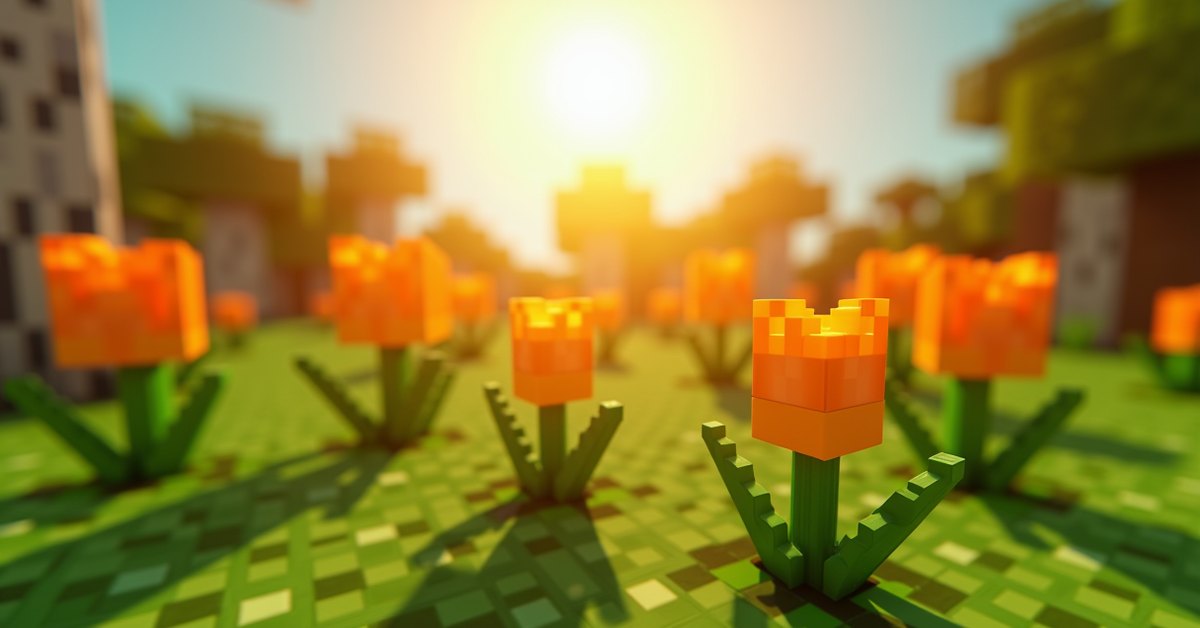
The orange tulip is one of the small flowers that grow wild in Minecraft. It is exactly what the name describes: a single green stem topped with a cup-shaped orange bloom, standing one block tall. It is part of the tulip family, which comes in four colors.
If you searched for it, you probably want one of two things. Either you need orange dye and saw that a tulip is listed as an ingredient, or you found one in the wild and want to know what it does. Both answers are below.
Tulips were added in Java Edition 1.7.2, the update that reworked terrain generation and introduced a wave of new plants. They have stayed mostly the same ever since.
The four tulip colors
Minecraft has four tulips: red, orange, white, and pink. They share a model and behave the same way in almost every respect. The one practical difference is the dye each produces. A red tulip makes red dye, an orange tulip makes orange dye, a white tulip makes light gray dye, and a pink tulip makes pink dye.
This matters when you go flower hunting. All four colors often grow side by side in the same field, so it is easy to scoop up a handful without checking colors and come away short on the one you actually need. If orange dye is the goal, look closely before you harvest.
Where to find orange tulips
Orange tulips do not appear in every biome. The one that matters most is the flower forest, a rare variant of the forest biome filled with flowers of almost every type. It is the most reliable place to see all four tulip colors growing together in large clusters. Flower forests are uncommon, so locating one can take a fair bit of exploring, but a single trip usually nets you all the tulips you will ever need.
Tulips also show up in plains biomes, but plains lean heavily toward dandelions and poppies, so a tulip there is more of a lucky find than a dependable source. The meadow biome, which generates high in mountain regions, can grow tulips as well.
Wherever they grow, tulips sit on grass blocks and dirt in open, well-lit spots. Small flowers need a light level of 8 or higher, so you will only ever see them out under the sky, never deep underground.
How to get orange tulips
Picking them by hand
The simplest method is to walk up to a tulip and break it. Flowers have no hardness, so one hit with any tool, or with an empty hand, knocks the tulip loose and drops it as an item. You do not need shears, and the flower never breaks into anything other than itself.
Duplicating one with bone meal
Once you have a single orange tulip, you can turn it into a stack. Place the tulip on a grass block, then use bone meal on the flower itself. It drops an exact copy. Repeat as often as you want. This is the fastest way to build up a supply, and it means one starter tulip is all you ever need to find.
Bone meal on grass blocks
Using bone meal directly on a grass block makes flowers and tall grass sprout on the grass blocks around it. The flowers you get depend on the biome. Inside a flower forest, this can produce tulips of every color, which makes it a quick way to gather them in bulk. In a plains biome the same trick mostly returns dandelions and poppies, so it is far less useful for tulip farming there.
What orange tulips are used for
Crafting orange dye
Dye is the reason most players look up the orange tulip. Place one orange tulip anywhere in the crafting grid, with nothing else, and it becomes one orange dye. There is no recipe shape to learn and no second ingredient.
Orange dye colors a long list of blocks and items, including wool, carpet, beds, banners, candles, terracotta, stained glass, concrete powder, and leather armor. It also works on a few mobs, such as dyeing a sheep so it grows orange wool. Beyond plain coloring, orange dye is an ingredient for firework stars, which lets you tint a fireworks burst orange, and it feeds into the recipe chain for orange glazed terracotta.
There is a second recipe for orange dye that uses one red dye plus one yellow dye. If you have flowers nearby, the tulip route is simpler, since a single flower gives you the finished dye in one step.
Suspicious stew
Tulips are one of the flowers that can be cooked into suspicious stew. Place a bowl, a red mushroom, a brown mushroom, and an orange tulip in the crafting grid, and the result is a suspicious stew that grants a brief Weakness effect when eaten. All four tulip colors produce the same Weakness stew.
Weakness lowers your melee attack damage, so this is not a stew to eat before a fight. It does have one real use, though: Weakness is one of the two items needed to cure a zombie villager, the other being a golden apple.
Feeding a brown mooshroom
There is a renewable way to get that same stew. If you track down a brown mooshroom, you can feed it any small flower, an orange tulip included. Once it has eaten a flower, milking the mooshroom with an empty bowl gives you a suspicious stew carrying that flower’s effect. It is a steady source of Weakness stew that does not eat into your mushroom supply.
Decoration and flower pots
An orange tulip drops straight into a flower pot. Use the tulip on an empty pot and you get a potted orange tulip, a small splash of color for a windowsill, a shelf, or an interior build. Tulips also work well as ground cover, planted in rows or scattered through a garden. Because they only take up the top of a single block, they fit into tight builds where a taller plant would not.
Composting and bees
Put an orange tulip in a composter and it has a 65 percent chance of raising the compost level by one. That is the standard rate for plant items, so spare tulips are a fine thing to feed a composter when you are stocking up on bone meal.
Bees treat tulips the way they treat any flower. A bee will fly over to an orange tulip, collect pollen, and carry it back to its hive or bee nest. Planting tulips and other flowers near a hive helps bees fill it with honey faster.
Tips and common mistakes
A few things commonly trip players up with tulips:
- Check the color before you harvest. Orange and red tulips look alike at a glance, and grabbing the wrong one leaves you with the wrong dye color.
- Skip the shears. Flowers always drop themselves, so shears do nothing useful for tulips. Save them for grass, ferns, and leaves.
- Watch the light level on placed tulips. A tulip set down in a dim room or a shaded corner will pop off and drop as an item, because small flowers need a light level of 8.
- Build a duplication patch. Rather than roaming the map for more flowers, place one tulip and farm copies with bone meal. It is faster and it never runs out.
- A flower forest is worth the trip. If you cannot find tulips anywhere, locate a flower forest biome, where every tulip color grows in quantity.
Frequently asked questions
What biome has orange tulips?
The flower forest is the best biome for orange tulips, because it grows all four tulip colors in large numbers. Plains and meadow biomes can grow them as well, but much less reliably.
How do you make orange dye from a tulip?
Place a single orange tulip into any slot of the crafting grid. It converts to one orange dye, with no other ingredients required.
Can you grow orange tulips with bone meal?
Yes, in two ways. Use bone meal on a placed orange tulip to duplicate it, or use bone meal on grass blocks in a flower forest to make new tulips sprout nearby.
Do orange tulips stack?
Yes. Orange tulips stack up to 64 in one inventory slot, the same as most flowers and plant items.
What effect does an orange tulip give in suspicious stew?
It gives a brief Weakness effect. Every tulip color produces the same result, so red, white, and pink tulips all behave identically in stew.
Can you put an orange tulip in a flower pot?
Yes. Use the tulip on an empty flower pot to create a potted orange tulip for decoration.
Are orange tulips rare?
They are uncommon in most biomes but plentiful in a flower forest. Once you have one, bone meal duplication removes any scarcity, since a single tulip can be copied without limit.
Conclusion
The orange tulip is a small plant with one job most players care about: it turns into orange dye in a single crafting step. Past that, it serves as decoration, bee food, and a stew ingredient. Find a flower forest, take one tulip home, and a small bone meal patch will keep you stocked with orange dye for as long as your world lasts.