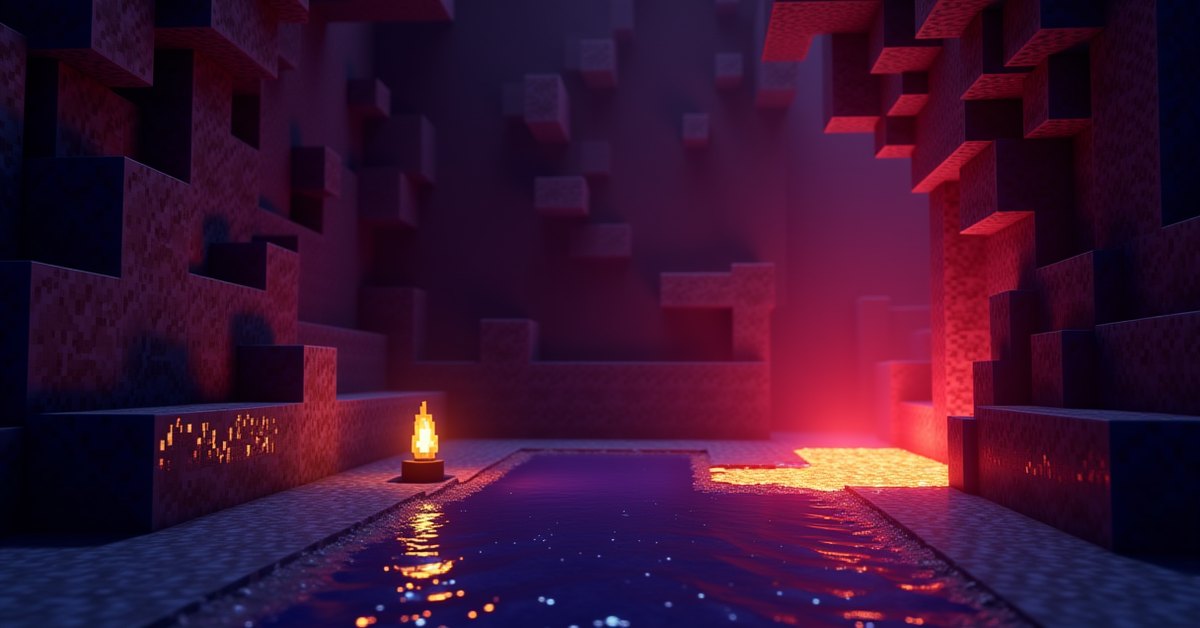
What obsidian is
Obsidian is a dark purple block that forms when flowing water touches a still lava source. It’s one of the hardest blocks in the game, with a blast resistance of 1,200, which is enough to shrug off creeper explosions and TNT. The only common thing that breaks it is a wither’s blue skull attack.
You can’t craft obsidian on a workbench. You either find it in the world, generate it with water and lava, or buy it from a cleric villager. Once placed, it stays put. Pistons can’t push it, fire won’t burn it, and lava can’t melt it down.
Most players first meet obsidian when they need to build a Nether portal. That’s only the start of what it’s good for.
How to get obsidian
Make it with water and lava
The reliable method: pour a water bucket onto a lava source block. The lava block turns into obsidian on the spot. Flowing lava doesn’t count. You need the still source.
The easiest setup is to find a surface lava pool, scoop up a water bucket, and stand on solid ground above the pool. Place the water so it flows across the lava. Each source block becomes obsidian. Mine the obsidian before refilling your bucket, because the water will get in your way.
If you’re working from a single lava bucket, build a small mold out of cobblestone, pour the lava into the hole, then pour water on top. This is called a lava cast and it’s how most players get their first 10 obsidian for a portal.
Find it in the world
Obsidian generates naturally in a few places:
- Around exposed lava lakes near bedrock, where flowing water has already met the lava.
- Inside ruined portals in the Overworld and the Nether. These structures often have obsidian, crying obsidian, and gold blocks scattered around them.
- Around some end city corridors and on the central End island, which has 10 obsidian pillars holding the ender crystals that heal the ender dragon.
- The exit portal that spawns after defeating the dragon is framed with bedrock, but the structure around it sits on a small platform of obsidian-adjacent blocks.
If you’re early game and haven’t found diamonds yet, ruined portals are the fastest source of free obsidian. You can pry blocks off the frame with a diamond pickaxe later if you can’t mine them now. The Nether-side ruined portals tend to have more loose obsidian around them than the Overworld ones, and they’re easier to reach once you’ve made your first portal.
Buy it from a villager
Novice cleric villagers sometimes offer obsidian for emeralds. The trade isn’t guaranteed, but when it shows up, the rate is roughly one emerald per obsidian. If you have a stack of emeralds and a working cleric nearby, this is a clean way to get obsidian without ever swinging a pickaxe.
How to mine obsidian
Obsidian needs a diamond or netherite pickaxe. A stone or iron pickaxe will break it eventually, but you won’t get the block. The break animation runs and nothing drops. This is the most common newbie mistake with obsidian.
Mining time at full speed:
- Diamond pickaxe: about 9.4 seconds per block.
- Netherite pickaxe: about 8.4 seconds per block.
- Add Efficiency V and a Haste II beacon and you’re down to a fraction of a second per block.
For a one-off Nether portal, raw diamond mining is fine. If you’re stripping an old base or an entire pillar, set up Efficiency and Haste before you start, or you’ll watch the same animation hundreds of times.
Obsidian has a hardness of 50, which is why it’s so slow. Most other late-game blocks sit between 1.5 and 5.
For long obsidian-mining sessions, an Unbreaking III diamond pickaxe stretches your durability much further than a plain one. If you have a Mending book and an XP farm nearby, a Mending pickaxe will basically pay for itself while you mine, since obsidian doesn’t drop XP but you can keep the pickaxe topped up between trips.
What obsidian is used for
Nether portals
The classic use. A working portal needs an obsidian frame at least 4 wide by 5 tall, with the inside open. That’s 10 obsidian if you skip the corner blocks, or 14 if you fill them in. Light the inside with flint and steel and the portal opens.
You can build portals up to 23 wide by 23 tall. Bigger portals look impressive but behave the same way as a minimum portal. A mob walking through still ends up at the same coordinates in the Nether.
Crafting recipes
Several important items use obsidian:
- Enchanting table: 4 obsidian, 2 diamonds, 1 book.
- Ender chest: 8 obsidian and 1 eye of ender.
- Beacon base: a 3×3 platform under the beacon made of any combination of obsidian, iron, gold, diamond, emerald, or netherite blocks. Obsidian is the cheapest option.
Respawn anchors need crying obsidian, which is a separate block. You can find crying obsidian in ruined portals or barter for it from piglins. Regular obsidian won’t substitute for crying obsidian in that recipe.
Defensive building
Obsidian’s blast resistance makes it the default block for explosion-proof builds. A creeper next to an obsidian wall does no damage to the wall. TNT cannons can’t punch through it. End crystals can’t break it either, which is why obsidian is the standard PvP base material on multiplayer servers.
One catch: the wither boss can break obsidian by ramming into it or hitting it with its blue skulls. A wither cage built out of pure obsidian doesn’t work. You need bedrock for that, and bedrock isn’t a placeable block in survival.
How obsidian behaves
A few behavior notes that come up often:
- Pistons can’t push or pull obsidian. It’s on the same list as bedrock for that.
- Endermen can pick up most solid blocks but not obsidian.
- Obsidian doesn’t catch fire and doesn’t transfer heat. You can place it right next to lava without worry.
- Mobs treat obsidian like any other full block. They can walk across it and spawn on top of it under normal light conditions.
- It’s not transparent. Light doesn’t pass through it. Build a wall of it and the back side will be dark.
Java vs. Bedrock differences
Obsidian behaves the same way across both editions for almost everything. Mining time, blast resistance, recipe ingredients, and piston interaction all match. The small differences come down to particle counts on crying obsidian (Bedrock shows fewer drip particles by default) and minor rounding in mining-speed math (the gap is fractions of a second per block). If you’ve learned the block on one edition, you know it on the other.
The one place to double-check is the wither fight. Both editions let the wither’s blue skull projectiles break obsidian, but Bedrock has slightly different explosion mechanics on the wither’s spawn animation. If you’re building an obsidian-walled arena, leave a bit of extra room either way.
Tips and common mistakes
- Don’t try to mine obsidian with iron. The animation completes and you get nothing. Always use diamond or netherite.
- Carry a water bucket when you’re mining obsidian near lava. The block under it is often lava, and one misstep ends your run.
- If you make obsidian by flooding a lava lake, mine each block before the water reaches the next one. Otherwise you end up with cobblestone or stone where you wanted obsidian.
- For Nether portal builds, count to 10 before you start. The math is 4 wide by 5 tall minus the corners. Skipping the corners saves you four blocks.
- Watch your fall path. People die more often falling into lava while collecting obsidian than during any other mining activity.
Frequently asked questions
Can you craft obsidian?
No. There’s no recipe. You either generate it from water and lava, mine it from natural sources, or buy it from a cleric villager.
What pickaxe do you need for obsidian?
Diamond or netherite. Iron and lower won’t drop the block. Gold doesn’t work on obsidian at all.
Can creepers or TNT break obsidian?
No. Obsidian has a blast resistance of 1,200, which is far above what any standard explosion produces. Only the wither boss can break it under normal conditions.
How much obsidian does a Nether portal need?
A minimum of 10 blocks for a 4-by-5 frame with the corners removed. With the corners included, it’s 14 blocks. Both light up the same way.
Can pistons push obsidian?
No. Obsidian is on the same list of unmovable blocks as bedrock, ender chests, and a few others.
What is crying obsidian and is it the same thing?
Crying obsidian is a separate block. It looks purple with dripping particles and is used to craft respawn anchors. Regular obsidian won’t substitute for crying obsidian in any recipe.
Does obsidian burn?
No. Fire and lava have no effect on it. You can use obsidian as a hearth, a lava channel wall, or a roof for a Nether base without worrying about fire spread.
Can mobs spawn on obsidian?
Yes. Obsidian counts as a normal opaque full block, so hostile mobs can spawn on top of it if the light level is low enough. The block itself doesn’t prevent spawning. If you want a dark base wall that mobs can’t camp on, light the top surface or cap it with a slab.
Can endermen pick up obsidian?
No. Obsidian is on the short list of blocks endermen never carry. They can still teleport on and around it like any other surface, but the block stays where you put it.
Where it fits in the bigger picture
Obsidian sits at the top of the practical-block tier. It isn’t the rarest material in the game, but it’s the most useful tough block. Every late-game project, whether a beacon array or an ender chest network, eventually leans on it. Stock a double chest of it if you plan to play long.