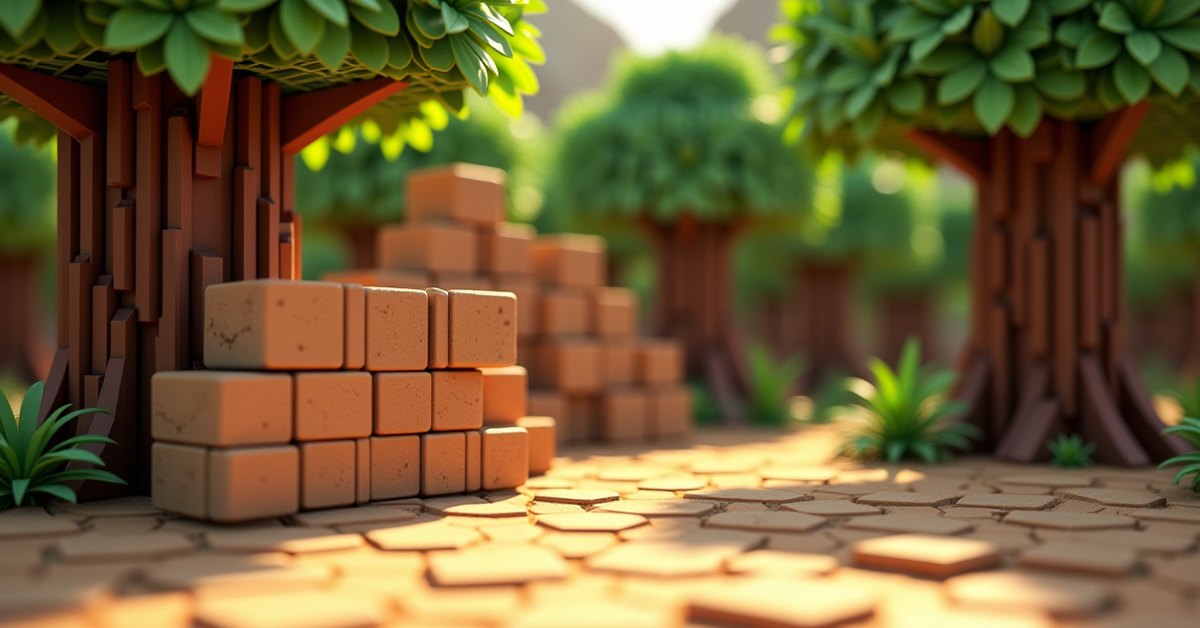
What is packed mud?
Packed mud is a building block made by combining a block of mud with wheat. It looks like dried, cracked earth, and it behaves like a normal solid block, so you can walk and build on it without sinking the way you do on plain mud.
Most players meet packed mud for one reason: it’s the first step toward mud bricks. If you’ve ever wanted the warm, sandy look of an adobe house without hauling sandstone across the map, packed mud is the block that gets you there.
This guide covers how to make packed mud, where to get the mud you need, what the block is good for, and the mistakes that trip people up.
Where packed mud comes from
Packed mud arrived in the 1.19 Wild Update, the same release that added mangrove swamps, frogs, and the mangrove tree. It’s a crafted block, so it never generates naturally in the world. If you want some, you have to make it.
The block has a flat, light-brown texture with shallow cracks running through it, like soil that has dried out in the sun. It’s a full opaque cube, and it stays put once placed. It won’t fall the way sand and gravel do.
Because it’s craft-only, packed mud counts as a renewable block as long as you keep a wheat farm going and have a source of dirt or mud. There’s no mining trip and no rare ingredient involved, which is part of what makes it so cheap to build with at scale.
How to make packed mud
Packed mud needs two ingredients: one block of mud and one piece of wheat. The recipe is shapeless, so you can drop both items anywhere in the crafting grid. Each craft gives you one packed mud.
Wheat is the easy half. Grow it from wheat seeds on farmland, or trade for it with a farmer villager. Mud is the part worth planning for.
Getting mud
There are two ways to get mud. The first is to find it. Mud covers the ground across mangrove swamp biomes, so if you have one within reach, you can dig up stacks of it with a shovel in a few minutes.
The second way works anywhere. Fill a glass bottle with water to make a water bottle, then use that water bottle on a dirt block. The dirt turns into mud, and you get the empty bottle back to use again. Coarse dirt and rooted dirt convert the same way. This method means you never have to travel to a swamp if you’d rather not.
Worth knowing before you start: mud is a soft block. You sink a small amount into it when you walk across it, and it makes a wet squelching sound. That’s normal, and it’s exactly the property that packing the mud removes.
Crafting the block
Once you have mud and wheat, open a crafting table. Your 2×2 inventory grid works too, since the recipe is shapeless and only uses two items. Place one mud and one wheat, then take the packed mud out. Repeat for as many as you need.
Wheat farms cheaply in bulk, so the real limit on how much packed mud you can produce is how much mud you can gather or convert.
Packed mud vs mud: the difference
Because the names are so close, players mix these two blocks up constantly. They’re related, but they don’t behave the same way.
Mud is the raw block. It’s soft and slightly darker, and you sink a fraction of a block into it when you stand on it, which slows you down and makes a wet sound. Mud has one other trick: placed directly above a downward-pointing dripstone, it slowly dries into clay, which turns clay into a renewable resource.
Packed mud is what you get when you firm that mud up with wheat. It’s a normal solid block. You stand on top of it at full height, and it works in builds exactly like stone or planks. The trade-off is that packed mud is a one-way street. You can’t convert it back into mud, and you can’t use it for the clay trick.
What packed mud is used for
Packed mud has two jobs. It’s a building block on its own, and it’s the gateway to the mud brick family.
As a standalone block, packed mud gives you a muted, earthy color that suits desert builds, farmhouses, weathered ruins, and anything going for a natural look. It sits well next to mangrove wood, terracotta, and sandstone, so it slots into a lot of palettes without clashing.
The bigger use is mud bricks. Place four packed mud in a 2×2 square in the crafting grid and you get four mud bricks. From mud bricks you can craft the full set of building shapes:
- Mud brick stairs
- Mud brick slabs
- Mud brick walls
That gives you a complete building palette starting from nothing but dirt, water, and wheat. For players who don’t live near a desert, it’s the cheapest route to a sandstone-style look, and none of it costs a single block of stone.
For build ideas, packed mud and mud bricks work well for pyramids, sun-baked village huts, dried riverbed paths, and crumbling ruins. Using both blocks side by side gives you two tones in the same earthy family, so a wall can read as worn brick in one spot and bare dried clay in another without you ever leaving the mud palette.
How packed mud behaves
Packed mud is simple to build with, and a few properties are worth knowing before you commit to it.
It breaks quickly and always drops itself, whatever tool you use, so you’ll never lose a block by mining it with the wrong thing. A pickaxe clears it fastest when you’re taking down a large structure.
It doesn’t catch fire and won’t carry flames, which makes it a safe pick for builds near lava, campfires, or anywhere fire could spread.
It’s a full, solid cube, so it supports torches, redstone dust, rails, and anything else that needs a flat top. Hostile mobs can spawn on it in the dark, the same as on stone or dirt, so light your builds properly.
One limit to keep in mind: you can’t till packed mud into farmland, and you can’t turn it back into mud or dirt. Once it’s packed, it stays that way.
Tips and common mistakes
The most common mistake is forgetting the wheat. Players see “mud” in the name and assume packed mud is just mud that’s been squashed together. It isn’t. Without wheat, there’s no recipe at all. Keep a small wheat farm running if you plan to build with packed mud or mud bricks.
Another one is gathering mud the slow way. Converting dirt a block at a time with a water bottle works fine, but if there’s a mangrove swamp within reach, a few minutes of shoveling there will out-produce the bottle method by a wide margin. Bring a shovel with Efficiency if you have one.
If you only care about mud bricks, remember you still have to make packed mud first. No recipe skips straight from mud to mud bricks. Plan the two-step chain: mud and wheat into packed mud, then packed mud into mud bricks.
Last, don’t confuse packed mud with mud bricks when you’re stocking up for a build. They’re different blocks with different textures. Packed mud has the plain dried-earth look, while mud bricks show a visible brick pattern.
Frequently asked questions
How do you make packed mud in Minecraft?
Combine one block of mud with one piece of wheat in the crafting grid. The recipe is shapeless, so placement doesn’t matter. Each craft produces one packed mud.
Can you make packed mud without wheat?
No. Wheat is a required ingredient. Mud on its own won’t craft into anything. If you’re out of wheat, grow some from seeds or trade for it before crafting.
Where do you get mud for packed mud?
Dig it up in mangrove swamp biomes, or make it anywhere by using a water bottle on a dirt block. Coarse dirt and rooted dirt work as well. Both methods give the same mud.
Can you find packed mud naturally?
No. Packed mud doesn’t generate anywhere in the world, including villages and other structures. The only way to get it is to craft it yourself.
Does packed mud need a pickaxe to mine?
No. Packed mud drops itself whatever you break it with, including your bare hand. A pickaxe only breaks it faster.
Can you grow crops on packed mud?
No. A hoe won’t turn packed mud into farmland, so crops won’t grow on it. Use dirt or grass blocks for farming.
Is packed mud the same as mud bricks?
No. Packed mud is the intermediate block. Four packed mud crafted together make four mud bricks, which have a different texture and lead to the stair, slab, and wall set.
How much packed mud do you need for mud bricks?
The ratio is one to one. Four packed mud craft into four mud bricks, so a full stack of 64 packed mud yields 64 mud bricks.
If you’re building anywhere without easy access to sandstone, packed mud is one of the best-value blocks in the game. A small wheat farm and a stack of dirt will keep you in mud bricks for as long as you want them, and that warm, dried-earth color is tough to get from any other block.