What is polished granite?
Polished granite is the smoothed version of granite, one of Minecraft’s three igneous stone types. Where rough granite has a coarse, heavily speckled face, polished granite has a cleaner surface with a tighter pattern and a warm pink color. It is a pure building block, so its whole job is to look good in floors, walls, and trim.
You will not dig polished granite out of the ground. It exists only when a player makes it. Granite is the raw material, and you turn that granite into the polished version at a crafting table or a stonecutter.
The block uses the ID minecraft:polished_granite. It behaves like ordinary stone in nearly every way, which makes it predictable and safe to build with.
How to make polished granite
There are two ways to polish granite, and both give the same result. Which one you pick depends on how much granite you have and whether you mind a bit of waste.
The crafting table recipe
Place four granite blocks in a 2×2 square in the crafting grid. That gives you four polished granite. The recipe is a flat one-to-one trade: four granite in, four polished granite out. Because the pattern is only 2×2, it also fits the small crafting grid in your inventory, so you can polish granite without setting down a crafting table.
The recipe is not shapeless, but the 2×2 square can sit in any corner of a larger grid, so placement is forgiving. The one limit is that you must work in groups of four.
Using a stonecutter
A stonecutter turns one granite into one polished granite with a single click. The ratio matches the crafting table, but the stonecutter has a real advantage: it handles odd numbers. If you have seven granite and want seven polished granite, the crafting table forces you into groups of four, while the stonecutter cuts each block on its own with nothing left over.
The stonecutter also skips the recipe pattern. Drop granite into the slot, pick the polished granite option from the menu, and pull out the result. For most builders this is the faster and cleaner choice, and it is worth keeping a stonecutter near any large project.
Where granite comes from
Since polished granite is always crafted, the real question is where to find granite. Granite generates underground throughout the Overworld in large blobs mixed into ordinary stone. You will run into it at most mining depths, and it appears on the surface in mountains and rocky areas wherever stone is exposed.
Granite is common. A normal mining trip usually leaves you with a stack or more without any effort. If you want granite on purpose, dig a branch mine at a mid-level depth and you will cut through several veins of it.
You can also craft granite from scratch if you would rather not mine. One diorite plus one Nether quartz makes one granite. Diorite in turn comes from two cobblestone and two Nether quartz. That route costs quartz, so mining is cheaper unless you already have quartz to spare from a trip to the Nether.
What polished granite does
Polished granite is a full, solid block with no special behavior. Its hardness and blast resistance match stone, so creeper blasts and TNT damage it at a normal rate. It is not a true blast shield like obsidian, but it holds up as well as most of the stone you would build with anyway.
You mine it with a pickaxe. Any tier works, though stone or better is fast. Mining it with your hand or the wrong tool destroys the block and drops nothing, so always swing a pickaxe at it. There are no rare drops and no reason to use Silk Touch or Fortune, since the block just drops itself.
Pistons can push and pull polished granite, it does not catch fire, and mobs walk on it like any other ground. Because it is a regular opaque block, redstone dust and components sit on top of it and against it exactly as they do on stone.
Building with polished granite
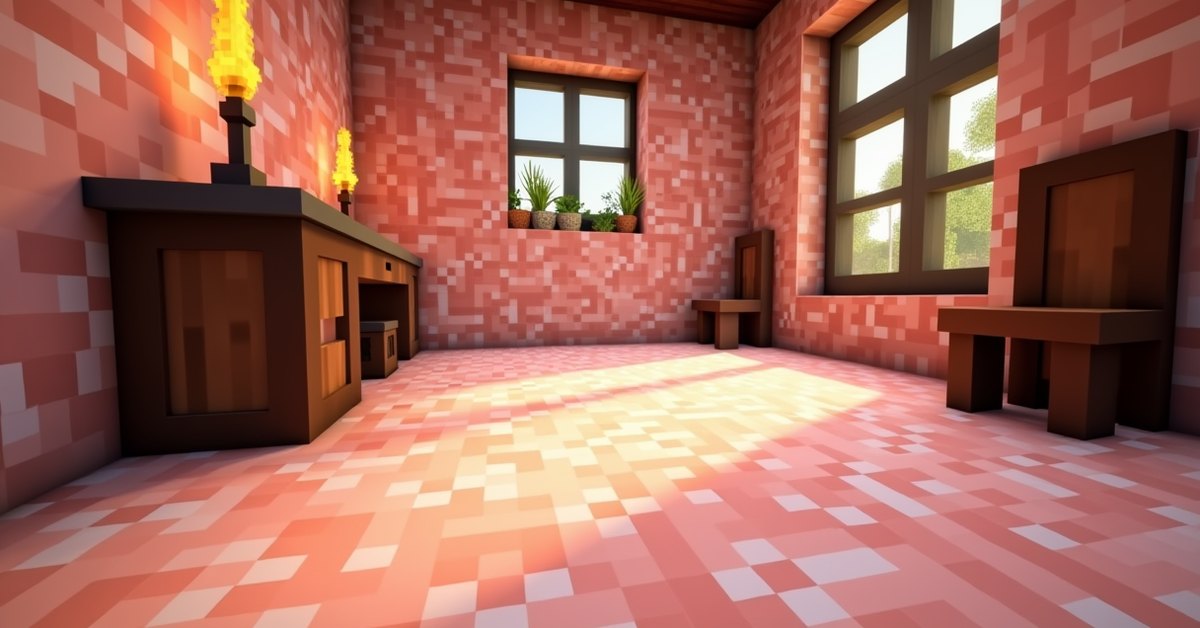
Polished granite reads as warm pink with faint gray and white flecks. That color is what sets it apart from its relatives, and it is the main reason to choose it. If your palette is feeling cold, granite warms it up fast.
The smooth face works well as flooring, where the even pattern looks finished rather than rough. Builders also use it for accent walls, pillars, and the trim around windows and doors. It sits nicely against darker woods like dark oak and spruce, and it contrasts well with blackstone or deepslate.
One caution: a whole structure in nothing but polished granite can look flat, because the texture is so uniform. Break large surfaces up with stairs, slabs, and a second material so the wall has some depth and shadow.
Polished granite vs polished diorite and andesite
Minecraft has three igneous stones, and each one has a polished form. Polished granite is the warm option, with its pink tone. Polished diorite is near-white and reads cold and bright, close to snow or quartz. Polished andesite is a neutral gray that blends with stone and works as a default modern building block.
All three share the same hardness, blast resistance, and crafting pattern, so the choice between them is purely visual. Many builders mix them: andesite for the bulk of a wall, diorite for highlights, and granite for warmth. They are cheap, so testing a few blocks of each in place is the quickest way to decide.
Polished granite stairs and slabs
Polished granite has its own stairs and slab. Both are made from the polished block rather than raw granite, and both can also be cut on a stonecutter.
For stairs, six polished granite arranged in the standard stair shape yields four polished granite stairs. For slabs, three polished granite in a row yields six polished granite slabs. A stonecutter gives equal or better returns and lets you cut single pieces, which is handy when you need an exact count.
There is no polished granite wall. Walls in the granite family use plain granite instead, so if your build needs a granite wall, keep some unpolished granite on hand before you polish everything.
Tips and common mistakes
The most common mistake is mining granite without a pickaxe and getting nothing for it. Granite blends into the stone around it, so it is easy to forget which tool is in your hand. Keep a pickaxe equipped while you mine through stone.
The second is over-crafting. Polishing is a one-way trip. You cannot turn polished granite back into granite, so only polish what you plan to place. If you might want granite walls or the rough texture later, hold some raw granite back.
If you are gathering granite for a large build, lean on the stonecutter. Crafting in fours leaves awkward leftovers, while the stonecutter lets you polish the exact number of blocks the build calls for.
Last, do not confuse granite with red sandstone or terracotta when you plan a build. All three lean warm, but granite is stony and speckled while the other two are smoother and more even. Place a test block in daylight before you commit to a full wall.
Frequently asked questions
Does polished granite occur naturally?
No. Polished granite is only ever made by players. Regular granite generates underground in the Overworld, and the polished version is crafted from it at a table or a stonecutter.
How much granite do you need for polished granite?
Four granite makes four polished granite at a crafting table, a one-to-one ratio. A stonecutter also runs one-to-one and can polish a single block at a time.
Can you use polished granite as a beacon base?
No. Beacon pyramids only accept blocks of iron, gold, emerald, diamond, or netherite. Polished granite will not power a beacon no matter how you stack it.
Can you turn polished granite back into granite?
No. Polishing is permanent. There is no recipe that reverses it, so decide how much granite you want to keep rough before you craft.
Is polished granite blast resistant?
It has the same blast resistance as stone. It survives a creeper hit about as well as a normal stone wall, but it is not a dedicated blast-proof block like obsidian.
What is the difference between granite and polished granite?
The difference is appearance. Granite has a rough, heavily speckled face, while polished granite has a smooth, even surface with a subtle pattern. Their hardness and blast resistance are identical.
Can you make stairs and slabs from polished granite?
Yes. Polished granite stairs and polished granite slabs are both craftable from the polished block, or cut from it on a stonecutter. There is no polished granite wall, so walls use plain granite.
What version added polished granite?
Granite and its polished form arrived in Java Edition 1.8, the update that introduced all three igneous stones. Polished granite stairs and slabs came later, in version 1.14. Both forms have been in the game for years and work on every current version.
Polished granite is a quiet, dependable building block. It costs almost nothing once you have granite, and a stonecutter turns the job into a few clicks. If your builds tend to come out gray, a floor or accent wall of polished granite is one of the easiest ways to give them some warmth.