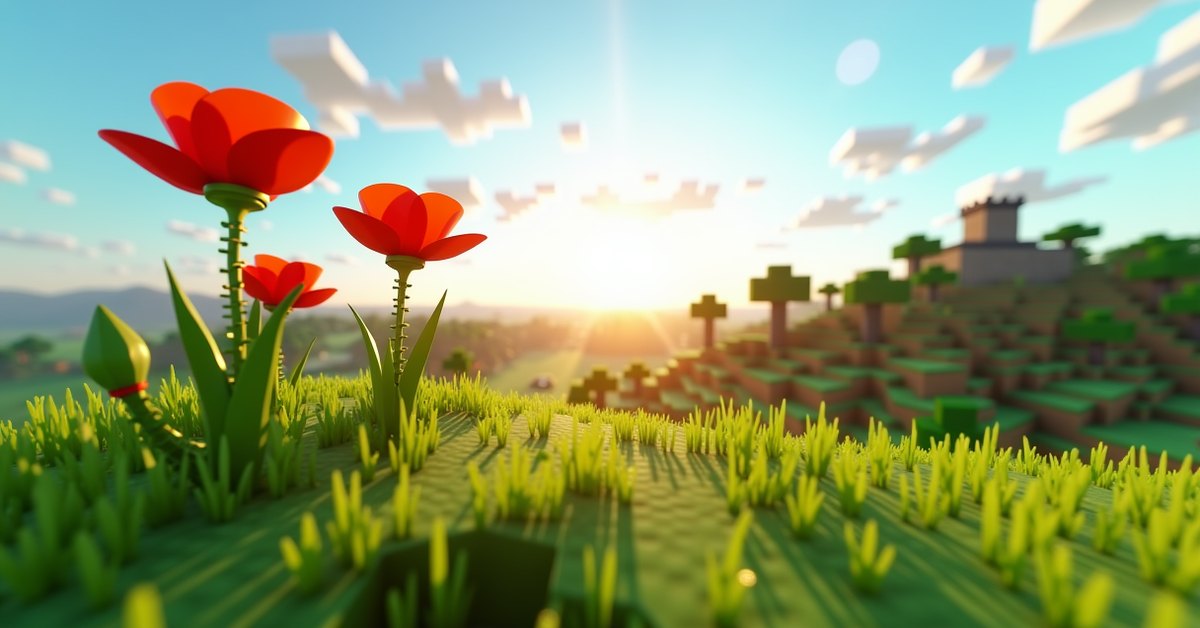
What a poppy is in Minecraft
The poppy is a small red flower that grows wild across much of the Minecraft overworld. It stands one block tall, sits flat on the ground, and you can walk straight through it without slowing down. It deals no damage and blocks no movement, so it works as pure decoration or as a crafting ingredient.
If you have played Minecraft for a long time, you may remember this flower by a different name. Until the 1.7 update in 2013, the red flower was called the rose. That version renamed it the poppy and added the wider set of flowers the game has now. Some old guides still call it the rose, but the block in game today is the poppy.
Poppies are one of the two flowers you will see most often, the other being the dandelion. They show up early, they are easy to gather, and a single stack goes a long way once you know what to do with them.
Where to find poppies
Poppies generate naturally on grass blocks in a long list of overworld biomes. Plains, meadows, sunflower plains, and forests all tend to have them scattered around. Flower forests have the highest variety of flowers, and poppies appear there alongside many rarer types. Flowers tend to generate in loose patches rather than one at a time, so where you see one poppy you will usually find several more close by.
If you cannot find one nearby, you can grow your own. Use bone meal on a grass block and flowers sprout on the grass around it. In a plains biome this usually produces a mix of poppies and dandelions. The flower types you get depend on the biome, so a grass block in a plains gives different results than one in a flower forest.
Iron golems are another source. A golem drops zero to two poppies when it dies, on top of its iron. Golems also carry poppies for a friendlier reason: a golem will sometimes hold one out to a baby villager as a small gift. That is just an animation, but it is where a lot of players first notice the flower.
Breaking a poppy is instant. Punch it with your hand or any tool and it drops itself as an item every time. There is no tool requirement and no chance of losing the drop. Wandering traders occasionally sell flowers too, so check their stock if one stops by your base.
How to farm poppies
If you want poppies in bulk, the fastest method is a bone meal field. Clear a flat area of grass blocks, stand in the middle with a stack of bone meal, and apply it to the grass around you. Each use spawns grass and flowers in a small radius. Walk the area, pick up everything that grew, and repeat. There is no waiting on growth timers, so the only limit is how much bone meal you have.
The catch is biome. A bone meal field in a plains gives you poppies and dandelions. The same field in a flower forest gives a much wider mix, so you collect more flower types but a smaller share of poppies. Pick a plains if poppies are all you want. Bone meal is the only real cost, and a skeleton farm or a steady supply of bones keeps the field running.
What poppies are used for
A poppy is a crafting ingredient first and a decoration second. Here is what it actually does.
Red dye
Put a single poppy anywhere in the crafting grid and it becomes one red dye. Red dye colors wool, beds, banners, candles, and concrete powder, among other things. Red dye also combines with other dyes to make new colors, such as pink from red and white, or orange from red and yellow. If you want red anything, poppies are the cheapest path to it, since they cost nothing but the time to pick them.
Suspicious stew
Poppies are one of the flowers you can cook into suspicious stew. Combine a bowl, a red mushroom, a brown mushroom, and a poppy to make a stew that restores hunger and gives a short Night Vision effect when eaten. The flower you use decides the effect, and the poppy is the one that grants Night Vision. It is a cheap way to see in caves or underwater if you have not found a Night Vision potion yet.
Breeding and leading bees
Bees treat poppies like any other flower. Hold a poppy and nearby bees will follow you, which makes it easy to walk them back to a hive. Feed a flower to two bees and they enter love mode and breed. Poppies are common enough that they make a reliable bee-handling tool.
Bees also pollinate poppies on their own. A bee that visits a flower picks up pollen and carries it back to its nest or hive, which is what raises the honey level inside. A patch of poppies near a hive gives your bees something to work with and keeps honey and honeycomb coming.
Flower pots and decoration
You can place a poppy in a flower pot for a tidy bit of indoor decoration. Potted or planted, the flower never grows, spreads, or wilts, so it stays exactly where you put it.
Composting
Drop a poppy into a composter and it has a 65 percent chance to raise the compost level by one. Flowers are a fine thing to compost when you have a surplus, though seeds and crops fill a composter faster.
How poppies behave
A poppy is a “small flower,” which is the game’s term for the one-block flowers, as opposed to two-block plants like the rose bush or lilac. You can place a poppy on grass, dirt, coarse dirt, podzol, mycelium, and moss blocks. It will not sit on stone, sand, or gravel.
Once placed, a poppy stays put. It does not spread to nearby blocks on its own, and it needs no water or tending. If the block under it is removed, or flowing water or lava reaches it, the flower pops off as a collectable item. Poppies never regrow, so a wild patch only thins out over time unless you replant or bone meal in more.
A note on the rose bush
The rose bush is a separate red flower that stands two blocks tall, and it is easy to mix up with the poppy because of the color and the old rose name. The rose bush yields two red dyes when crafted, and you can duplicate it by using bone meal on it. If a build calls for a taller red flower, that is the one to look for.
Tips and common mistakes
A few things worth knowing before you build a poppy farm or go hunting for red dye.
- Use bone meal on a grass block, not on the flower. Bone meal does nothing when used directly on a poppy. You want to bone meal the grass around where you are standing so new flowers spawn.
- Biome controls the flower type. If you keep getting dandelions when you want poppies, you are not unlucky, you are in the wrong biome mix. Both spawn in plains, so that is a good place to farm them.
- Flower forests are worth the trip if you want rare flowers as well as poppies, since they give the widest spread in one place.
- Do not confuse the poppy with the wither rose. The wither rose is black, not red, and it hurts anything that touches it. The poppy is completely harmless.
- Stock up before a cave trip. A few poppies plus two mushrooms turn into Night Vision stew, which is a cheap backup light source underground.
Frequently asked questions
Was the poppy ever called the rose?
Yes. The red flower was named the rose until the 1.7 update in 2013, when it became the poppy. The two-block rose bush kept the rose name and still exists as its own plant.
How do you get red dye from a poppy?
Place one poppy anywhere in the crafting grid. It produces one red dye, and no other ingredients are needed.
Can you grow poppies with bone meal?
You cannot bone meal a poppy itself to make more. Instead, use bone meal on a grass block, and flowers, often including poppies, spawn on the grass nearby. The biome decides which flowers appear.
What effect does a poppy give in suspicious stew?
A poppy gives a short Night Vision effect when used in suspicious stew. The recipe is a bowl, a red mushroom, a brown mushroom, and the poppy.
Do poppies attract or help bees?
Yes. Bees collect pollen from poppies like any other flower, you can lead bees by holding a poppy, and feeding poppies to two bees makes them breed.
Do poppies spread or regrow?
No. A placed poppy stays a single flower. It will not spread to other blocks, and once you pick it, nothing grows back in its place.
Where do poppies spawn most often?
Plains and meadow biomes are reliable. Flower forests have the most flower variety overall, so they are the best spot if you want poppies plus rarer types.
Do poppies need light or water to survive?
No. Once a poppy is placed it holds on its own. It does not need light, water, or farmland, and it will not wilt with age. It only comes loose if the block beneath it is removed or a liquid flows over it.
Worth keeping a stack on hand
Poppies are easy to overlook because they are everywhere, but a full stack of them is a small toolkit: red dye on demand, emergency Night Vision, and a way to herd bees. Pick a few every time you cross a plains, and you will rarely need to go looking for red dye again.