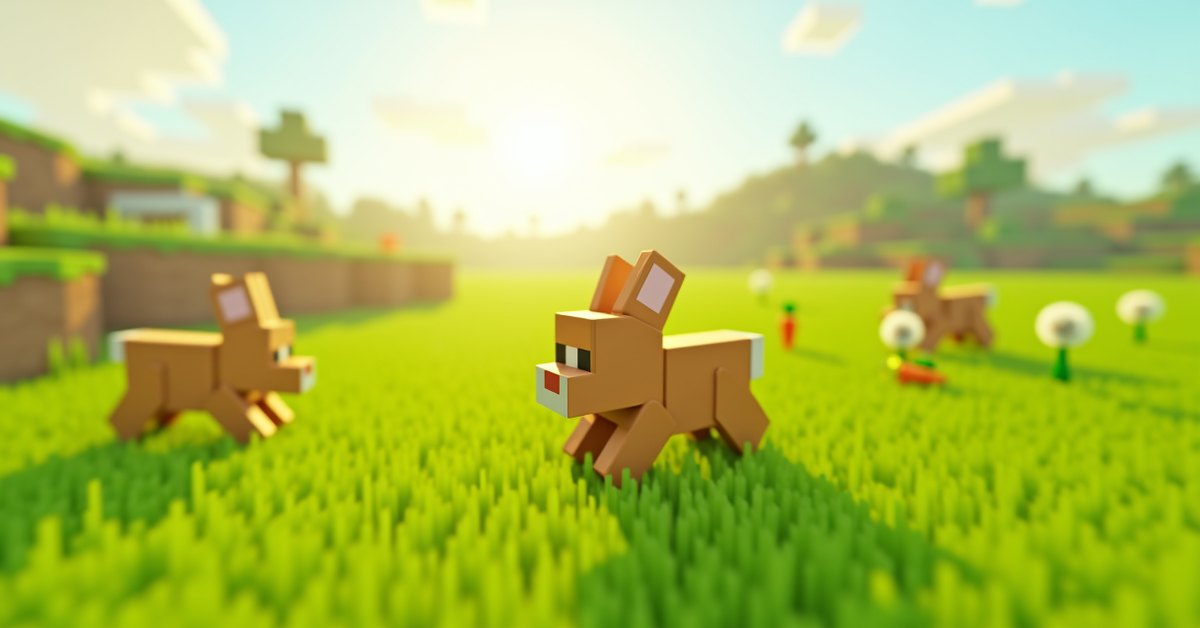
What rabbits are in Minecraft
Rabbits are small passive mobs that hop around the surface in groups. They have 3 health points (a heart and a half), move quickly, and bolt away the moment a player or a wolf gets close. They are one of the few mobs whose coat color changes to match the biome they spawn in, so a rabbit in the desert looks nothing like one in a snowy field.
Most players hunt rabbits for two things: raw rabbit to cook into food, and the rabbit’s foot, a rare drop used to brew jump potions. They also fit into a quiet farm build, since they breed with carrots and never fight back.
Where to find rabbits
Rabbits spawn on grass and sand across a handful of biomes. The most reliable places to look are deserts, snowy plains, snowy slopes, taigas, flower forests, and meadows. They spawn in small herds of two or three, often with a baby in the group.
Because they blend into the ground around them, a sandy gold rabbit in a desert or a white rabbit in the snow is easy to walk past until it moves. Watch for the hopping motion rather than the color.
How rabbits behave
Rabbits do not walk. They hop in short jumps, which gives them a quick, jittery movement that covers ground faster than it looks. When you get close they treat you as a threat and hop away, so trying to corner one in the open usually ends with the rabbit gone. The same goes for wolves: a rabbit will flee from a wolf on sight, and a wolf that spots a rabbit will chase and kill it.
Their small size and jumping also means they take less fall damage than most mobs, so a drop that would hurt a player often leaves a rabbit unharmed. If you want to keep a group in one place, the answer is a pen rather than a chase. Build a fenced enclosure, lead a pair in with food in hand, and let them settle.
Rabbit coat colors
A rabbit’s color comes from the biome it spawns in, not a random roll across the whole world. Snowy biomes push toward white coats, deserts toward sandy gold, and everywhere else you get earthy browns and speckled patterns.
| Coat color | Where it usually appears |
|---|---|
| Brown | Temperate biomes |
| Black | Temperate biomes |
| Salt and pepper (speckled black and white) | Temperate biomes |
| White | Snowy biomes |
| Black and white | Snowy biomes |
| Gold (sandy) | Deserts |
What rabbits drop
When an adult rabbit dies it can drop:
- Raw rabbit, 0 or 1, which cooks into cooked rabbit for food.
- Rabbit hide, 0 or 1. Four hides craft into one leather.
- The rabbit’s foot, a rare drop of roughly 10 percent. A Looting sword raises the odds.
If you kill a rabbit while it is on fire, the meat drops already cooked. Baby rabbits drop nothing at all, so there is no reason to chase them down.
What the rabbit’s foot is for
The rabbit’s foot is a brewing ingredient. Add it to an Awkward Potion to make a Potion of Leaping, which gives the Jump Boost effect and a little extra height on every jump. That makes the foot the gating item for any jump potion, so a steady supply of rabbits near your base is worth keeping around.
How to breed rabbits
Feed two adult rabbits to send them into love mode and produce a baby. They accept three foods:
- Carrots
- Golden carrots
- Dandelions
The baby takes about 20 minutes to grow into an adult, and you can speed that up by feeding it the same foods. After a pair breeds, there is a short cooldown before they can breed again.
Wild rabbits also seek out and eat mature carrot crops on farmland. A warren living next to your carrot patch will nibble the harvest down, so fence the farm off if you see rabbits nearby.
Rabbit stew
Rabbit stew is one of the strongest foods in the game that does not need gold. It restores a large chunk of hunger and a lot of saturation, which means it keeps you fed for a long time before you need to eat again.
You craft it in the regular crafting grid from a cooked rabbit, a baked potato, a carrot, a mushroom (red or brown), and a bowl. The result is a single bowl of stew that does not stack, and eating it hands the empty bowl back so you can reuse it. Butcher villagers will also trade rabbit stew, which is handy if you have a trading hall but not a steady rabbit supply.
The catch is the ingredient list. Five separate items go into one bowl, and one of them (the cooked rabbit) depends on a drop you cannot farm as fast as wheat or potatoes. That is why most players treat rabbit stew as a special-occasion food for long mining trips rather than an everyday meal, and lean on bread or baked potatoes for the daily grind.
Setting up a rabbit farm
A working rabbit farm is simple. Wall off a small area with fences and a gate, lead two adult rabbits inside, and grow a few carrots nearby for breeding food. Feed the pair to make a baby, wait for it to grow, and you have a self-replacing source of meat and the occasional rabbit’s foot. Keep the pen lit so hostile mobs do not spawn inside, and keep foxes and wolves out, since both will treat your rabbits as prey.
The killer bunny
There is exactly one hostile rabbit in the game: the killer bunny, a white rabbit with red horizontal eyes and a clear nod to the killer rabbit from Monty Python. It moves fast, leaps at players, and deals real damage. It does not spawn naturally. In Java Edition you can summon it with a command by setting the rabbit type to 99. In normal survival you will never run into one, so treat it as a novelty rather than a threat.
The Toast rabbit
Name a rabbit “Toast” with a name tag and its skin changes to a unique black and white pattern. It is a memorial that was added at a player’s request after they lost their real pet rabbit. The skin is purely cosmetic and changes nothing about the rabbit’s behavior or drops.
Tips and common mistakes
- Skip the babies. Only adult rabbits drop meat, hide, and the foot.
- Fence carrot farms when wild rabbits are around, or they will eat the crop down to nothing.
- Foxes and wolves both hunt rabbits, so keep predators out of any pen you build.
- A Looting sword raises both the meat yield and the rabbit’s foot odds, so it pays off if the foot is what you are after.
- Rabbits are fast and skittish. Pen them in before you try to feed and breed, or they will hop out of reach.
Java and Bedrock differences
Rabbits work almost the same in both versions. The clearest gap is the killer bunny, which you can summon with a command in Java Edition and which is not part of normal Bedrock survival. Coat colors, breeding foods, drops, and the rabbit stew recipe all behave the same way across editions, so most of what you learn on one version carries straight over to the other.
Frequently asked questions
What do rabbits eat in Minecraft?
Carrots, golden carrots, and dandelions. Those same foods send a pair into love mode for breeding. Wild rabbits will also eat mature carrots off farmland if a patch is nearby.
How do you get a rabbit’s foot?
Kill an adult rabbit. The foot is a rare drop of about 10 percent, and a sword with Looting raises that chance. Baby rabbits never drop it, so only adults are worth hunting for the item.
What is the rabbit’s foot used for?
Brewing. Combine it with an Awkward Potion to make a Potion of Leaping, which grants Jump Boost. It is the one ingredient you cannot substitute for that potion.
Can you tame a rabbit?
No. Rabbits cannot be tamed the way wolves or cats can. You can breed them and pen them in, but they stay skittish and will never follow you around as a pet.
Which biome has the most rabbits?
Deserts and snowy biomes are the easiest places to find them in numbers. Those are also where you get the gold and white coat colors that you cannot find anywhere else.
Do rabbits despawn?
No. Like other passive animals, a rabbit that has spawned stays in the world unless something kills it. You do not need to name it to keep it from vanishing.
Worth keeping a few around
A small rabbit pen near a carrot farm gives you a renewable source of meat and a slow trickle of rabbit’s feet for jump potions. They are quiet, harmless, and easy to breed, which makes them one of the lower-effort animals to keep once you have fenced them in.