What riptide does in Minecraft
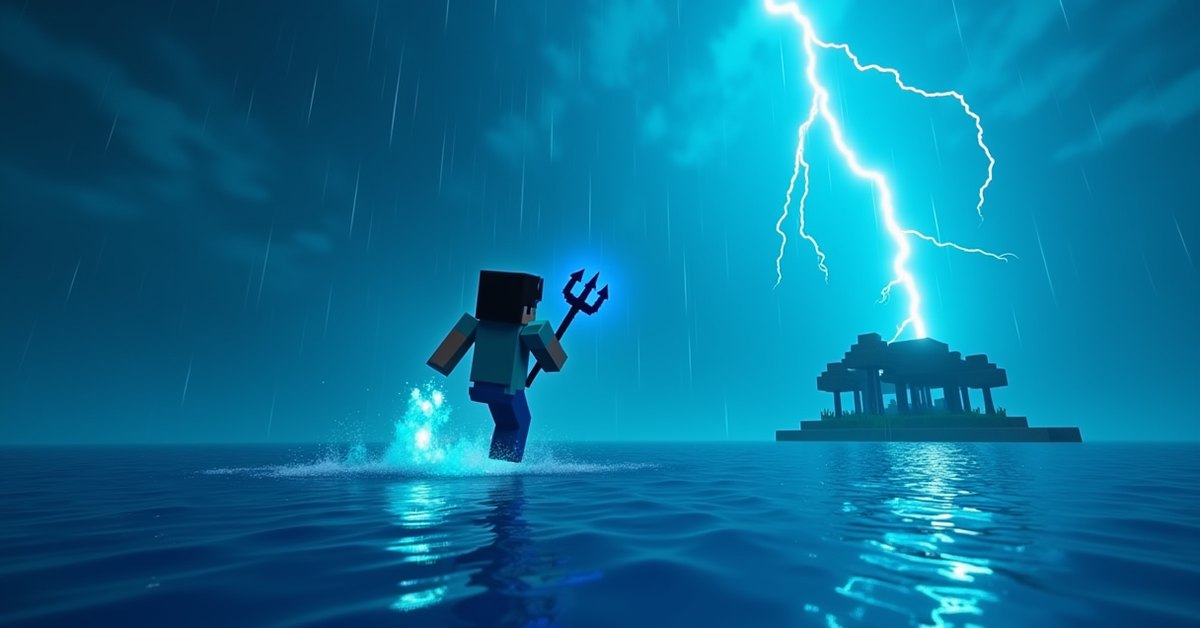
Riptide is a trident enchantment that launches the player forward in the direction the trident is aimed. You don’t throw the trident. You hold it, right-click, and ride it like a rocket for a short burst. It only fires when you are standing in water, in the rain, or in falling snow.
The enchantment turns a normal trident into a personal travel tool. In a thunderstorm, on the open ocean, or under heavy snowfall, one right-click sends you many blocks in a straight line. Pair it with elytra and you get the fastest weather-dependent flight in the game without firework rockets.
Riptide caps at level III, and it can’t share a trident with Loyalty or Channeling. That trade-off keeps the trident single-purpose, but anyone who has crossed an ocean in a thunderstorm with one already knows it earns its slot.
How to get a riptide trident
Tridents are not craftable. The only vanilla source is drowned, the underwater zombie variant. A small percentage of drowned spawn already holding a trident, and killing one that does has a chance to drop the weapon. On Java Hard difficulty, around 6.25% of drowned spawn with a trident in hand. On Bedrock the rate is lower.
Base drop rate from a trident-holding drowned is around 8.5%, and Looting III on your sword raises that to roughly 11.5%. Plan on a few hours of drowned farming if you want a trident through this route alone.
Once you have a trident, there are three ways to put Riptide on it:
- Enchanting table. Place the trident, place lapis, and spend 30 levels for the top-tier offer. Riptide is one of the rarer offers on tridents, so expect to reroll using a cheaper enchant to refresh the table.
- Anvil and an enchanted book. Riptide books drop from drowned, appear in librarian villager trades at a higher career level, and come up in fishing loot and shipwreck or underwater ruin chests.
- Pre-enchanted trident from a drowned. The trident a drowned spawns with sometimes carries an enchantment already, including Riptide. The level is random.
If you want Riptide III specifically and the enchanting table keeps offering lower levels, level up a librarian villager and trade for the book. It’s slower up front and faster overall.
How riptide works in the game
Levels and launch distance
Riptide has three levels. Each level adds noticeable distance and speed to the launch:
- Riptide I gives the shortest hop.
- Riptide II roughly doubles the distance of level I.
- Riptide III roughly triples it, and on flat ground or open water it sends you about twenty blocks in a single launch.
The actual distance depends on the angle you are aimed at. Pointed flat across the surface of a body of water, you cover the most ground. Pointed straight up, you gain height instead of horizontal distance. Pointed down, you slam into the floor and take fall damage on impact, which is rarely what you want.
The launch also damages mobs you collide with. Riptide carries the trident’s normal melee damage value, and Impaling adds bonus damage on top for the right targets. A Riptide III, Impaling V trident can flatten a small group of mobs during a storm if you steer it through them.
Where you can use it
Riptide only fires when one of these is true:
- You are standing in a water source block, even one block deep.
- It is raining on the block you are standing on.
- It is snowing on the block you are standing on.
Standing inside a building during a storm doesn’t count. The game checks whether precipitation can actually reach your position from above. If a roof, slab, or any solid block sits over your head, the precipitation does not register and Riptide is locked.
It also won’t fire in biomes where it never rains. Deserts and badlands stay dry no matter what the weather elsewhere is doing, so a Riptide trident only works there if you have a water source block under your feet.
Why riptide can’t share a trident with Loyalty or Channeling
Riptide is mutually exclusive with both Loyalty and Channeling. The reason is mechanical. Loyalty and Channeling both depend on the trident actually being thrown away from the player. Riptide launches the player with the trident still in hand, so there is no thrown weapon for Loyalty to return to you or for Channeling to call lightning down on.
If you want both a thrown trident and a launch trident, keep two separate tridents. One with Loyalty, and optionally Channeling, handles ranged combat, including the lightning-strike trick during thunderstorms. The other with Riptide handles travel and storm mobility.
Other enchantments do stack with Riptide:
- Unbreaking. Riptide eats durability fast, so Unbreaking III is close to mandatory if you plan to use the trident every day.
- Mending. The most efficient durability fix, especially if you also farm XP from a mob farm or villager trading.
- Impaling. Adds damage to aquatic mobs on Java, and to any mob in or touching water on Bedrock. On Bedrock that includes mobs in the rain, which makes the Impaling line especially useful on a Riptide trident.
Riptide and elytra: the fastest stormy travel in the game
The reason a Riptide trident earns a spot in most late-game loadouts: combined with elytra, it gives you the fastest movement option in the overworld during rain or snow. Faster than firework rockets at takeoff, and the only resource you burn is durability.
The basic move:
- Stand outside in the rain or snow. Make sure the sky is open above your head.
- Aim where you want to go. Slightly above the horizon is best so you don’t slam back into the terrain.
- Right-click to launch.
- While in the air from the launch, press the jump key to deploy your elytra.
- You are now gliding at the speed the riptide gave you, which is far faster than a normal elytra takeoff.
- Right-click again while still flying to chain another launch, as long as it is still raining or snowing on you.
This stacks. Every chain launch resets your speed to roughly the riptide top speed. You can keep doing it as long as the storm lasts. If the weather clears mid-flight, you are stuck with normal elytra glide until you land near a water source or another storm rolls in.
A common hybrid loadout: a Riptide trident for storm travel, a separate Loyalty and Channeling trident for combat and lightning calls, and a stack of firework rockets for fair-weather elytra. The Riptide trident goes into the hotbar the moment a storm starts.
Tips and common mistakes
Things that trip players up:
- Trying to use Riptide indoors during a storm. Walls or a roof block the rain, so the enchantment won’t fire. Step outside, or open a one-block hole in the ceiling above your head.
- Forgetting how much durability riptide costs. Each launch is one durability hit. Without Mending or Unbreaking III, a Riptide trident wears out after a few hundred launches.
- Aiming straight up over flat ground. You get a satisfying vertical launch, then you fall. Without elytra, that is fall damage on landing.
- Trying to throw a Riptide trident at a mob. Right-click won’t release it. If you want a thrown trident, switch to a Loyalty one.
- Sleeping through every storm. Sleeping in a bed resets the weather. If you want Riptide travel to be reliable, leave at least some nights for the rain to roll in.
- Counting on Riptide in the Nether. It doesn’t rain in the Nether, no snow falls, and water can’t be placed normally there. Don’t plan on Riptide working there at all.
Java vs Bedrock differences
The core mechanic is the same in both editions. Three levels, same launch behavior, same incompatibility with Loyalty and Channeling, same requirement for water or precipitation.
The differences are smaller in scope. On Bedrock, Impaling damages any mob in or touching water, not only mobs tagged as aquatic. That makes a Riptide and Impaling trident more useful during a rainy raid on Bedrock, because raid mobs standing in the rain count. Drowned trident spawn rate is also lower on Bedrock than on Java Hard, so finding a base trident takes longer on average.
Riptide-to-elytra timing is also slightly more forgiving on Java. Some Bedrock players report tighter input windows depending on framerate. Both work in practice. The feel is just a touch different.
Frequently asked questions
Does riptide work in the Nether?
No. The Nether has no rain, no snow, and almost no water. Without one of those, Riptide will not fire.
Can I get Riptide IV?
No. The max level in vanilla Minecraft is III. Commands or mods can push it higher, but the unmodded game caps at III.
Does Riptide damage mobs when I fly through them?
Yes. While you are traveling from a launch, contact deals the trident’s normal melee damage. Impaling adds bonus damage on top for the right targets.
Why does my Riptide trident lose durability so fast?
Every right-click launch costs durability. The cost per launch is small, but over a few hundred trips it adds up. Mending plus a steady XP source keeps the trident repaired.
Can I use Riptide from a boat?
You can use it while sitting in a boat that is on a water source, because you and the boat both count as in water. You cannot use Riptide from a boat dragged onto dry land.
What’s the best level of Riptide to aim for?
Riptide III, every time. Launch distance scales with level, and III gets you about three times as far per right-click as level I.
Does Riptide work in shallow puddles?
One block of water under your feet is enough. A waterlogged stair or slab does not always trigger the launch, so a full water source block is the safer setup.
Can I use Riptide and a shield at the same time?
Yes. The trident occupies the main hand for the launch, so a shield in the off-hand is fine. You can ready the trident, launch, and still keep the shield slot active for combat after you land.
One more thing to know
If you live on the coast, hunt in the rain, or fly often with elytra, a Riptide III trident with Mending and Unbreaking III is one of the strongest single tools in the game. Keep one in your hotbar for storms and you will start looking forward to bad weather.