What is a rose bush?
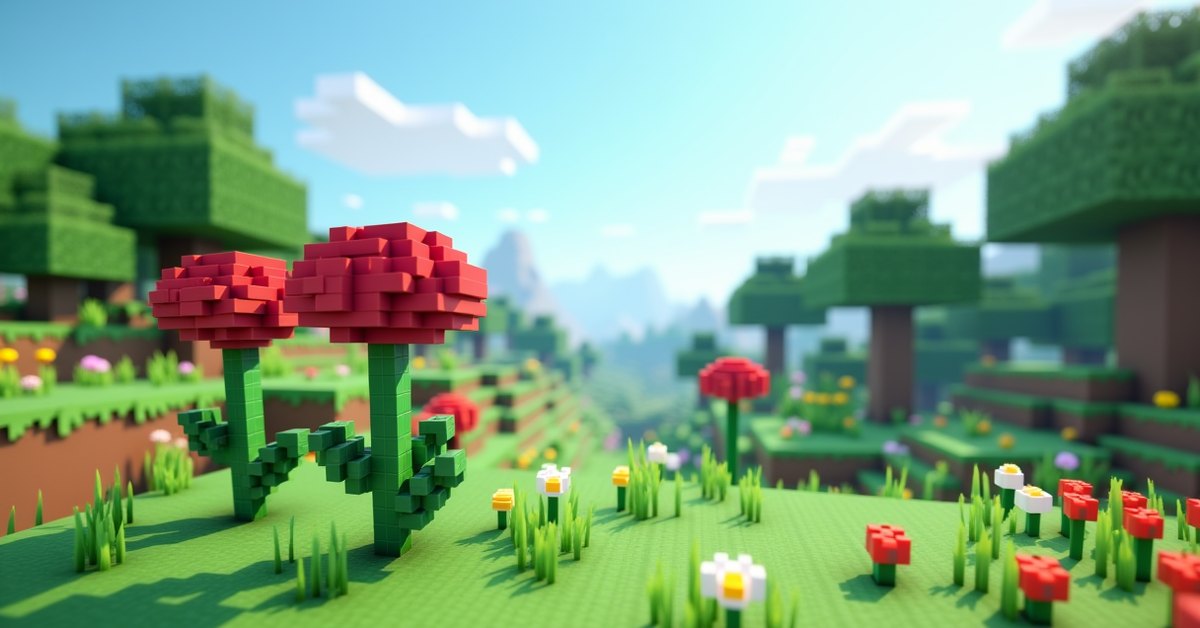
A rose bush is a decorative plant that occupies two blocks of vertical space. The lower block holds the stem and the upper block holds the bloom. The two halves are linked, so breaking either one destroys the whole plant and gives you a single rose bush item back.
It arrived in Java Edition 1.7.2, the update that overhauled Minecraft’s flowers. Older versions had a short red flower simply called the rose. That flower was cut and replaced by the poppy, while the taller rose bush was added as a new, separate plant. The rose bush you place today is not the old rose returning; it is its own block with its own behavior.
A placed rose bush is purely cosmetic. It has no collision box, so players and mobs pass straight through it, and it gives off no light. A rose bush also never grows, spreads, or wilts. Once you plant one, it stays exactly where you put it at any light level, which makes it predictable for both farms and builds.
Where to find rose bushes
Rose bushes generate naturally in the flower forest biome. A flower forest is a woodland carpeted in flowers of nearly every kind, and the tall flowers, including the rose bush, lilac, and peony, are scattered through it in clusters. If you want a place to harvest, this is the biome to search for.
Flower forests are not common, so finding your first one can take some exploring. The payoff is worth it. A single flower forest usually contains more rose bushes than you will ever need, plus every other flower in the game for dye and decoration. It is also a good spot to set up beehives, since the dense flowers keep bees fed.
Once you have found a rose bush, you only ever need to harvest one. Everything after that can be done at home with bone meal, covered below.
How to get a rose bush
You collect a rose bush by breaking it. Any tool works, and so do your bare hands. Hitting either the top or the bottom block breaks the entire plant and drops one rose bush item. No tool is faster than another for this, and the drop is the same every time.
A rose bush has no crafting recipe. The only two ways to obtain one are to break a naturally generated bush or to duplicate a bush you already own.
Duplicating rose bushes with bone meal
Apply bone meal to a placed rose bush and it drops a copy of itself as an item while the original stays standing. Every tall flower behaves this way, and it is the fastest method for stockpiling rose bushes. Carry one bush back from a flower forest, plant it somewhere safe, and bone meal it as often as you want. Each use gives you another rose bush.
This is what makes the rose bush a renewable resource. You never have to return to a flower forest after that first trip.
Placing a rose bush
A rose bush needs a valid block underneath it and two empty blocks of space above that ground block. It will sit on grass blocks, dirt, coarse dirt, podzol, rooted dirt, moss, mud, and farmland. You place it like any other flower, and it fills both spaces automatically.
If the block beneath it is removed, or the headroom above it later gets blocked, the rose bush pops off as a dropped item. Flowing water and a piston push break it the same way. Keep that in mind when you build water features or redstone near a flower bed, or you may come back to a pile of loose rose bush items.
What to do with a rose bush
The rose bush has four real uses: red dye, decoration, feeding bees, and composting. Red dye is the one most players are after.
Crafting red dye
Put a single rose bush anywhere in the crafting grid and it produces two red dye. A poppy placed the same way returns only one, so the rose bush is twice as efficient. Pair that with bone meal duplication and you have the cheapest steady red dye supply in the game.
Red dye colors wool, terracotta, concrete powder, beds, banners, candles, and leather armor. It also mixes with other dyes to produce pink and several secondary shades. If you run any project that needs red in volume, such as a large banner display or a red brick build, a small rose bush farm pays for itself quickly.
Decoration and landscaping
Because the rose bush is two blocks tall, it adds vertical interest that single flowers cannot. A line of rose bushes makes a fast, low hedge along a path or a garden edge. The deep red sits well against gray stone, dark wood, and green leaves, so it works as an accent color for medieval and cottage builds.
Since the plant has no hitbox, you can walk through a field of rose bushes at full speed, which makes them practical as ground cover and not only as border decoration.
Bees and pollination
Bees treat a rose bush as an ordinary flower. A bee will fly to it, pollinate it, and carry pollen back to its hive or bee nest, which raises the honey level inside. For a honey or honeycomb farm, rose bushes work as well as any other flower, and a flower forest full of them is a natural place to start one.
Composting for bone meal
A rose bush can be dropped into a composter, where it has a 65 percent chance to add a compost layer, the same odds as other flowers. Composting spare rose bushes turns them back into bone meal, and that bone meal can then duplicate more rose bushes. Any bushes you do not need become fuel for making more.
Rose bush vs. the poppy
Players often mix these two up, since both are red flowers that craft into red dye. The difference is size and yield. The poppy is a single-block flower that fits in a flower pot and can flavor a suspicious stew. The rose bush is a two-block plant that does neither, but it gives two red dye per craft instead of one.
For pure dye production, the rose bush wins. For potted decoration or stew ingredients, you need the poppy. Many players keep both: poppies for flower pots and recipes, rose bushes for a bulk dye farm.
Tips and common mistakes
The most frequent mistake is reaching for shears, expecting a rose bush to act like tall grass or a large fern. Shears do nothing useful here. Break the bush with anything and it drops itself.
Another common slip is trying to put a rose bush in a flower pot. Flower pots only hold single-block plants, so the rose bush will not go in. The same limit applies to suspicious stew, which accepts only small flowers.
If you want a renewable dye station, plant one rose bush at your base, keep a stack of bone meal within reach, and duplicate on demand. There is no reason to make repeat trips to a flower forest.
When you decorate with rose bushes, always account for the two-block height. A bush will not place under a ceiling only one block high, and a bush whose headroom gets sealed off later will break and drop as an item.
Frequently asked questions
Can you craft a rose bush in Minecraft?
No. The rose bush has no crafting recipe. You get one by breaking a naturally generated bush in a flower forest, then duplicate it at home with bone meal.
How much red dye does a rose bush give?
A single rose bush crafts into two red dye. That is double the yield of a poppy, which makes the rose bush the better choice for bulk dye once you can duplicate it freely.
Do you need shears to collect a rose bush?
No. Breaking a rose bush with any tool, or with no tool at all, drops the rose bush item. Shears give no benefit.
What biome do rose bushes grow in?
The flower forest. It is the reliable biome for wild rose bushes, and it also holds lilacs, peonies, and almost every other flower in the game.
Can you put a rose bush in a flower pot?
No. Flower pots only accept single-block plants. The rose bush is two blocks tall, so it cannot be potted. Use a poppy if you want a red flower in a pot.
Why won’t my rose bush place?
A rose bush needs two free blocks of vertical space and a valid block such as grass or dirt beneath it. If the spot has only one block of headroom, the bush will not place.
The rose bush is worth grabbing the first time you pass through a flower forest. One bush, a composter, and a stack of bone meal give you an endless red dye supply and a tall flower for builds, with no farming cycle to manage. Plant it once and it keeps paying out.