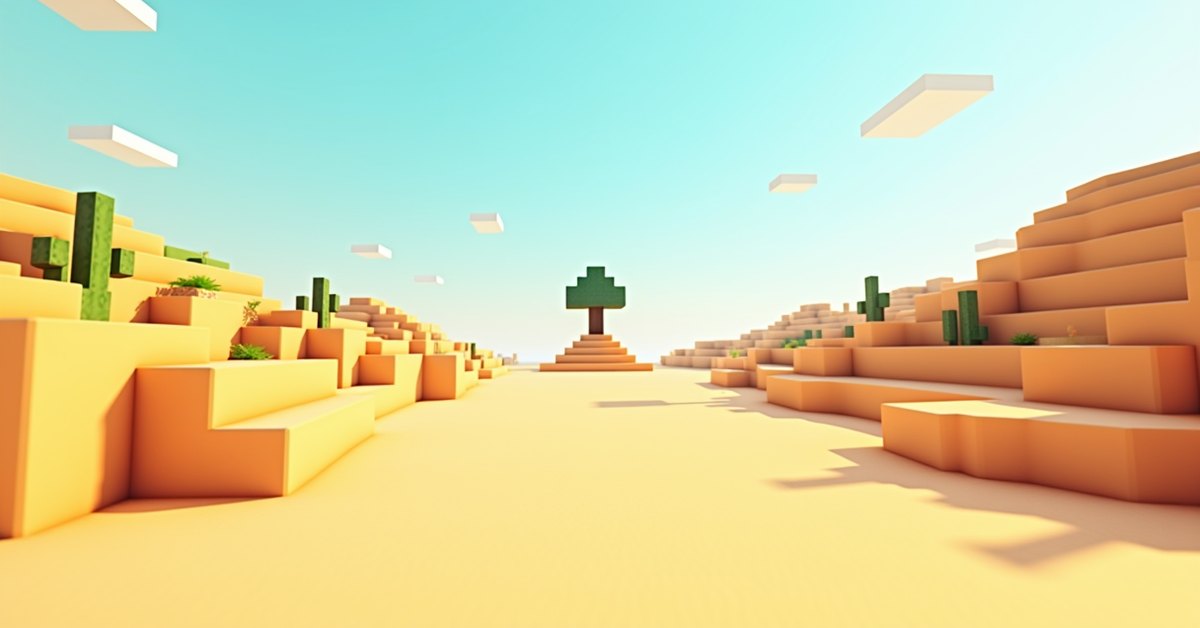
What is sand in Minecraft?
Sand is a loose block that obeys gravity. If nothing holds it up, it falls straight down until it hits a solid surface. That single trait shapes almost everything about how you use it, from mining it safely to building with it.
You will run into sand constantly. It covers deserts, lines beaches, and forms the floor of most oceans and rivers. It is also one of the most useful raw materials in the game, since it smelts into glass and crafts into sandstone, TNT, and concrete powder.
There are two versions of the block: regular yellow sand and red sand. They behave the same way and are used for almost all the same recipes, with a couple of exceptions covered below.
Because sand is so common, it is easy to treat it as throwaway terrain. It is worth a second look. A few stacks can become a full glass roof, a wall of concrete, or a stockpile of TNT for clearing land.
Where to find sand
Regular sand shows up anywhere there is exposed water or open desert. The most reliable places to look are deserts, beaches, the shallow floor of oceans, and the banks of rivers. Deserts give you the largest open stretches, so if you need a stack or two in a hurry, head for one.
Red sand is rarer. It generates naturally only in badlands biomes, the orange mesa-style terrain. If your world has no badlands nearby, red sand is harder to stock up on.
Both kinds of sand are also sold by the wandering trader. The trader offers small amounts of sand and red sand for an emerald each. It is not a fast supply, but it does mean sand is technically renewable even after you have mined out every desert near your base.
How to mine sand
You can break sand with your bare hands, but a shovel is much faster and is the right tool for the job. Any shovel works, and the Efficiency enchantment makes a real difference when you are clearing a large area. Sand always drops itself as an item, so you never lose the block by mining it.
Because sand falls, mining it has a quirk. If you dig a column of sand from below, the blocks above drop toward you one at a time. Dig from the top down instead, or stand off to the side, so a falling stack does not land on your head.
A lot of sand sits underwater on ocean and river floors. Mining it down there is slower, because you break blocks at reduced speed while submerged and you have to watch your air. An Aqua Affinity helmet removes the underwater mining penalty, and Respiration buys you more time before you need to surface. For a quick haul, sticking to dry desert sand is simpler.
How sand gravity works
Sand is a falling block, along with gravel, the concrete powders, and anvils. When the block under a piece of sand is removed, the sand turns into a falling entity and drops until it lands on something solid.
Two things are worth knowing about that fall. First, if falling sand lands in a space already occupied by a non-full block such as a torch, a slab, a rail, or a sapling, it does not become a block. It pops off as an item instead. Farms that need sand to clear itself out rely on this behavior.
Second, falling sand can suffocate you. If a column drops onto your head and fills the space, you take suffocation damage until you break free. Be careful when you tunnel under deserts or dig straight up through sandy ground.
There is one more wrinkle. A sand block does not check for support every tick. It falls when it receives a block update, which usually happens the moment you place it or change a neighboring block. That is why you sometimes see sand appear to float for a second: nothing has updated it yet. Place or break any block next to it and it drops at once.
Builders use the falling behavior on purpose. Placing sand on a temporary support, then knocking the support out, is a common trick for dropping a block into a spot you cannot easily reach.
What sand is used for
Sand is the starting material for several of the most common crafted and smelted items in the game.
Glass
Smelt a block of sand in a furnace to get one block of glass. Red sand works the same way and still produces ordinary clear glass, not a red-tinted version. Glass is the base for glass panes, and adding dye turns it into stained glass.
Sandstone
Place four sand blocks in a two-by-two square on the crafting grid to make one sandstone. Red sand makes red sandstone with the same recipe. Sandstone is far better to build with than loose sand because it does not fall, and it opens up chiseled, cut, and smooth variants for decoration.
TNT
TNT needs sand. The recipe is five gunpowder and four sand arranged in a checkerboard pattern in the crafting grid, which yields one block of TNT. Regular sand and red sand both work here.
Concrete powder
Concrete powder combines four sand, four gravel, and one dye, giving you eight blocks of colored powder. Concrete powder is itself a falling block. When it touches water it hardens into solid concrete, one of the cleanest building blocks in the game.
Growing cactus and sugar cane
Cactus can be planted only on sand or red sand. No other block will hold it. Sugar cane is less picky and will grow on sand, dirt, grass, and a few other blocks, as long as the block sits next to water. Most desert farms are built on sand for exactly this reason.
Cactus also damages anything that touches its sides, so leaving a one-block gap around each plant keeps the drops from being destroyed when a cactus breaks.
Red sand vs regular sand
The two blocks are nearly interchangeable. Both fall under gravity, both smelt into clear glass, and both craft TNT and concrete powder. The differences are small: red sand crafts red sandstone rather than regular sandstone, and it only generates in badlands biomes. If a recipe calls for sand, either type will do unless you specifically want the red sandstone color.
One common mix-up is worth clearing up. Soul sand is a completely separate block found in the Nether. It is not a color variant of sand, it does not smelt into glass, and it is not used in any of the recipes above.
Tips and common mistakes
Carry a few spare blocks of sand when you explore. Dropping sand into a one-block gap is a quick way to plug a hole, since it falls into place on its own.
Do not build load-bearing structures out of raw sand. The moment a support block disappears, the whole stack comes down. Convert sand to sandstone first if you want it to stay put.
When you need a lot of sand, strip a desert in long rows rather than digging random pits. You will move faster and you are less likely to drop a stack on yourself.
If you are placing sand high up, remember it will fall the instant it has no support. Place it against a solid block, not floating in the air.
Sand also makes a fast emergency floor. If you fall into a ravine or a cave with a gap below you, dropping sand into the hole gives you something to stand on while you climb back out.
Frequently asked questions
Is sand renewable in Minecraft?
Yes, in a limited way. The wandering trader sells both sand and red sand for emeralds, so you can keep getting more even after mining out nearby deserts. There is no fast farm for it, though.
Does red sand make red glass?
No. Red sand smelts into the same clear glass as regular sand. To get red-tinted glass you need stained glass, made by combining glass with red dye.
Why does my sand keep falling?
Sand is a gravity-affected block. It falls whenever the block beneath it is removed or was never there. If you want sand to stay in place, support it from below or craft it into sandstone.
What tool mines sand fastest?
A shovel. Any material works, and Efficiency speeds it up further. You can mine sand by hand, but it is slow.
Can sand kill you?
It can. If falling sand lands on your head and fills the block space, you take suffocation damage. Move out of the column or break the sand to stop it.
Can you plant cactus on red sand?
Yes. Cactus grows on both regular sand and red sand. Those are the only two blocks it will grow on.
How much sand do you need for TNT?
Four sand per block of TNT, along with five gunpowder. The sand and gunpowder go into the crafting grid in a checkerboard layout.
Does sand float in Minecraft?
It can appear to. Sand falls only when a block update reaches it, so a piece placed without an update nearby may hang in the air until you place or break a neighboring block. Once updated, it drops normally.
Final word
Sand is easy to overlook because it is everywhere, but it feeds into glass, TNT, concrete, and every desert farm you will ever build. Keep a stack on hand and convert the rest into sandstone so it stops sliding around your builds.