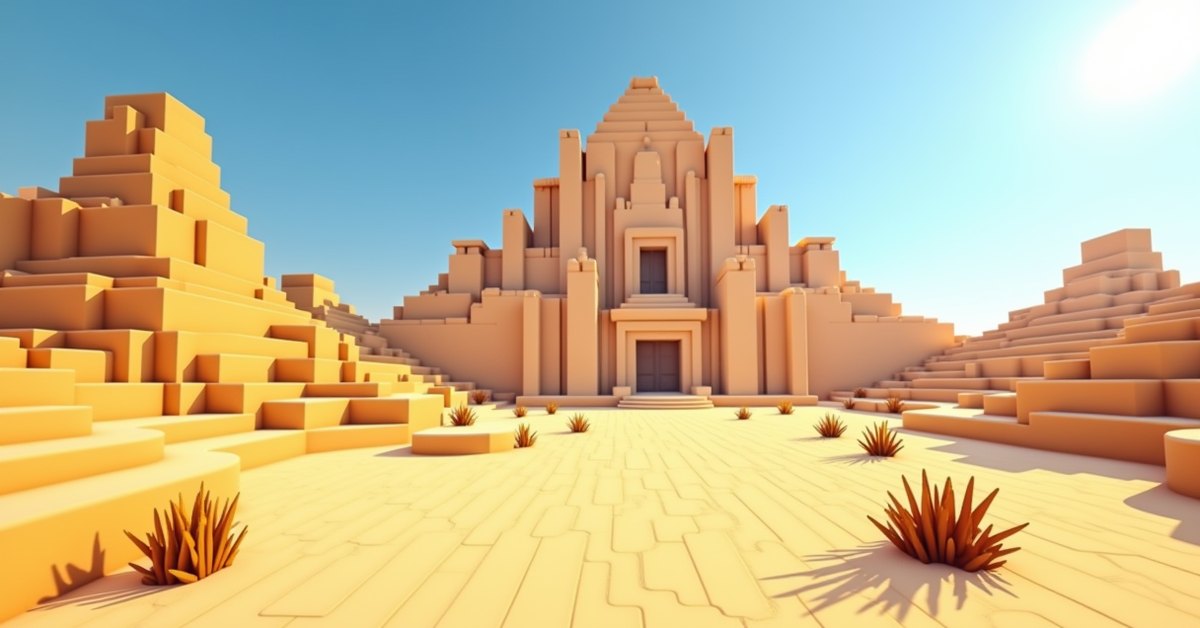
What is sandstone?
Sandstone is a solid block made from compressed sand. It shares sand’s pale tan color and a faint banded texture, but it behaves nothing like sand in one important way: it does not fall. Remove the block under a piece of sandstone and it stays exactly where you placed it.
That single property is what makes sandstone useful. It is a real building block you can stack into walls, towers, and floors without worrying about gravity. It is also the block that holds up every desert in the game. Without a sandstone layer beneath it, loose sand would keep collapsing into any cave or ravine below.
Where sandstone generates
Sandstone forms a solid layer directly beneath sand. Anywhere you see a sandy surface, there is sandstone a few blocks down. The most common places to find it are deserts, beaches, and the floors of warm and lukewarm oceans.
In a desert, the top few blocks are loose sand, and below that sits a thick band of sandstone before you reach ordinary stone. Dig straight down in any desert and you will pass through it within seconds.
Sandstone also makes up the desert structures. Desert pyramids, desert wells, and the houses in desert villages are all built from sandstone and its cut, chiseled, and smooth variants. If you raid a pyramid, you are effectively standing inside a free pile of sorted sandstone blocks.
How to get sandstone
There are two ways to get sandstone: craft it from sand, or mine it where it generates. Most players use both.
Crafting sandstone from sand
Place four sand blocks in a 2×2 square on a crafting table. That produces one block of sandstone. The four blocks just need to fill a 2×2 area anywhere in the grid.
Crafting is the steadiest supply. Sand covers entire deserts and lines every beach, so raw material is rarely a problem. The catch is the conversion rate: four sand makes only one sandstone, so a full stack of 64 sand becomes just 16 blocks. Plan your gathering around that ratio.
Crafting is also the only option when you are far from a desert. Carry a few stacks of sand and you can build with sandstone anywhere.
Mining sandstone underground
To collect sandstone where it generates, you need a pickaxe. Every tier works, from a basic wooden pickaxe up to netherite, but a pickaxe is required. Break sandstone with your hand, an axe, or a shovel and the block still breaks, but it drops nothing.
Sandstone has low hardness, so even a stone pickaxe chews through it quickly. An Efficiency enchantment makes short work of large digs. Mining the natural layer skips the crafting step entirely, so if you are already in a desert it is usually faster than gathering sand and converting it.
Sandstone variants and how to craft them
Plain sandstone is the base of a small family of blocks. Each variant has a different surface, and together they give you enough texture to detail a whole build from one material.
Cut sandstone
Place four sandstone blocks in a 2×2 square to get four cut sandstone. The texture loses the natural banding and gains a clean framed border, which suits tidy, modern builds. A stonecutter makes cut sandstone one block at a time with no waste.
Chiseled sandstone
Stack two sandstone slabs in a vertical column on the crafting grid to get one chiseled sandstone. This variant carries a carved decorative face and is the block you see set into the walls of desert pyramids. A stonecutter can also cut it straight from a full sandstone block.
Smooth sandstone
Smelt a block of sandstone in a furnace to get smooth sandstone. Smelting removes the banded texture and leaves a flat, even surface that works well for floors and clean facades. Smooth sandstone has its own slabs and stairs, so you can carry the look across a full structure.
Slabs, stairs, and walls
Plain sandstone makes slabs, stairs, and walls through the usual recipes. Three sandstone in a row gives six slabs. Six sandstone laid out in a staircase shape gives four stairs. Six sandstone in two rows of three gives six walls. Cut sandstone has its own slab, and smooth sandstone has both a slab and stairs. A stonecutter produces all of these and converts stairs at a better rate than the crafting table, so it pays for itself fast if you build with sandstone often.
What sandstone is used for
Sandstone is, above all, a building block. Its warm pale color reads as sun-bleached stone, which makes it the natural pick for desert bases, pyramids, temples, and anything meant to look ancient or weathered.
The strength of the sandstone family is that every variant shares a color. You can detail an entire build without ever leaving the palette: plain sandstone for the bulk of the walls, smooth sandstone for floors, cut sandstone for trim and borders, and chiseled sandstone for accent panels. A build that uses all four looks far more finished than one made of a single flat block, and you never have to hunt down a matching color.
One limit is worth knowing. Sandstone is not a defensive block. Its blast resistance is low, so a creeper explosion or a stray TNT charge punches right through it. For anything that needs to survive a blast, use stone, deepslate, or obsidian, and keep sandstone for the decorative parts of the build.
Red sandstone vs sandstone
Red sandstone is the rusty-orange version of the same block. It behaves identically, with one difference in the source. Regular sandstone is crafted from regular sand. Red sandstone is crafted from red sand, which generates across badlands biomes.
Every recipe carries straight over. Four red sand makes red sandstone, four red sandstone makes cut red sandstone, smelting produces smooth red sandstone, and the slab, stair, and wall recipes all match. Learn to build with one and you already know the other. The only real decision is color: pale tan sandstone or deep orange red sandstone. Many desert and mesa builds mix the two for contrast.
Tips and common mistakes
The mistake almost every new player makes is mining sandstone without a pickaxe. Sand breaks instantly by hand, so it is easy to keep swinging a shovel right into the sandstone layer and lose every block. Switch to a pickaxe the moment the texture changes.
Another common slip is grabbing sand when you meant to grab sandstone. Sand obeys gravity and sandstone does not, so a wall built from the wrong block can collapse the instant it has air beneath it. Glance at your hotbar before you place a tall column.
If you need sandstone in bulk, set up a crafting table on site near a desert instead of hauling raw sand home. Since four sand collapses into one sandstone, crafting in the field means you carry far less weight per useful block. The same goes for a furnace if you want smooth sandstone: smelt where you mine.
Finally, get a stonecutter early if sandstone is your main building material. It converts blocks into stairs and slabs more efficiently than the crafting table and lets you flip between every variant from a single source block, which cuts down on inventory clutter during a big build.
Frequently asked questions
Do you need a pickaxe to mine sandstone?
Yes. Sandstone only drops as a block when you mine it with a pickaxe. Any tier works, but breaking it with your hand, an axe, or a shovel destroys the block and leaves nothing to pick up.
Does sandstone fall like sand?
No. Sandstone is a normal solid block and ignores gravity. You can place it in mid-air against a support block, remove the support, and it stays put. That is exactly why a sandstone layer can hold up an entire desert of loose sand.
Can you turn sandstone back into sand?
No. There is no recipe that breaks sandstone down into sand. The conversion runs one direction only, so think before you craft a large stack you might want as sand later.
What is the difference between sandstone and red sandstone?
Only the source and the color. Regular sandstone comes from regular sand and looks pale tan. Red sandstone comes from red sand in badlands biomes and looks rusty orange. Every crafting recipe is the same for both.
How do you make chiseled sandstone?
Stack two sandstone slabs in a vertical column on a crafting table. That gives one chiseled sandstone with its carved face pattern. A stonecutter can also cut it directly from a full sandstone block.
Can creepers destroy sandstone?
Yes. Sandstone has low blast resistance, so creepers and TNT break through it easily. Plan for that in any build that sits near hostile mobs.
Where do you find sandstone naturally?
Beneath sand. Dig down in any desert, beach, or warm ocean floor and you will hit a sandstone layer within a few blocks. Desert pyramids, desert wells, and desert villages are also built almost entirely from it.
Sandstone is cheap to gather, simple to shape, and forgiving to build with, which makes it one of the strongest starter materials for anyone settling near a desert. Stock up on sand early, smelt and cut a few variants, and you have a full palette ready for a base that looks like it grew out of the dunes.