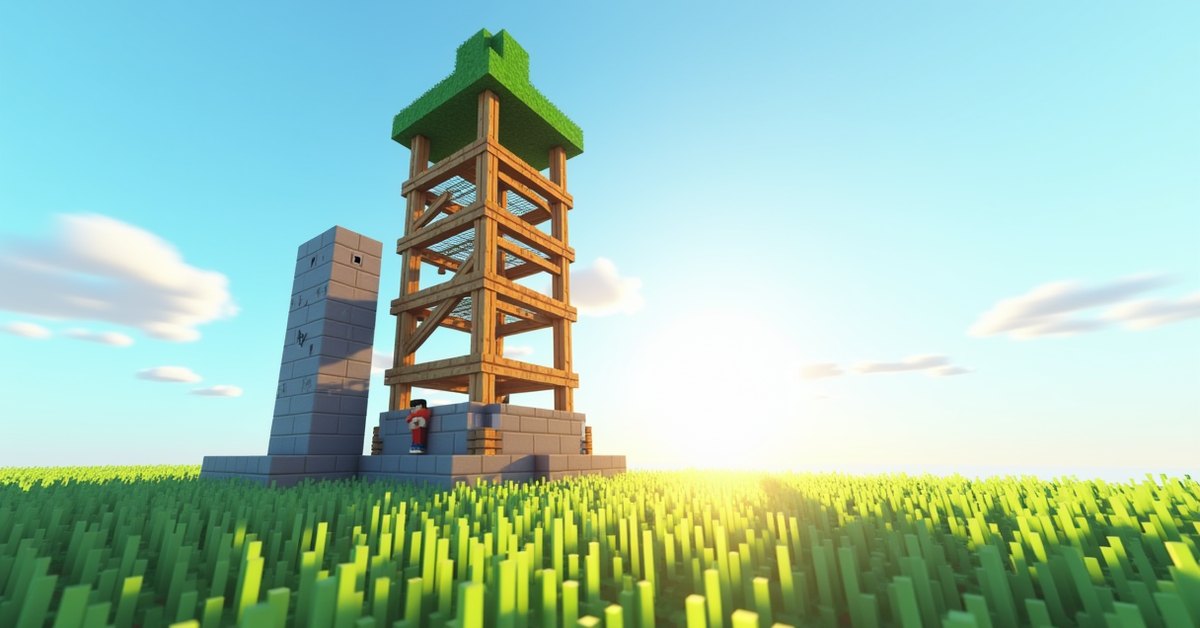
What is scaffolding?
Scaffolding is a climbable building block in Minecraft made from bamboo and string. It gives you a fast way to reach high places and an even faster way to get back down. Builders use it to put up walls and towers without stacking dirt or wasting a ladder on every floor. It is one of the few blocks built purely to be temporary, though plenty of players keep it around for the look.
The block looks like a bamboo frame. You can walk through it, climb it like a ladder, and stand on top of it. Place one block, keep placing against it, and the column grows upward on its own. That means you can ride a scaffolding tower into the sky and pull the whole thing down in seconds when you finish.
If you have ever built a big project and spent half the time bridging up and digging back down, scaffolding fixes that problem.
How to craft scaffolding
The recipe needs 6 bamboo and 1 string. Place the bamboo in the left and right columns of the crafting grid, three in each column, and put the string in the top middle slot. One craft gives you 6 scaffolding.
Bamboo grows in jungle biomes and turns up in jungle temple and shipwreck chests. It also drops from pandas. Bamboo grows quickly once planted, so a small bamboo farm keeps you stocked for as much scaffolding as you will ever need.
String comes from spiders, from breaking cobwebs, from fishing, and as a drop from tamed cats. One string per craft is cheap, so the bamboo is the real cost. Six scaffolding for six bamboo and one string is a fair trade for how much building time it saves.
How scaffolding works
Scaffolding follows a few rules that make it behave differently from any other block. Once you know them, it becomes the fastest building tool in the game.
Placing the first piece
The first scaffolding block has to touch a solid surface. You can set it on the ground or against the side or top of any block. Once that first piece is down, every block after it attaches to the scaffolding itself with no other support, which is what lets a column climb into open air and a platform hang off a wall.
Climbing up and down
Walk or jump into a scaffolding column to climb it like a ladder. Hold the jump key to keep rising. To go down, hold the sneak key (crouch) while you are inside the column, and you drop straight through it. Release sneak and you stop. This makes scaffolding a two-way elevator: jump to rise, sneak to fall, with full control over where you stop.
You can also stand on top of a scaffolding block as if it were solid ground. That helps when you want a stable platform to work from at the top of a build.
Building a tower fast
Place one scaffolding block on the ground. Stand on it, look down at the block under your feet, and hold the place button. The column extends upward one block at a time, and you ride up with it. You can build a tower dozens of blocks high without moving your character, as long as you have scaffolding in hand.
This is the main reason builders carry a stack of it. Reaching the top of a 40-block build takes a few seconds instead of a slow, careful pillar climb. Pair that with the one-block teardown and a full tower goes up and comes down inside a minute.
Extending sideways
Scaffolding can also reach out horizontally. Place a block against the side of an existing piece and it floats there with no support underneath. Every block tracks how far it sits from the nearest vertical column that reaches solid ground. The limit is 6 blocks. Try to place a seventh block past that range and it will not stay; it falls as an item instead.
This horizontal reach lets you build flat work platforms or short bridges off the side of a tower without touching the ground below.
Tearing it down
Here is the part that saves the most time. A scaffolding column depends on the block at its base. Break that bottom block and the entire column above it collapses at once and drops as items you can pick up.
When a build is done, you do not climb down and break each block one by one. You go to the bottom, mine a single block, and the whole tower rains into your inventory. Horizontal sections work the same way: cut the support and the floating part drops.
What scaffolding is good for
The obvious use is construction. Any time you build something taller than your character, scaffolding gets you up and down without fuss. It works as temporary access during a build and as a clean teardown afterward.
It also works as a permanent feature. The bamboo-frame look fits builds with an industrial or tropical theme, and some players leave scaffolding in place as railings or support beams. Because you climb it freely, a scaffolding shaft makes a simple two-way elevator between floors of a base.
Scaffolding also helps on mining trips. Drop a column down a deep shaft or the side of a ravine, climb to the bottom to dig, then ride the same column back up without cutting a single stair. When you move on, break the base and carry the whole shaft to the next dig site.
Scaffolding can be waterlogged, so you can place it in water and still use it. A waterlogged column gives you an easy climb out of a deep pool or a quick route down into an ocean build.
One more trick: because a whole column drops when you break the base, scaffolding is a tidy way to move a large amount of building material upward. Build the tower, harvest it from the bottom, and you get your blocks back with almost no loss.
Common mistakes
The most common mistake is forgetting the 6-block horizontal limit. If a flat section of scaffolding suddenly drops while you build, you have run past the distance a column can support, and you need a new vertical leg closer to the work.
Another is breaking the wrong block. Since the base holds up everything above it, knocking out a low block by accident sends the entire column down, sometimes with you riding it. If you are standing high on a scaffold and want to keep it, mine from the top down, not the bottom.
Players also forget that you fall through scaffolding the moment you hold sneak. If you sneak to avoid walking off a ledge near a scaffold, you can drop straight down the shaft instead. Keep track of whether you are standing on top of a block or inside the column.
One last trap: a flat section can look finished and still sit one block past the limit. If part of a platform vanishes the instant you place it, that block was already out of range, and you need to bring a support column closer before it will hold.
Java and Bedrock differences
Scaffolding works almost the same on both editions. You craft it from 6 bamboo and 1 string, climb it the same way, and collapse it from the base on both. The control to descend is the sneak or crouch input on each edition, though the exact key or button depends on your device. There are no major mechanical differences to plan around, so a scaffolding technique you learn on one edition carries straight over to the other.
Frequently asked questions
How do you go down on scaffolding?
Hold the sneak or crouch control while you are inside the scaffolding column. You drop straight down through it and stop the moment you release the key. Tapping it lets you descend one level at a time.
How do you craft scaffolding in Minecraft?
You need 6 bamboo and 1 string. Put three bamboo in the left column of the crafting grid, three in the right column, and one string in the top center slot. The craft produces 6 scaffolding.
How far can scaffolding extend without support?
A horizontal run of scaffolding can reach 6 blocks from the nearest vertical column that connects to solid ground. The seventh block past that point will not place and drops as an item.
Does scaffolding fall when you break the bottom?
Yes. A scaffolding column is held up by the block at its base. Break that block and the whole column above it collapses at once and drops as items.
Can scaffolding be waterlogged?
Yes. Place scaffolding in a water source block and it becomes waterlogged. You can still climb it normally, which makes it useful for getting in and out of deep water.
Can you reuse scaffolding?
Yes. Scaffolding always drops itself when broken, and a collapsed column drops every block as items. Pick the pile back up and use it again on the next build, so one stack lasts a long time.
When was scaffolding added to Minecraft?
Scaffolding was added in the 1.14 Village and Pillage update. It has been part of both Java and Bedrock editions ever since.
Final word
Once scaffolding is in your hotbar, tall builds stop being a chore. Carry a stack on any large project, build up from the base, and remember the rule that does the most work for you: break the bottom block and the whole tower comes home to your inventory.