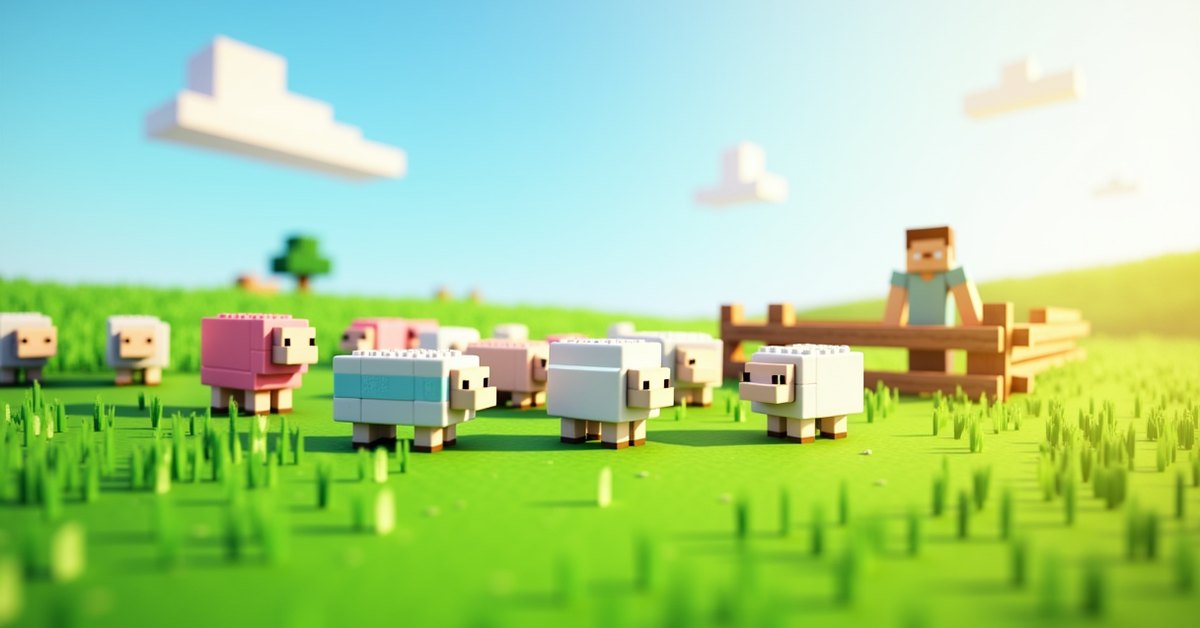
What sheep are and where they spawn
Sheep are passive mobs that spawn on grass blocks across most of the Overworld. You’ll find them in plains, meadows, forests, taigas, and just about any biome with grass and daylight. Meadows are the standout: they spawn more sheep than anywhere else, so a meadow near your base is worth its weight in wool. Villages often generate with a few sheep wandering the streets or penned behind fences, especially villages that include a shepherd.
Sheep spawn in small groups, usually two to four at a time, and a few of them spawn as lambs. They wander slowly, eat grass, follow players holding wheat, and run from nothing except damage. They can’t attack you, and nothing about them is dangerous. The only way a sheep hurts you is when you fall in a hole while chasing one.
Adult sheep are big enough to block a one-wide corridor, which matters for farm design later. Lambs are tiny, can’t be sheared, and grow into adults in about 20 minutes of game time. Feeding a lamb wheat speeds that up.
Wool colors and how rare each one is
Every naturally spawned sheep has one of six colors, and the odds are heavily tilted toward white. The natural spawn chances are:
| Color | Spawn chance |
|---|---|
| White | 81.8% |
| Black | 5% |
| Gray | 5% |
| Light gray | 5% |
| Brown | 3% |
| Pink | 0.164% |
A naturally pink sheep is roughly a 1-in-600 find. If you spot one, don’t eat it. Pen it, breed it, and brag about it. The other ten wool colors (red, orange, yellow, blue, and so on) never spawn naturally on sheep. You get those by dyeing, which is covered below and is easier than it sounds.
How to shear a sheep
Shears are the tool for the job. Craft a pair from two iron ingots placed diagonally in a crafting grid. Then use the shears on an adult sheep with its wool grown, and it drops 1 to 3 blocks of wool on the spot. The sheep survives, looks embarrassed for a while, and regrows its coat.
Shearing beats killing in every way that matters. A killed sheep drops a single block of wool once. A sheared sheep gives up to three blocks, over and over, for the rest of its life. Each use costs one point of shear durability, and a pair of shears has 238 uses, so one pair lasts through a lot of haircuts.
You can’t shear lambs, and you can’t shear a sheep that’s already bare. If a sheep won’t shear, it either hasn’t regrown its wool yet or it’s still a baby.
Wool regrowth: why grass matters
A sheared sheep regrows wool by eating a grass block. When it does, the grass block turns to dirt and the coat comes back, ready to shear again. This is the single most important fact for anyone building a wool farm: no grass, no wool.
If you pen sheep on dirt, stone, or any surface without grass, they stay bare forever after the first shear. Keep pens on natural grass and give the grass room to spread back. Grass regrows onto dirt from adjacent grass blocks, so a pen with a healthy lawn around it keeps itself stocked.
Breeding sheep
Hold wheat and nearby sheep will follow you, which is the easiest way to lead a pair home. Feed wheat to two adult sheep and hearts appear, they pair up, and a lamb pops out. The parents can breed again after about five minutes.
The lamb’s color follows a simple rule with a fun twist. Normally the baby copies the color of one parent at random. But if the two parents’ colors are dyes that combine in a crafting grid, the lamb can be born the mixed color instead. Breed a red sheep with a yellow sheep and you can get an orange lamb. Blue and white can make light blue. This is a real shortcut when you’re hunting a specific shade and don’t have the dye on hand.
Sheep only eat wheat from your hand for breeding. They graze grass on their own for wool regrowth, but wheat is what triggers love mode.
Dyeing sheep: the renewable color trick
Use any dye directly on a sheep and its wool permanently changes to that color. Every shear from that point on drops wool in the dyed color. This is dramatically cheaper than dyeing wool blocks by hand.
The math sells itself. One dye applied to one wool block converts exactly one block. One dye applied to a sheep converts every block that sheep produces for the rest of its life, and its color even passes on through breeding. If you build with a lot of red wool, dye two sheep red once and you have a lifetime supply.
Sixteen wool colors exist in the game, and a dyed flock covers all of them. A common setup is a “rainbow pen” with two sheep of each color you actually use, penned on grass, sheared on a loop.
What sheep drop
Killing an adult sheep drops one block of wool (only if it hasn’t been sheared) and one or two pieces of raw mutton. If the sheep dies while on fire, the mutton comes out cooked. The Looting enchantment raises the mutton count but does nothing for wool, so there is never a good reason to slaughter sheep for wool. Shear first if you’re culling a flock; the wool is a free bonus on top of the meat.
Mutton is a solid early food source. Cooked mutton restores six hunger points (three drumsticks), which puts it in the upper tier of meats. A sheep farm doubles as a food farm once your flock is breeding faster than you can eat.
Lambs drop nothing, so let them grow up before harvest.
Building a simple wool farm
A manual wool farm is just a grass pen with a gate: lead sheep in with wheat, dye them if you want colors, and walk through with shears every few days. For most players this is plenty.
The automatic version uses a dispenser. Dispensers can shear sheep, and that unlocks a fully hands-off farm:
- Place a single grass block with a sheep confined on top of it, walled in so it can’t wander.
- Point a dispenser loaded with shears at the space above the grass block.
- Put an observer facing the grass block. When the sheep eats the grass, the block changes to dirt and the observer fires the dispenser.
- Collect the wool with a hopper or a hopper minecart running under the pen floor.
The cycle runs itself: the sheep eats, the observer sees the grass change, the dispenser shears, the grass regrows, and the sheep eats again. One dyed sheep per module gives you a sorted, automatic supply of that color. Stack sixteen modules and you never craft dye into wool again.
Keep the collection hoppers out of the sheep’s reach and leave the grass block as the only thing it can eat. Torches or lanterns around the farm stop hostile mobs from spawning in the dark corners at night.
Tricks and easter eggs
Name a sheep jeb_ with a name tag (lowercase j, underscore at the end) and its wool cycles through the full rainbow like a disco light. The effect is visual only. Shear a jeb_ sheep and the wool that drops is its original color, not whatever color it happened to be flashing. It makes a great centerpiece for a pen.
The evoker, the spellcasting illager from woodland mansions and raids, has a hidden idle spell: given the chance, it will zap a blue sheep and turn it red. You’ll rarely see it happen in survival, but it’s a nod to the “wololo” priests from the old Age of Empires games.
One more practical trick: sheep, like other animals, won’t walk over open trapdoors or gaps they can see, so a simple trench with open trapdoors works as a one-way door for herding them into a pen.
Frequently asked questions
Do sheared sheep regrow their wool?
Yes. A sheared sheep regrows its full coat after eating a grass block, which turns that block to dirt. On grass, this takes moments to minutes. Off grass, it never happens.
How do you get wool without killing sheep?
Shear them. Two iron ingots make a pair of shears, and each shear drops 1 to 3 wool without harming the sheep. It’s renewable, and it out-produces slaughter by a wide margin.
What is the rarest natural sheep color?
Pink, at a 0.164% spawn chance, roughly 1 in 600 sheep. Brown is the second rarest at 3%. Every other color you see in the wild is white, black, gray, or light gray.
Can you shear a baby sheep?
No. Lambs have no shearable wool. Feed them wheat to speed up growth, then shear them once they’re adults.
What do sheep eat?
They graze grass blocks on their own, which is how they regrow wool. From your hand they only accept wheat, which triggers breeding and speeds up lamb growth.
Does dyeing a sheep waste the dye?
The opposite. One dye permanently converts the sheep, and every future shear drops dyed wool. Dyeing the sheep instead of the wool is the single most dye-efficient move in the game.
Final thoughts
The best time to start a sheep pen is the first time you walk past two sheep with wheat in your pocket. Grab a white pair for beds and banners, dye a couple in whatever color your current build eats the most of, and keep them on grass. Wool stops being something you gather and becomes something you have.