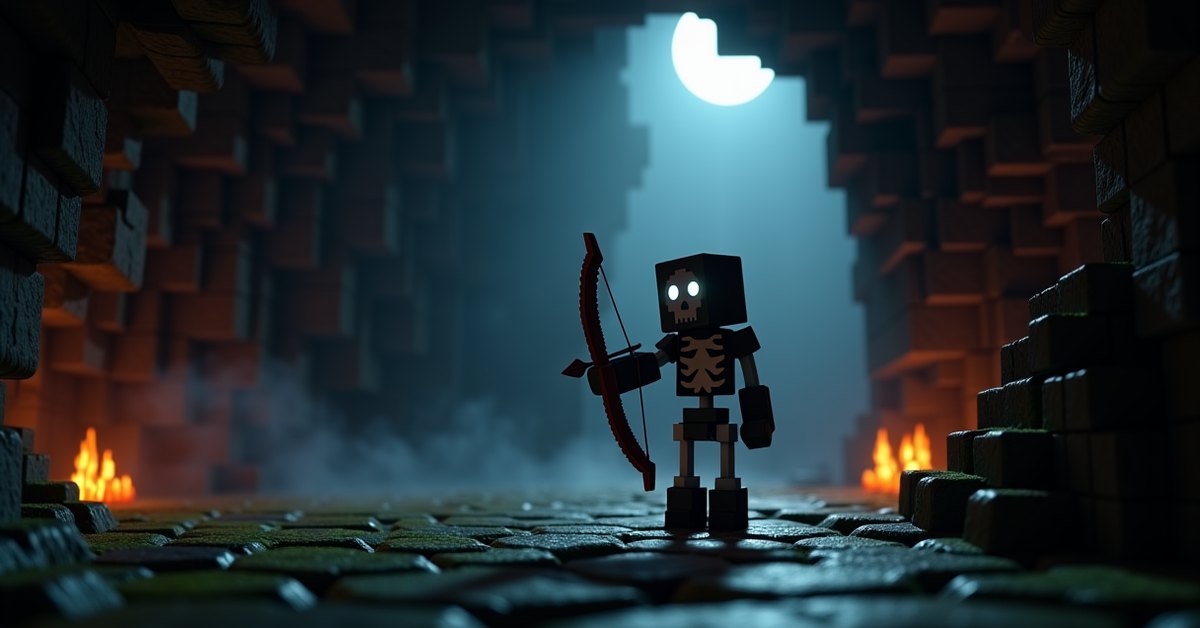
The skeleton is one of Minecraft’s oldest hostile mobs: a bow-carrying pile of bones that spawns in the dark, burns at sunrise, and has knocked more players off cliffs than any other enemy in the game. It has 20 health points (10 hearts) and attacks from range, which makes it more dangerous in open ground than a zombie could ever be.
Skeletons are also worth hunting on purpose. They drop bones and arrows, two items you never stop needing. Bones grind into bone meal for crops and tame wolves, and arrows feed your own bow. Once you can kill skeletons safely and often, both problems are solved for good.
This guide covers where skeletons spawn, how they fight, what they drop, the variants that replace them in certain biomes, and the habits that keep their arrows out of your back.
Where skeletons spawn
Skeletons spawn in the Overworld at light level 0, on solid blocks, usually in groups of up to four. Since the 1.18 update, torches are a harder guarantee than they used to be: any block at light level 1 or above is safe from hostile spawns, so a lit base stays clear. Caves, ravines, and unlit corners of your own builds are where they show up.
They also spawn in the Nether. Soul sand valleys produce regular skeletons in large numbers, and nether fortresses can spawn them alongside wither skeletons. If you hear bow fire in the Nether, it is probably not your imagination.
Skeleton spawners
Dungeons (the small mossy cobblestone rooms buried underground) sometimes contain a skeleton spawner. Roughly a quarter of dungeon spawners produce skeletons. A spawner keeps generating mobs as long as a player is within 16 blocks and the area around it is dark, which makes it the single best skeleton resource in the game. Do not break it when you find it. Light the room with torches to switch it off, then decide whether you want to build a farm around it later.
Other ways skeletons appear
A small fraction of spiders spawn with a skeleton riding them. The spider jockey is rare, fast, climbs walls, and shoots at you the whole time. It is as unpleasant as it sounds.
Skeleton horsemen arrive with thunderstorms. Lightning near a skeleton trap horse spawns a group of mounted skeletons wearing iron helmets and carrying enchanted bows. Beating them is the only way to get skeleton horses in survival, so a thunderstorm is an opportunity as much as a threat.
Trial chambers also spawn skeletons from their trial spawners, scaled to the number of players in the room. And around Halloween, skeletons can spawn wearing pumpkins, which is exactly as silly as it sounds and slightly harder to take seriously in a fight.
How skeletons behave
A skeleton notices you from up to 16 blocks away and starts shooting when you are inside roughly 15. The closer you get, the faster it fires, so the worst place to stand is two blocks away with no shield. Arrow damage depends on difficulty and how long the skeleton drew the bow, and a full-power shot on Hard can take a real bite out of unarmored health.
On Java, skeletons strafe sideways and circle while shooting, which makes them annoying to hit with your own bow. They also walk around obstacles to regain line of sight rather than waiting politely behind a wall.
Sunlight
Direct sunlight sets skeletons on fire. Shade, water, or a helmet cancels this. A skeleton wearing a helmet survives the day while the helmet slowly burns away its durability instead. This is why a skeleton standing under a tree at noon can still ruin your morning.
Gear and pickups
Skeletons can spawn wearing armor, and a small number carry enchanted bows, with better odds in areas of higher local difficulty. They can also pick up weapons and armor from the ground. Hand one a sword (or let it walk over one) and it switches to melee. A skeleton with a sword is a strange sight, but it is a real one.
Wolves
Skeletons run from wolves, and wolves attack skeletons on sight. A couple of tamed wolves turn skeleton encounters from a threat into a cleanup job, and every kill feeds you bones to tame the next wolf. It is a loop that pays for itself.
Drops and XP
A skeleton killed by a player drops 0 to 2 bones and 0 to 2 arrows, plus 5 experience points. Looting raises the drop counts, which adds up fast at a farm.
There is a small chance, around 8.5 percent, that a skeleton drops its bow, occasionally with enchantments intact. Looting improves those odds too. Any armor the skeleton wore can also drop, usually well damaged.
The famous rare prize is not a drop from the skeleton at all. If a skeleton’s arrow kills a creeper, the creeper drops a music disc. Lining that shot up on purpose takes patience: stand so the creeper is between you and the skeleton, let the skeleton fire, and step aside. Getting it to work feels like a heist.
Stray, bogged, and wither skeleton
Three other mobs share the skeleton frame, and the differences matter.
The stray spawns in snowy biomes like snowy plains, frozen oceans, and ice spikes, usually where the sky is visible. Strays shoot tipped arrows of Slowness, which is a serious problem when you need to close distance or run away. Killed by a player, they can drop a Slowness arrow you can use yourself.
The bogged arrived in 1.21 and spawns in swamps, mangrove swamps, and trial chambers. It has less health than a regular skeleton (16 points instead of 20) but shoots poison-tipped arrows, and it fires more slowly. Mushrooms grow on its shoulders, and shearing a bogged gets you a couple of them, which is one of the stranger interactions in the game.
The wither skeleton is a fortress mob and a different fight entirely: a tall melee attacker with a stone sword whose hit inflicts the Wither effect. It drops coal, bones, and the skulls you need to summon the Wither. Do not treat it like a regular skeleton with a tan.
How to fight skeletons
The shield changes everything. Holding a shield blocks arrows completely, so the basic approach is: block, walk in, swing, block again. Without a shield, approach in a zigzag rather than a straight line, since a strafing skeleton punishes predictable movement.
Use cover. Skeletons need line of sight, so breaking it forces them to walk toward you. Stand behind a corner or a tree, wait, and hit them when they path around it. You turn a ranged fight into a melee fight you control.
A few more things that help:
- Water slows arrows to almost nothing. Fighting from inside water is unfair, in your favor for once.
- The Smite enchantment deals bonus damage to undead mobs, and skeletons count. A Smite sword drops them in one or two hits.
- Knockback is risky near cliffs and lava, but so is the skeleton’s knockback on you. Watch your footing more than theirs.
- At night, deal with skeletons before creepers. An arrow interrupting your creeper retreat is how most “how did I die” moments happen.
Building a skeleton farm
A skeleton spawner is the foundation of the easiest farm in the game. The standard design floods the spawner room so water pushes spawned skeletons into a channel, drops them 22 blocks to bring them to half a heart, and collects them where you can kill each one with a single punch. You get bones, arrows, bows, and XP while standing still.
Keep the spawner area dark, stay within 16 blocks so it keeps running, and light the surrounding caves so ambient spawns do not eat your mob cap. If you have no spawner, a dark-room farm produces skeletons among other hostile mobs, but the targeted spawner farm beats it for bones per hour.
Java vs. Bedrock differences
The skeleton is nearly the same mob on both editions. Spawn rules, health, drops, and the sunlight burn all match. The clearest behavioral gap is self-preservation: on Bedrock, a burning skeleton actively seeks shade or water to put itself out, while Java skeletons are less committed to saving their own bones. Combat pacing also feels slightly different between editions, so if you switch platforms, expect your dodge timing to need a day of adjustment.
Frequently asked questions
What are the odds a skeleton drops its bow?
About 8.5 percent when a player lands the kill. Each level of Looting raises the chance. The bow is usually heavily damaged, but enchantments carry over.
Do skeletons burn in daylight if they wear a helmet?
No. The helmet absorbs the sun damage and loses durability instead. Once the helmet breaks, the skeleton starts burning like normal.
How do I get a music disc from a skeleton?
You do not, directly. A creeper killed by a skeleton’s arrow drops a music disc. Position the creeper between yourself and the skeleton, bait the shot, and dodge at the last moment.
What is the difference between a stray and a skeleton?
Strays spawn in snowy biomes and shoot tipped arrows of Slowness. Same health, same general behavior, much more dangerous arrows.
Do skeletons turn into anything in water?
No. Zombies convert into drowned underwater, but skeletons do not transform. A submerged skeleton just sinks and waits, which is its own kind of unsettling.
Can skeletons spawn with enchanted gear?
Yes. A small percentage spawn with enchanted bows or armor, and the chance grows with local difficulty. The skeleton horsemen from thunderstorms always carry enchanted bows.
One habit worth building
Treat every skeleton dungeon you find as an asset, not an obstacle. Torch it, mark the coordinates, and come back when you have hoppers and a bucket. A half hour of digging turns one lucky find into a lifetime supply of bones and arrows, and the skeleton finally starts working for you.