What smelting does in Minecraft
Smelting is how you turn raw materials into something more useful by cooking them in a heat block. You drop an input on top, add fuel below it, and after a short burn you get the finished item out the bottom slot. Raw iron becomes iron ingots, sand becomes glass, raw chicken becomes cooked chicken, and cobblestone becomes smooth stone.
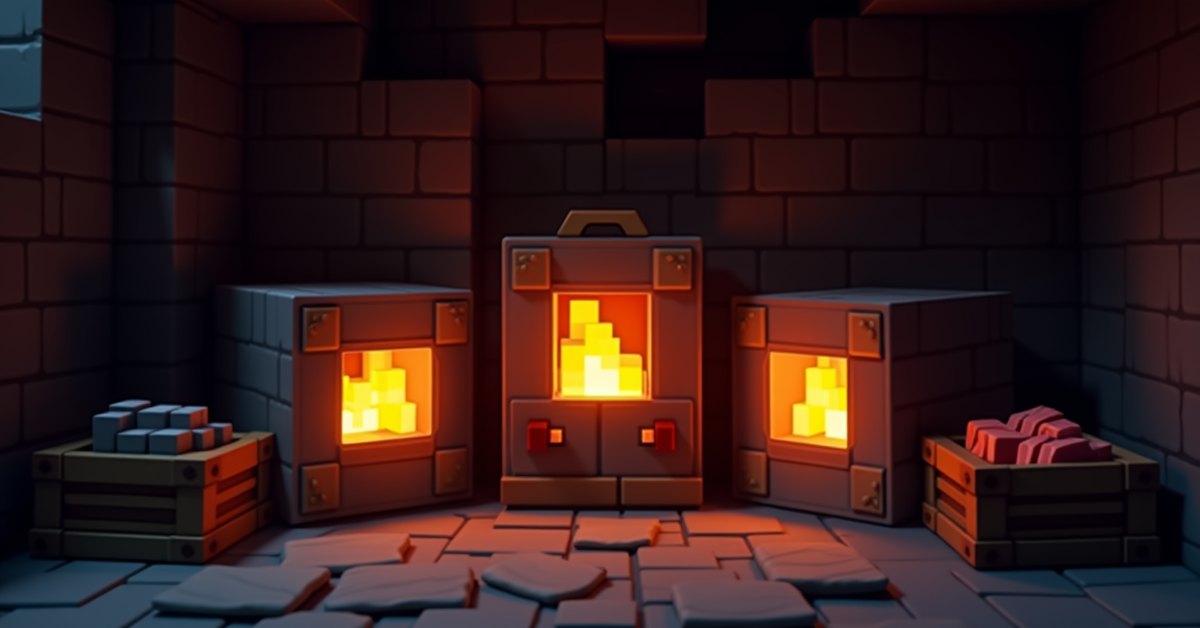
There are three blocks that smelt: the furnace, the smoker, and the blast furnace. The furnace handles everything. The smoker is a faster oven for food only, and the blast furnace is a faster oven for ores and metal items only. Picking the right one saves you real time once you start processing things in bulk.
This guide covers what each block can cook, how to craft them, which fuels last longest, how speed and experience work, and how to wire a furnace up so it runs while you do something else.
The three smelting blocks
All three share the same interface: an input slot at the top, a fuel slot at the bottom left, and an output slot on the right. What changes between them is what they accept and how fast they work.
Furnace
The furnace is the all-rounder. It smelts every smeltable item in the game, including ores, food, glass, charcoal, and building blocks like smooth stone and terracotta. One item takes 10 seconds to cook. If you only want one heat block, this is the one to keep.
Smoker
The smoker cooks food in 5 seconds, half the time of a furnace. It only accepts food: raw meat, raw fish, potatoes, kelp, and chorus fruit. It will not smelt ore, sand, or anything that isn’t edible. If you run a farm or an animal pen, the smoker clears a backlog of raw meat in a hurry.
Blast furnace
The blast furnace also works in 5 seconds, but only on ores and metal items: raw iron, raw gold, raw copper, ancient debris, and metal tools or armor you want to melt down into nuggets. It can’t cook food or sand. For a big mining haul, it doubles your smelting speed compared to a plain furnace.
How to craft each one
The furnace is the starting point, and the other two are upgrades built around it.
A furnace takes 8 blocks of cobblestone arranged in a ring with the center square empty. Blackstone and cobbled deepslate also work in place of cobblestone, so you can build one from whatever stone you have early on.
A smoker takes one furnace in the center with 4 logs around it (top, bottom, left, right). Any wood type works, and stripped logs, wood, and stems are all accepted.
A blast furnace takes one furnace in the center, 5 iron ingots, and 3 smooth stone. Place the smooth stone across the bottom row, a furnace in the middle, and the iron ingots filling the rest. Note that it needs smooth stone, which you get by smelting regular stone, not the stone block itself.
Fuel: what to burn and how long it lasts
Every smelt needs fuel in the bottom slot. Each fuel type burns long enough to cook a set number of items before it runs out. Coal and charcoal are the everyday choice, but a few options go much further.
| Fuel | Items smelted per unit |
|---|---|
| Lava bucket | 100 |
| Block of coal | 80 |
| Dried kelp block | 20 |
| Blaze rod | 12 |
| Coal | 8 |
| Charcoal | 8 |
| Wooden planks | 1.5 |
| Stick | 0.5 |
A lava bucket is the most fuel per slot, and the empty bucket stays in the slot when it’s done so you can refill it. A block of coal is the most convenient bulk fuel since it packs nine coal into one slot and smelts 80 items straight through. Charcoal is the renewable pick: smelt logs into charcoal, then use that charcoal to smelt more logs, and you never have to mine coal at all.
Dried kelp blocks are worth a mention because a kelp farm is easy to automate, which makes them a hands-off renewable fuel for a steady supply.
Smelting speed and fuel efficiency
A regular furnace cooks one item every 10 seconds. The smoker and blast furnace both cook in 5 seconds, so they finish twice as fast within their categories.
Speed and efficiency are two different things. The faster blocks burn fuel twice as fast too, so a single coal still smelts 8 items in any of the three, it just gets through them quicker in a smoker or blast furnace. You don’t save fuel by switching, you save time. For food and metals you process in large amounts, the time savings alone make the upgrade worth it.
One more detail: fuel only starts burning when there’s something in the input slot to cook. An empty furnace with coal in it won’t waste the coal, so you can pre-load fuel and walk away.
Experience from smelting
Smelting stores experience inside the block and releases it when you pull the finished items out. Different items are worth different amounts. Ores and raw metals give the most, food gives a smaller amount, and items like cobblestone give very little.
The experience builds up while the furnace runs, so if you smelt a full stack and collect it all at once, you get a satisfying burst of XP. There’s a cap on how much a single furnace stores, so for very large batches it pays to collect the output now and then rather than leaving it for hours.
Automating smelting with hoppers
You can run any of the three blocks hands-free with hoppers. A hopper feeding into the top loads the input slot, a hopper feeding into the side loads the fuel slot, and a hopper underneath pulls finished items out into a chest.
A common setup is a chest of raw items on top, a chest of fuel on the side, and a collection chest below. Drop in a stack of raw iron and a stack of coal, and the system cooks and sorts itself while you mine or build. Scale it up with several blast furnaces in a row and you can process an entire mining trip in one pass.
Villager job sites
The smoker and blast furnace double as villager workstations. A smoker turns an unemployed villager into a butcher, and a blast furnace turns one into an armorer. The plain furnace is not a job site block, so it won’t give a villager a profession.
If you’re setting up a trading hall, place the workstation next to the villager and wait for them to claim it. Armorers are valuable for cheap diamond armor trades, and butchers buy up raw meat from your farms for emeralds.
Common mistakes to avoid
The most common mix-up is trying to cook the wrong thing in a specialized block. A smoker won’t smelt your raw iron and a blast furnace won’t cook your steak, so keep a regular furnace around for everything that doesn’t fit the other two.
Another is forgetting that the blast furnace recipe needs smooth stone, not stone. Smelt stone in a furnace first to get the smooth version. And don’t break a furnace that still has items inside unless you mean to: breaking it drops whatever is in the slots, but you’ll lose any experience that hasn’t been collected yet.
Frequently asked questions
What is the fastest way to smelt ores?
A blast furnace smelts ores and raw metals in 5 seconds each, half the time of a regular furnace. For a big haul, line up several blast furnaces and split the load across them.
Can a smoker cook everything a furnace can?
No. A smoker only cooks food. For ores, sand, glass, and building blocks you still need a furnace or, for metals, a blast furnace.
What’s the best fuel for smelting?
For convenience, a block of coal smelts 80 items from one slot. For the longest single burn, a lava bucket does 100 and leaves an empty bucket behind. For a renewable option, charcoal made from your own logs never runs out.
Does smelting give experience?
Yes. The block stores XP and drops it when you collect the output. Ores give the most, food less, and cheap blocks like cobblestone very little.
Why won’t my furnace start?
Check that you have both fuel in the bottom slot and a smeltable item in the top slot. Fuel only burns when there’s something to cook, so an empty input slot will keep the furnace cold.
Can I automate a furnace?
Yes. Use hoppers: one into the top for input, one into the side for fuel, and one underneath to pull output into a chest. This works on all three smelting blocks.
Which block should you build?
Start with a furnace because it cooks everything and you’ll always need one. Add a smoker once you’re cooking food in volume and a blast furnace once mining trips start filling your inventory with ore. Most bases end up with all three side by side, each handling the job it’s fastest at.