A smithing template is a special item that unlocks two of the most useful upgrades in Minecraft. One type turns diamond gear into netherite. The others let you decorate armor with custom patterns.
You cannot craft a smithing template. Every one is tucked inside a loot chest in a generated structure, and each template is used up the moment you put it to work. That makes them feel rarer than they really are, because most players burn their first one before they learn it can be copied.
The good news is that any template can be copied with diamonds. Once you own one, that pattern is yours for good, and you never have to raid the same structure twice.
The two types of smithing template
Every smithing template falls into one of two groups, and they do completely different jobs.
The Netherite Upgrade Smithing Template is the one you need to turn diamond gear into netherite gear. Since the 1.20 update, you cannot make netherite tools, weapons, or armor without it. There is only one template of this type.
The armor trim templates are cosmetic. Each one applies a different decorative pattern to a piece of armor. As of version 1.21 there are 18 trim patterns, which puts the full count of smithing templates at 19.
Where to find smithing templates
Templates almost never drop from mobs, and no villager sells them. You find them in loot chests inside generated structures, with one exception noted below.
The netherite upgrade smithing template
This template generates in bastion remnants, the large blackstone structures in the Nether. It appears in bastion loot chests often, so a single bastion raid usually gives you at least one. Grab it as early as you can. Until you have this template, your diamond gear stays diamond.
Bastions come in different layouts, and the chests inside vary in quality. The upgrade template can turn up in most bastion chests, so if your first bastion comes up empty, the next one is worth checking.
Armor trim templates
The 18 trim templates are spread across the overworld, the Nether, and the End. Here is where each pattern generates:
| Trim pattern | Where to find it |
|---|---|
| Coast | Shipwreck |
| Dune | Desert pyramid |
| Sentry | Pillager outpost |
| Wild | Jungle pyramid |
| Eye | Stronghold |
| Vex | Woodland mansion |
| Tide | Dropped by an elder guardian |
| Snout | Bastion remnant |
| Rib | Nether fortress |
| Spire | End city |
| Ward | Ancient city |
| Silence | Ancient city |
| Wayfinder | Trail ruins |
| Raiser | Trail ruins |
| Shaper | Trail ruins |
| Host | Trail ruins |
| Bolt | Trial chamber |
| Flow | Trial chamber |
Some of these are far easier to collect than others. The Sentry trim sits in pillager outposts, which are common across the overworld and quick to clear. The Ward and Silence trims hide in ancient cities deep underground, where the warden makes every chest a real risk.
How to use a smithing template
Every template is used at a smithing table. You can craft a smithing table from two iron ingots and four wooden planks, or take one from a village. In a village the smithing table doubles as the job site block for the toolsmith, so the one you find may already belong to a trader.
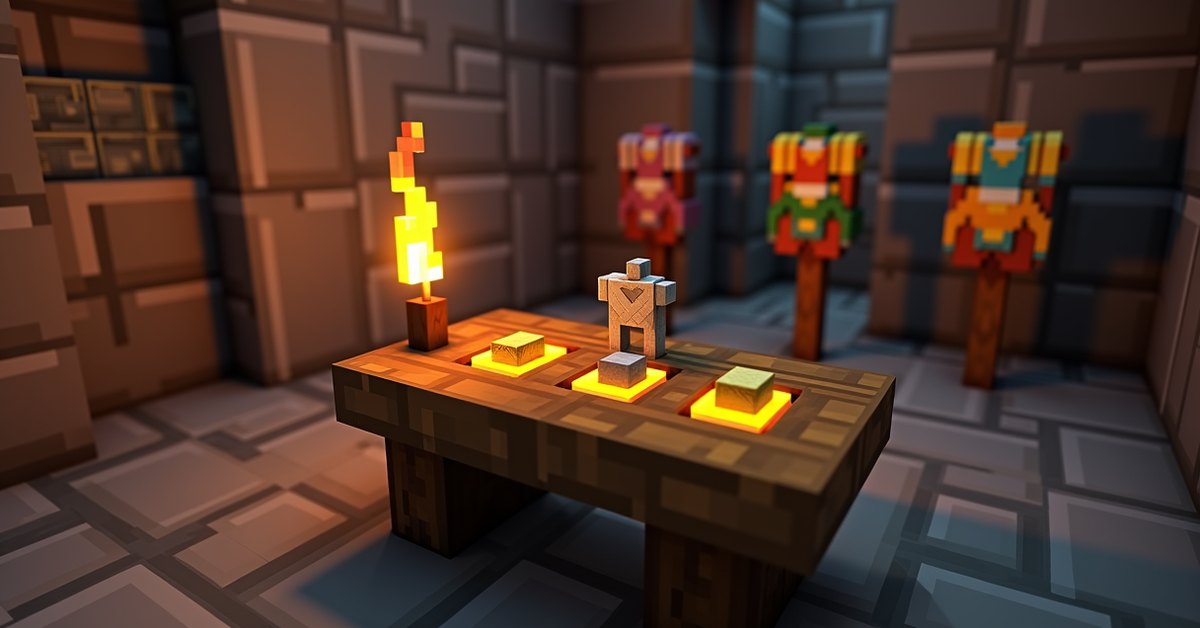
The table has three slots in a row, filled left to right. The first slot holds the smithing template. The second holds the item you want to change. The third holds the material.
Upgrading diamond gear to netherite
Put the Netherite Upgrade Smithing Template in the first slot, a diamond tool, weapon, or armor piece in the second, and one netherite ingot in the third. The result is the netherite version of that item.
The upgrade keeps everything the item already had. Enchantments, durability damage, and custom names all carry over. Netherite gear has more durability than diamond, an armor toughness and knockback bonus on armor pieces, and it floats in lava instead of burning up.
The template is consumed each time. Upgrading a full armor set plus a few tools means running the smithing table once per item, and every run eats a template. That is the main reason to copy the template before you start.
Adding an armor trim
Put an armor trim template in the first slot, an armor piece in the second, and a trim material in the third. The armor comes out with that pattern stamped onto it in the color of the material you chose.
Trims work on helmets, chestplates, leggings, and boots of any armor tier, from leather to netherite. They change nothing about how the armor performs. A trimmed netherite chestplate protects exactly as much as a plain one. The point is the look.
You can mix patterns and colors freely across a set. Nothing forces all four pieces to share one trim, though a single pattern in a single color is the cleanest look for matched armor. Trims also survive the netherite upgrade, so a trimmed diamond chestplate keeps its pattern after it becomes netherite.
Trim materials and colors
The template decides the pattern. The material in the third slot decides the color. Ten materials work as trim colors: iron, copper, gold, lapis lazuli, redstone, emerald, diamond, netherite, amethyst, and quartz.
Each material gives its own shade, from the pale gray of iron to the deep red of redstone and the soft purple of amethyst. Netherite behaves a little differently. Instead of a bright color it produces a dark trim and slightly darkens the armor underneath. Using a material that matches the armor’s own metal, such as a gold trim on gold armor, gives a brighter raised finish that builders like for matched sets.
How to copy a smithing template
Because templates are single-use, copying them is what makes the system practical. Duplication happens in a crafting table, not the smithing table.
Place the template you want to copy, seven diamonds, and one block of the template’s base material in the grid. You get your original template back plus one copy. Run the recipe again with the copies to build up as many as you need.
The base material differs for each template and is tied to the structure where the template generates. Plan on seven diamonds for every copy you want. That is a steep price early in a world, but it is far cheaper than a second trip to an ancient city.
Which templates to chase first
You do not need every template, and most players never collect all 19. The one worth a deliberate trip is the Netherite Upgrade template, because without it your gear tops out at diamond. Everything else is optional decoration.
Among the trim patterns, pick based on effort. Sentry from a pillager outpost and Coast from a shipwreck are easy surface finds. Ward and Silence from an ancient city, or Spire from an End city, are expedition-level goals you might save for later. There is no wrong order, and the rarity of a template does not make its pattern look any better.
Tips and common mistakes
The mistake that costs the most is using a rare template on the wrong item. The template is consumed whether or not the result was what you wanted. Copy any hard-to-reach template before it ever goes near a smithing table.
Trimming a full armor set takes four templates of the same pattern, one for each piece. Copy enough before you start so you are not left with a half-trimmed set and no way to match it.
A trim cannot be peeled off once it is applied. If you are unsure about a color, test it on a cheap piece of armor first rather than your enchanted netherite.
Armor trims add zero protection. If someone tells you a trim makes armor stronger, it does not. The value is entirely visual.
Frequently asked questions
Do smithing templates get used up?
Yes. Every smithing template is consumed when you use it at a smithing table, both the netherite upgrade template and the trim templates. Copy a template with diamonds if you want to keep using it.
Do armor trims give extra protection?
No. Armor trims are cosmetic only. A trimmed armor piece has the same protection, durability, and enchantments as the same piece without a trim.
How many smithing templates are there?
As of version 1.21 there are 19: one Netherite Upgrade Smithing Template and 18 armor trim templates.
Can you craft a smithing template?
No. Smithing templates cannot be crafted from raw materials. You either find one in a structure or copy one you already own using a crafting table, seven diamonds, and the right base material.
Where do I get the netherite upgrade smithing template?
It generates in bastion remnant loot chests in the Nether. Bastions hold them often, so one solid raid usually gives you a template to copy.
Can you remove an armor trim?
No. Once a trim is applied it stays on that armor piece for good. Settle on your pattern and color before you commit a piece you care about.
Do you need a smithing template for netherite gear?
Yes. Since the 1.20 update, the Netherite Upgrade Smithing Template is required to turn diamond gear into netherite. Before 1.20 a netherite ingot alone was enough.
If you only chase one template, make it the Netherite Upgrade from a bastion, since it gates the strongest gear in the game. The trim patterns can wait until you have spare diamonds and a reason to make your armor look like your own.