What a spider is in Minecraft
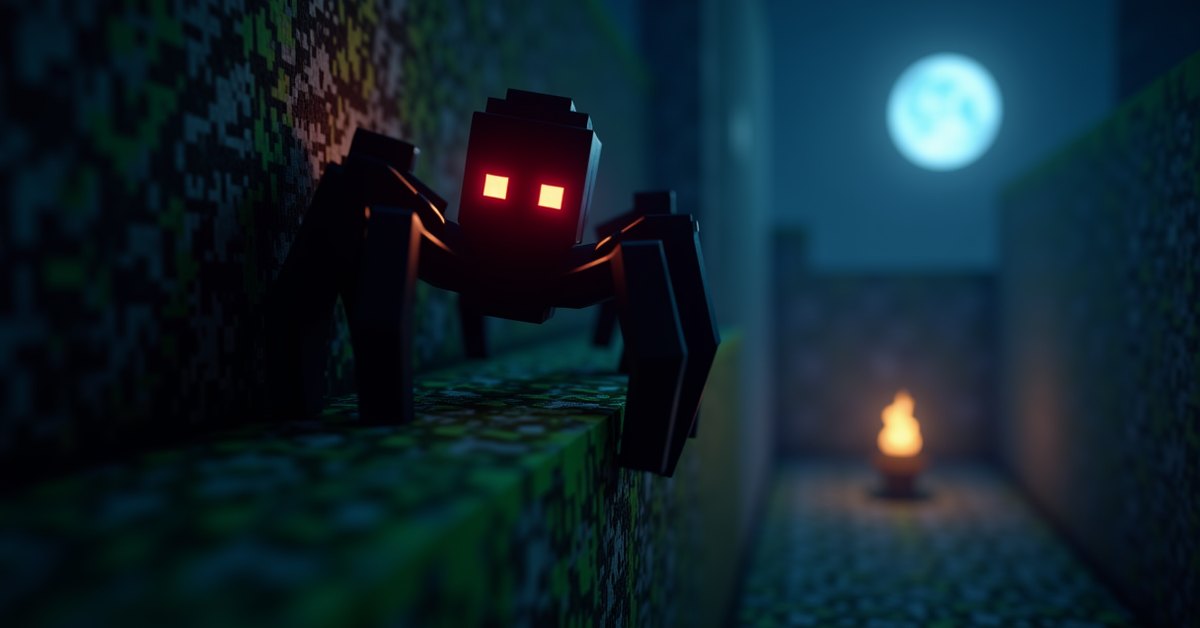
A spider is one of the most common hostile mobs in the Overworld, and it behaves differently from almost every other monster you meet early on. It can walk up walls, squeeze through a one-block gap, and it doesn’t burn when the sun comes up. If you’ve ever been chased across a hillside at dawn by something with eight glowing red eyes, that was a spider that never got the memo about daylight.
Spiders have 16 health points (8 hearts) and attack by biting. What makes them tricky isn’t raw damage, it’s mobility. A zombie has to find a way around a wall. A spider just climbs it.
This guide covers where spiders spawn, when they leave you alone, what they drop, how to fight them, and how to farm them for string once you want a steady supply.
Where spiders spawn
Spiders spawn in the Overworld on solid blocks in the dark, at light level 0 in current versions. They tend to appear in small groups rather than one at a time, so a dark cave opening or an unlit cliff face can produce three or four at once.
Because a spider is two blocks wide but only about one block tall, it needs a flat open space to spawn rather than a narrow tunnel. That footprint is also why spiders show up on cave floors, ravine ledges, and the flat ground around your base at night.
They spawn from the same darkness rules as most Overworld monsters, so the fix is the same too: light up the area. A block placed at light level 8 or higher stops new spiders from appearing on it.
When a spider turns hostile
A spider decides whether to attack you based on the light around it, not the time of day. In light level 12 or brighter, a spider is neutral. It wanders, it ignores you, and it won’t bite unless you hit it first. Drop below light level 12 and the same spider turns hostile and comes after you.
This is the part that surprises new players. A spider that spawned at night doesn’t despawn or calm down at sunrise. It just becomes neutral because the light went up. Walk into a shadow, step into a cave, or wait for dusk, and that “friendly” spider will bite. Never trust one near a dark doorway.
Unlike zombies and skeletons, spiders don’t catch fire in daylight. A daytime spider is safe to walk past in the open, but it stays alive and stays dangerous the moment the light drops.
Climbing and squeezing: how spiders move
Two movement traits make spiders a real threat to a base.
First, spiders climb walls. A vertical stone wall that would stop a zombie means nothing to a spider, which treats it like a ladder and crawls straight up. A simple perimeter wall won’t keep them out.
Second, spiders fit through gaps only one block tall. Because their hitbox is short and wide, a spider can crawl under a slab or through a one-high opening that you’d expect to be safe.
The standard fix for both problems is an overhang. Put a lip on top of your wall that sticks out one block, or top the wall with a row of upside-down slabs or a fence with a block above it. A climbing spider reaches the overhang and can’t get past it. That single detail turns a useless wall into a real barrier.
What spiders drop
Kill a spider and you’ll usually get string, which is the whole reason players farm them. A spider drops 0 to 2 string, and the Looting enchantment on your sword raises the maximum. On top of that, a spider has a 1 in 3 chance to drop a single spider eye, but only when a player or a tamed wolf lands the killing blow. A spider that dies in a fall or in lava leaves nothing.
Spiders also give experience when a player kills them.
String is one of the more useful early materials in the game. You need it for a bow, a crossbow, and a fishing rod, and you can also turn it into wool (four string in a square makes one white wool), leads, scaffolding, tripwire hooks, and looms. A good string supply early on saves a lot of sheep-hunting.
Spider eyes have two main uses. Eating one restores a little hunger but poisons you, so it’s an emergency food at best. The better use is brewing: a spider eye is the base for a fermented spider eye, which flips potions into their negative versions like weakness, harming, and slowness.
How to fight a spider
Spiders are fast and they lunge, so backpedaling in a straight line rarely works. A few habits make the fight easier.
- Fight in the light when you can. Get the spider into light level 12 or higher and it stops attacking, which lets you land free hits.
- Use the terrain. Spiders struggle to reach you if you stand on a block two high with an overhang, since they climb up and then get stuck under the lip.
- Time your swing. A spider pauses slightly before it leaps. Hit it as it closes in rather than swinging wildly.
- Watch your back at dawn. Daytime spiders are neutral, not gone. Don’t turn away from one near a cave mouth.
Regular spiders do not poison you. If something bit you and your health bar started ticking down from poison, that was a cave spider, which is a separate, smaller mob found in mineshafts. A normal Overworld spider only deals plain bite damage.
Spider jockeys
Once in a while a spider spawns with a skeleton riding on its back. This combination is called a spider jockey, and it happens roughly 1% of the time a spider spawns. The result is nasty: you get a skeleton shooting arrows at you while the spider carries it up walls and closes distance fast.
The trick is to split them up. Kill the spider first and the skeleton drops to the ground where it fights like any normal skeleton. Try to fight both at once, especially near a ledge, and the mobility of the pair will punish you.
Spiders on hard difficulty
On hard difficulty, spiders sometimes spawn already carrying a random status effect, such as speed, strength, regeneration, or invisibility. An invisible spider is genuinely dangerous because you can only see its red eyes, and a spider with speed can outrun you. If you’re playing on hard and something is biting you out of thin air, look for a pair of floating eyes.
Building a spider farm
If you want string and spider eyes in bulk, a spawner-based farm is the cleanest option. Mineshafts contain cave spider spawners, but for regular spiders the usual approach is a dark mob farm that collects spiders along with other monsters.
A spider’s two-wide body makes it awkward inside a standard mob-farm collection channel, so many players build a dedicated design. The core idea is simple: a large dark platform where spiders spawn, a way to push them off the edge or into a channel, and a killing spot at the bottom where you can hit them for the string and eye drops.
Because spiders climb, farm walls need the same overhang trick as base walls, or the spiders will crawl out of the collection area. Build the drop chamber so they fall onto a floor rather than a wall they can climb, and give yourself a one-block gap to strike through so you get the player-kill drops.
For a first farm, string is the payoff worth chasing. A working spider or general mob farm gives you enough string for bows, fishing rods, and wool without ever tracking down a sheep.
Java and Bedrock differences
Spiders behave the same way in both editions. They climb, they squeeze through one-block gaps, they turn neutral in bright light, and they drop the same string and spider eyes. Crafting wool from four string works in both Java and Bedrock, so a spider farm feeds the same recipes no matter which version you play.
Frequently asked questions
Do spiders burn in sunlight?
No. Spiders are one of the few common hostile mobs that survive daylight. A spider in the sun becomes neutral but stays alive, and it turns hostile again as soon as the light around it drops below level 12.
Do normal spiders poison you?
No. Regular Overworld spiders only deal bite damage. Poison comes from cave spiders, a smaller mob that spawns from spawners in abandoned mineshafts.
Can you tame or breed spiders?
No. Spiders are hostile mobs, not animals. There’s no way to tame one, ride one on purpose, or breed them.
How do you stop spiders from climbing your walls?
Add an overhang. A lip that sticks out one block at the top of a wall, or a row of upside-down slabs, stops a climbing spider from reaching the other side.
What is the best drop from a spider?
String, in most cases. It’s used for bows, crossbows, fishing rods, leads, wool, and scaffolding. Spider eyes are useful for brewing fermented spider eyes but you need far fewer of them.
Why did a skeleton ride a spider at me?
That’s a spider jockey, a rare spawn where a skeleton rides a spider. Kill the spider first so the skeleton drops off, then finish the skeleton on the ground.
The one thing worth remembering
Most players get bitten by a spider they thought was safe. Daylight makes a spider neutral, not harmless, and the second it slips into shadow it will turn on you. Treat every spider near a cave or a doorway as a live threat and light up the ground around your base early, and spiders go from a nightly nuisance to a steady source of string.