What is a spyglass?
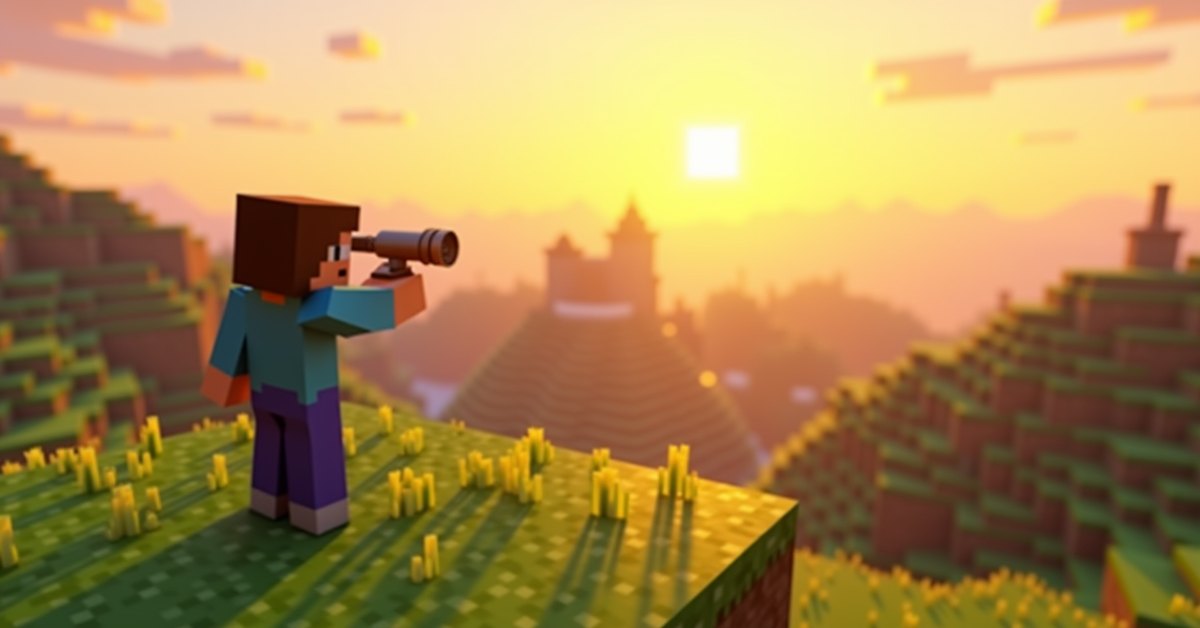
A spyglass is a handheld zoom tool in Minecraft. You look through it to magnify whatever you point at, so you can read the land far ahead before you walk into it. It doesn’t place a block or fire a projectile. Its one job is to zoom your camera in for as long as you hold the use button.
While you look through it, the game narrows your field of view to about a tenth of normal and darkens the edges of the screen into a round black scope. The result is a strong zoom, enough to pick out a mob, a building, or a cliff edge from a long distance.
The spyglass was added in version 1.17, the first Caves and Cliffs update, and it pairs two of that update’s materials: copper and amethyst. Once you have one it never wears out, so a single spyglass can last your whole world. It stacks to one, and you can keep it in your hotbar, your offhand, or a chest until you need a closer look.
How to craft a spyglass
You craft a spyglass from two copper ingots and one amethyst shard. Place the amethyst shard in the top center cell of the crafting grid, then put a copper ingot in the middle center and another in the bottom center. The three items form a vertical line down the middle column. Because the recipe uses all three rows, you need a crafting table rather than the small inventory grid.
Getting copper ingots
Copper comes from copper ore, one of the most common ores in the game. It shows up in both stone and deepslate across a wide band of underground levels, and it turns up in large amounts in dripstone caves, where copper generates more often than almost anywhere else. Mine it with a stone pickaxe or better, then smelt the raw copper in a furnace or blast furnace to get copper ingots. A spyglass needs only two ingots, so even a short mining trip covers it with plenty left over for lightning rods and other copper builds.
Getting an amethyst shard
Amethyst shards come from amethyst geodes, hollow round pockets that generate deep underground. Inside a geode you’ll find blocks of amethyst and growing amethyst clusters on the inner walls. Break a fully grown cluster with any pickaxe and it drops four shards, so one geode gives you far more amethyst than a spyglass needs.
One thing to watch: if you mine a cluster with a Silk Touch pickaxe, you collect the cluster block itself instead of the shards. Use a plain pickaxe when you actually want the shards for crafting.
If you expect to make more than one spyglass, or you want amethyst for tinted glass and other recipes, the clusters inside a geode grow back. They sprout from budding amethyst blocks, which keep producing new buds that mature into clusters over time. That makes a geode a renewable shard farm, so you never run out of the amethyst half of the recipe.
How to use the spyglass
Hold the spyglass and press and hold the use button (right click on Java, the use control on Bedrock and controllers). Your view zooms in and the scope border appears. Release the button and you snap back to your normal view.
A few things happen while you look through it. You move at a slow walk, close to sneaking speed, so you can’t sprint and scout at the same time. You still turn your camera normally, just zoomed in, and the view tracks wherever you aim. The spyglass also works underwater, and you can use it while riding a horse, a boat, or a minecart.
You can drop the spyglass into your offhand slot and raise it with the offhand use control. That leaves your main hand free for a sword or a map, which is the setup most players prefer when traveling.
The zoom centers on your crosshair, so whatever sits in the middle of your screen is what fills the scope. On Java you can hide the rest of the interface with the hide-HUD key while you glass the horizon, which gives you a cleaner view and a tidier screenshot if you’re capturing the moment.
What the spyglass is good for
The obvious use is scouting. Climb a hill, look out across the terrain, and check what’s ahead before committing to a long walk. Open biomes like oceans and deserts are where it earns its place, since you can spot a far shoreline or a structure that would be just a few pixels with the naked eye.
It’s also good for confirming structures at range. Villages, ocean monuments, pillager outposts, and nether fortresses all read more clearly through the zoom, so you can tell what you’re looking at before you cross dangerous ground to reach it. That saves a lot of wasted trips toward shapes that turn out to be nothing.
It helps with mobs too. You can count animals in a distant field, check whether that silhouette on a ridge is a creeper or a sheep, or watch a phantom circle overhead without losing track of it. On multiplayer servers, players use it to keep an eye on activity far across the map.
Builders reach for it as well. Lining up a faraway tower, checking that a large build stays symmetrical, or framing a clean screenshot all get easier when you can zoom in without installing a mod.
Tips and common mistakes
Keep the spyglass somewhere you can reach fast. Scouting works best when you can raise it the moment something catches your eye, then drop it and keep moving. A spot near the end of your hotbar or in the offhand works well.
Use it from high ground. The higher you stand, the more terrain clears the trees and hills in front of you, so a hilltop or a tower gives the spyglass far more to show than flat ground does.
Don’t expect to scan while sprinting. The slowdown means you stop to look, so plan to pause at vantage points instead of scanning on the run. Players who forget this get frustrated that the spyglass feels slow, when it’s really meant for standing still.
Craft a spare while you’re at the table. The materials are cheap, and a second spyglass in your ender chest or base means you’re never caught without one after a death or a long trip from home.
Spyglass mechanics and limits
The spyglass has no durability. Using it costs nothing and it never breaks, so you don’t have to ration it or carry replacements.
The zoom is a fixed amount. There’s no way to zoom further or less in the base game; you get the same magnification every time you raise it.
You can’t enchant a spyglass at an enchanting table, and it won’t take enchantments from books on an anvil. You can rename it on an anvil if you like, and you can display one in an item frame as decoration.
The movement slowdown is the real tradeoff. Because you crawl while looking through it, the spyglass is a stop-and-look tool rather than something you use on the move. Plan your scouting around short pauses and it stops feeling like a downside.
Java vs. Bedrock
The spyglass works the same way on both Java and Bedrock: same recipe, same zoom, same slowdown. The main difference is the control you press to use it, which follows whatever your use-item binding is on keyboard, controller, or touch.
Frequently asked questions
Can you zoom in further with a spyglass?
No. The spyglass has one fixed zoom level and there’s no vanilla way to increase it. Your in-game FOV slider changes how wide your normal view is, but the spyglass itself always zooms the same amount.
Does the spyglass have durability?
No. It never wears out and never breaks, no matter how often you use it. One spyglass lasts forever.
Why do I move slowly when using the spyglass?
That’s intended. Looking through the spyglass slows you to roughly sneaking speed so it can’t double as a free scouting tool while you sprint. Release the use button and your speed returns to normal.
Can you enchant a spyglass?
No. It can’t be enchanted at a table or with an anvil. You can rename it on an anvil, but that’s the only anvil interaction it has.
Does the spyglass work underwater?
Yes. You can use it underwater and while riding a boat, horse, or minecart. The zoom and the scope border behave the same as they do on land.
Can you find a spyglass instead of crafting it?
Crafting is the dependable way to get one. Stock up on copper and grab a handful of amethyst shards from a geode, and you’ll have the materials for a spyglass with plenty to spare.
Worth keeping one on hand
A spyglass is cheap, permanent, and saves you from a lot of pointless walking. If you’re heading into open ocean or a wide biome to hunt for a structure, craft one first and check the horizon before you commit to the trek.