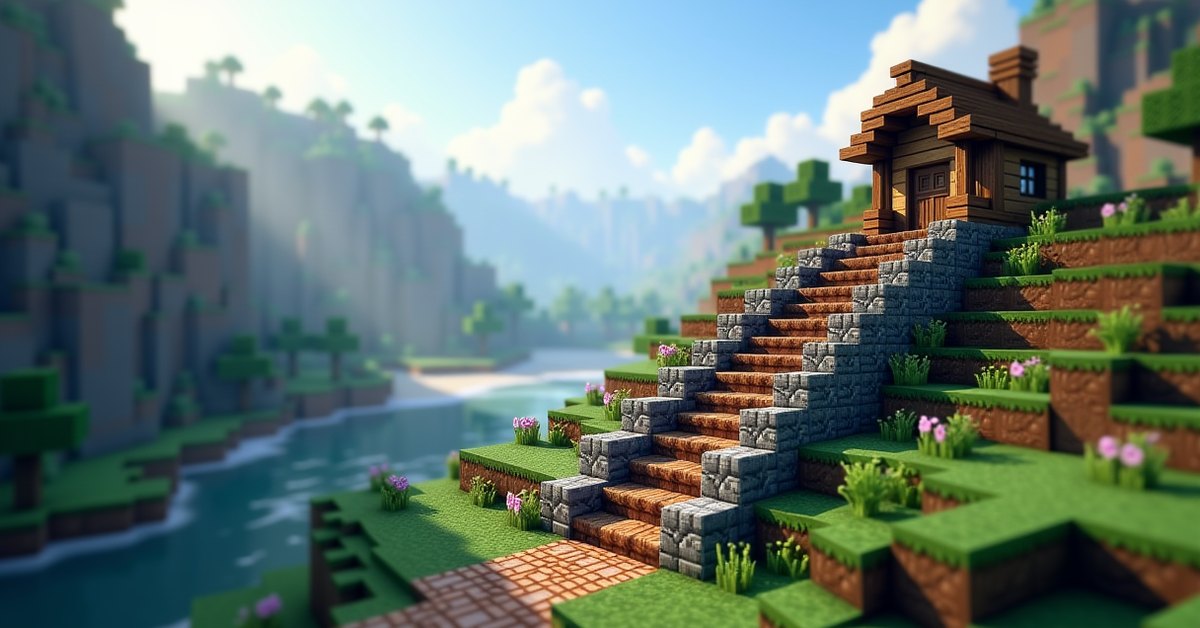
What are stairs in Minecraft?
Stairs are a partial block shape made from almost every solid building block in the game. One stair takes up roughly half the volume of a full block: a bottom slab on one side and a quarter-block step on top of it. That shape lets you climb without jumping, run smooth ramps to the top of any build, and break up flat walls with shadow and depth.
If a block can become a slab, there is almost always a matching stair. The family runs from oak planks to deepslate bricks to waxed cut copper. They all share the same crafting pattern and the same placement rules, so once you know how one works you know how all of them work.
How to craft stairs
Crafting recipe
The recipe is the same for every stair type: six of the base block laid out as an ascending staircase in the 3×3 crafting grid. Put one block in the top-left, two in the middle row (left and center), and three across the bottom row. The recipe yields four stairs.
Six oak planks gives four oak stairs. Six cobblestone gives four cobblestone stairs. The crafting table handles every variant; you don’t need a specialty workbench.
Stonecutter recipe
For stone-family stairs, a stonecutter is a cleaner option. One full block gives one stair with no waste, instead of six blocks for four stairs. That is a 33% material savings when you are working through a stack of cobblestone, deepslate bricks, sandstone, blackstone, prismarine, quartz, or any other stone-type base. The stonecutter does not work on wood, so plank stairs still go through the crafting grid.
Every stair variant
Minecraft has more stair variants than any other block family, and the list keeps growing with each update. Here is the rough breakdown as of version 1.21.
Wood stairs
One stair for every plank type: oak, spruce, birch, jungle, acacia, dark oak, mangrove, cherry, pale oak, bamboo, bamboo mosaic, crimson, and warped. Crimson, warped, and bamboo stairs are fire-resistant; the rest burn.
Stone and rock stairs
Almost every stone-family block has a stair version. The list covers cobblestone (regular and mossy), stone, smooth stone, granite (regular and polished), diorite (regular and polished), andesite (regular and polished), deepslate variants (cobbled, polished, brick, tile), tuff variants (regular, polished, brick), blackstone (regular and polished), polished blackstone brick, end stone brick, purpur, prismarine (regular, brick, dark), quartz (regular and smooth), sandstone (regular and smooth), red sandstone (regular and smooth), and stone bricks (regular and mossy). A few solid blocks skip stairs in vanilla, including calcite and basalt; if a build needs that color or texture, the closest substitute is a slab or a wall.
Brick, copper, and other stairs
Bricks, nether bricks (regular and red), mud bricks, and resin bricks all come in stair form. Cut copper has stairs at every oxidation stage (regular, exposed, weathered, oxidized), plus a waxed version of each. That gives copper builders eight separate cut copper stair entries to pick from, which is part of why copper has become a designer favorite.
How stairs are placed and shaped
Direction
The step of a stair faces away from you when you place it. Look at the wall, place the stair, and the climbable side will be on your side. If you want it facing the other way, walk around the block first.
Upside-down stairs
Stairs flip based on where on the target face you click. Click the bottom half of the target block face and the stair lands right-side up. Click the top half and the stair flips upside down. Upside-down stairs are how you get the cornice look under a roof or the overhang on a balcony.
Corner shapes
Two stairs placed next to each other at a 90-degree angle auto-snap into a corner piece. Inner corners fill the gap; outer corners cut a notch. You don’t craft these shapes separately; the game figures it out from how the stairs touch. If a corner snaps the wrong way, break one stair and replace it after the neighbor is set.
How stairs work
Walking up without jumping
You climb stairs at a walk. Slabs do the same for one step up, but stairs let you run long ascents without ever pressing jump. That makes them the standard for ramps, garden paths, and any build that animals or villagers need to traverse.
Waterlogging
Almost every stair in the game can be waterlogged. Hold a water bucket, right-click the stair, and water fills the empty space around the stair shape. The stair still looks solid, but the cell now counts as a water source. You can do the same with sea pickles or coral, then use waterlogged stairs to feed those plants. The same waterlogging works for elevators, hidden item-sorter parts, and underwater walkways where you want a path you can still breathe over.
Mining and tools
A stair takes the same tool as its base block. Wood stairs break fastest with an axe. Stone-family stairs break fastest with a pickaxe; mining them with anything else drops nothing. Copper stairs need a stone pickaxe or better. The mining time matches the base block, which makes stair-heavy builds slow to tear down if you change your mind.
Mobs, fire, and other quirks
Mobs treat stairs like a normal slope. Zombies, skeletons, and villagers walk up them without help. Fire spreads on wood stairs the same way it spreads on wood planks; if you put oak stairs next to a campfire, expect a problem. Crimson, warped, and bamboo stairs are immune. Torches, redstone torches, and other items that attach to block tops can sit on the flat top of a right-side-up stair, and on the underside of an upside-down stair if the underside is flush.
Build ideas
Stairs are one of the most-used blocks in any decorative build. A few patterns that work in almost any project:
- Run upside-down stairs under any roof edge to add a clean cornice.
- Stack stairs in a 1×1 column with alternating directions for a quick spiral staircase that fits inside a tower.
- Mix two stair materials in a checker pattern on a floor for a tiled look without changing block height.
- Use stairs as the front of a kitchen counter or workshop bench; a slab on top finishes the surface.
- Hide redstone wiring by capping the line with upside-down stairs that match the floor above.
Java vs. Bedrock differences
The stair system is one of the most consistent block families across editions. Crafting, placement, corner auto-snap, and waterlogging all behave the same on Java and Bedrock. The differences are small: stair rotation at certain odd angles can look slightly off where stair pieces meet stained glass or chains, and Bedrock occasionally renders inner corners with a tiny visual seam that Java does not. For practical builds, you can treat the two editions as identical for stair purposes.
Frequently asked questions
How many stairs does one craft give?
Four stairs per crafting recipe, from six base blocks. For a 1-to-1 conversion with no waste, use a stonecutter on any stone-family base. The stonecutter trades one full block for one stair.
Can mobs walk up stairs?
Yes. Hostile and friendly mobs both treat stairs like slopes. That makes stairs useful for villager paths and animal pens, and it makes them a poor choice for a wall you want zombies to bounce off. For zombie defense, use a full block step that is too tall to jump.
Do stairs block water?
Water flows over and around the stair shape. The solid part stops the flow, the open part lets it through. If you waterlog the stair, the whole cell counts as water and you can swim through the open part while the visual stair shape stays in place.
Can you waterlog stairs?
Yes, every standard stair can be waterlogged. Use a water bucket on the stair to add water; use an empty bucket on it to pull the water back out. The waterlogged state survives chunk reloads and works for plant farming, hidden builds, and underwater walkways.
Do wooden stairs burn?
Most do. Oak, spruce, birch, jungle, acacia, dark oak, mangrove, cherry, and pale oak stairs all catch fire and spread it. Crimson, warped, and bamboo stairs do not. If you are building near lava or a fireplace, pick a non-flammable wood or switch to stone.
Can you put a torch on a stair?
Yes, on the flat top of a right-side-up stair. The top half of a regular stair counts as a full block face for placement, so torches, signs, banners, and pressure plates sit on it cleanly. The slanted face does not accept attachments.
Is there a stair for every block?
No. Stairs exist for most building-grade blocks: planks, bricks, stone variants, copper, prismarine, sandstone, purpur, end stone brick, and so on. Resource blocks like iron, gold, diamond, emerald, and netherite do not get stair versions, and most ore blocks skip stairs too. If a stonecutter does not show a stair option for the block, there isn’t one.
Stairs are one of the first blocks new builders learn and one of the last advanced builders stop relying on. Knowing the placement rules and which materials burn is enough to use them in any build without surprises.