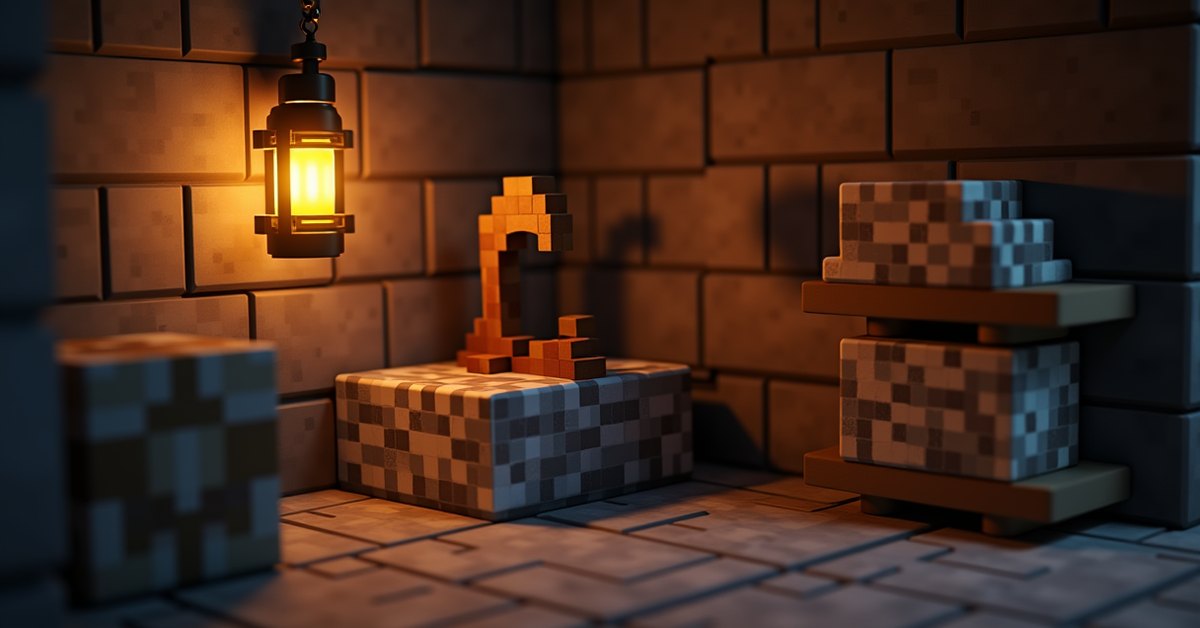
What the stonecutter does
The stonecutter is a utility block that turns stone-family blocks into their cut variants (stairs, slabs, walls, chiseled versions) at a 1:1 ratio. It’s the cleanest way to convert a stack of stone into the exact shapes you need for a build, and it skips most of the wasted recipe combinations you’d hit at a crafting table.
It’s also the job-site block for the mason villager profession. Drop one in front of an unemployed adult villager and they’ll become a stone mason, which unlocks trades for cut blocks, polished blocks, and emeralds.
You’ll spawn near one in most villages if a mason lives there. If you don’t have one, the recipe is cheap: 1 iron ingot and 3 stone blocks. Most players build one as soon as they have iron and a stable stone supply.
How to craft a stonecutter
The recipe is straightforward. Place 1 iron ingot in the top-center slot of the crafting grid, then put 3 stone blocks across the middle row. Cobblestone and other variants don’t work here; the recipe needs regular smooth stone, which you get by smelting cobblestone in a furnace.
Once it’s crafted, place the stonecutter anywhere with a solid block to support it. It only takes up one block of space and works on the floor, on tables, or as part of a stone workshop wall.
Where the stonecutter spawns naturally
You can also pick one up without crafting. Stonecutters generate in:
- Mason houses in plains, savanna, taiga, snowy, and desert villages
- Some village support structures and outpost-related builds, rarely
Mine the block with a wooden pickaxe or better. Anything less (hand, axe, shovel) breaks the block without dropping it, so check your hotbar before you swing.
How to use the stonecutter
Right-click the stonecutter (or use the “Use Item” button on Bedrock) to open the interface. You’ll see a single input slot on the left and a list of available recipes on the right.
Drop your stone-family block in the input slot. The right side populates with every cut variant available for that block. Click the variant you want, then drag the output into your inventory. For most recipes, each input block produces one output block.
Shift-click the output to craft as many as your input stack allows. With a full stack of 64 stone, that’s 64 stone stairs in one click. Much faster than running a 6-stone stairs recipe in the crafting table four times for the same 24 stairs.
What blocks the stonecutter accepts
The stonecutter accepts most stone-family blocks. Wood, glass, and biome blocks like terracotta won’t work. Here’s a rundown of what does:
- Stone, cobblestone, mossy cobblestone
- Stone bricks and the cracked, mossy, and chiseled variants
- Granite, diorite, andesite, and their polished forms
- Deepslate, cobbled deepslate, polished deepslate, deepslate bricks, deepslate tiles
- Tuff, polished tuff, tuff bricks
- Sandstone and red sandstone, including smooth, cut, and chiseled forms
- Quartz block, smooth quartz, quartz bricks
- Prismarine, prismarine bricks, dark prismarine
- Nether bricks, red nether bricks, cracked nether bricks, chiseled nether bricks
- Blackstone and polished blackstone
- End stone and end stone bricks
- Purpur block
- Mud bricks
- Cut copper and chiseled copper in any oxidation stage, waxed or unwaxed
- Resin bricks and chiseled resin bricks
Each input block has its own set of outputs. Cobblestone cuts into cobblestone slabs, cobblestone stairs, and cobblestone walls. Stone bricks unlock chiseled stone bricks and stone brick stairs, slabs, and walls. The right-side menu shows you everything available for whatever you put in.
Stonecutter vs. crafting table: when to use which
The stonecutter is more efficient for most stone-family conversions. A crafting table burns 6 stone bricks to make 4 stone brick stairs, a loss of 2 blocks per recipe. The stonecutter takes 1 stone brick and gives you 1 stone brick stair. Over a full stack of 64 stone bricks, that’s the difference between roughly 42 stairs and 64 stairs from the same input.
There’s one place the crafting table still helps: any recipe that mixes inputs. Mossy stone bricks come from a stone brick plus vine combination at the crafting table. The stonecutter can’t add the vine, so you make the mossy variant at a crafting table first, then cut it into stairs, slabs, and walls at the stonecutter.
The cutter is also slightly faster for chiseled blocks. A crafting table needs 2 slabs to make 1 chiseled stone brick, which means stacking two recipes. The stonecutter goes from 1 stone brick straight to 1 chiseled stone brick.
The mason villager
Place a stonecutter near an unemployed adult villager and they’ll claim it as their job site, turning them into a mason. Mason villagers buy clay for emeralds at Novice level, and offer cut and polished stone variants, dyed terracotta, and quartz at higher levels.
To build a useful mason trading post, lock in a Novice mason whose first trade is clay-for-emeralds before they level up. Clay is renewable from rivers, lush caves, and dripleaf areas, so the trade is one of the better budget paths to a steady emerald income.
To break a mason’s profession (so the villager can take a different job), break the stonecutter, wait until their badge disappears, and place a different job-site block within range.
Stonecutter mechanics and behavior
Does the stonecutter deal damage?
In Bedrock Edition, walking or standing on top of a stonecutter deals contact damage to mobs and players. That makes it usable as a floor trap when you funnel mobs across a line of stonecutters. In Java Edition, the stonecutter does not deal contact damage. It’s safe to stand on in Java.
Lighting and transparency
The stonecutter has a slightly shorter hitbox than a full block, so light bleeds around its edges. Most pathfinding mobs still treat it like a solid block, so you can use it in walkways and bridges without strange mob behavior.
Redstone and automation
The stonecutter doesn’t emit a redstone signal and doesn’t react to one. Comparators won’t read anything useful from it, and hoppers can’t pull items in or out. There’s no auto-cutting farm. It’s a manual-use block by design.
Mining the stonecutter
Mine it with a wooden pickaxe or better to get it back as a drop. Stone pickaxes and above also work and break the block faster. Hands, axes, swords, and shovels break it without dropping anything, which is a common way to lose a stonecutter when you’re rearranging a workshop.
Tips and common mistakes
Build the stonecutter next to your furnace. You’ll smelt raw cobblestone into stone, then cut the stone into whatever variant your current project needs. Having both tools in the same spot saves a lot of running around when you’re working on big stone builds.
Don’t try to make chiseled blocks from cobblestone directly. To get chiseled stone bricks at the stonecutter, the input has to be stone bricks, not cobblestone. The path is cobblestone, smelt to stone, craft to stone bricks, then cut to chiseled. Each step needs the right tool.
Watch the input slot. The recipe list updates the moment you place a block. If you put in the wrong block (andesite when you meant diorite, for example), the available cuts won’t match what you wanted. Pull the block back out, swap to the right one, and the list refreshes.
The stonecutter doesn’t consume or grant XP. Unlike a grindstone, it’s purely a converter. No experience cost, no experience reward.
For big projects, set up labeled chests next to the stonecutter: one for stone, one for cobblestone, one for deepslate, one for quartz. Pulling from a labeled chest is a lot faster than digging through a mixed inventory while you’re trying to keep a build flowing.
Java vs. Bedrock differences
Most of the stonecutter’s behavior is the same across editions. The biggest gameplay difference is contact damage: Bedrock stonecutters hurt mobs and players standing on top, while Java stonecutters do not. The UI is slightly different too (Bedrock shows recipes as icons in a scrollable grid, Java shows a single-column list), but the recipes available are the same in both. Placement rules are nearly identical, with Java being slightly stricter about needing a supporting block underneath in some edge cases.
Frequently asked questions
Can you craft wood items at a stonecutter?
No. The stonecutter only accepts stone-family blocks and a few special exceptions like cut copper. Planks, logs, and other wood items go through a crafting table.
Does the stonecutter save resources?
Yes, for most recipes. Stairs are the biggest saving: 1 input gives 1 stair at the stonecutter, while the crafting table needs 6 inputs to make 4 stairs. Walls and chiseled variants also come out cheaper at the cutter.
Can you automate a stonecutter with hoppers?
No. Hoppers can’t push items into the stonecutter or pull items out. It’s manual only.
Why won’t a villager take my stonecutter as a job site?
Either the villager is too young (only adults take jobs), the villager already has a profession, or another job-site block is closer. Move the stonecutter closer, break any competing workstations, and wait a few in-game minutes for the villager to claim it.
How many stonecutters do I need?
One is enough for personal building. For a trading hall, you need one stonecutter per mason villager you want to employ. Each mason needs their own job-site block.
Does the stonecutter work on copper blocks?
Yes. Cut copper, chiseled copper, and the slab and stair variants are all available at the stonecutter, in every oxidation stage and in waxed form. Other copper recipes (like crafting copper blocks from ingots) still need a crafting table.
Will the stonecutter break my pickaxe faster than other blocks?
No more than any other stone block. The stonecutter has the same hardness as regular stone, so mining it costs about the same durability as mining a single stone block.
Worth keeping in your toolkit
The stonecutter pays for itself within the first big stone build. If you’re laying down stairs along a long wall or filling a path with slabs, run them through the cutter instead of crowding a crafting grid with 6-block recipes. The iron ingot is cheap and the per-block savings add up faster than people expect.