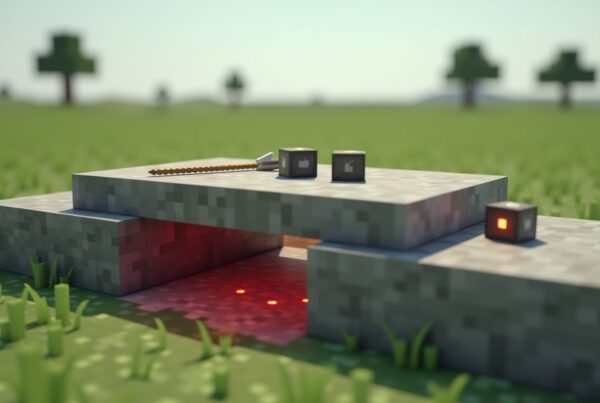
What string and tripwire actually are
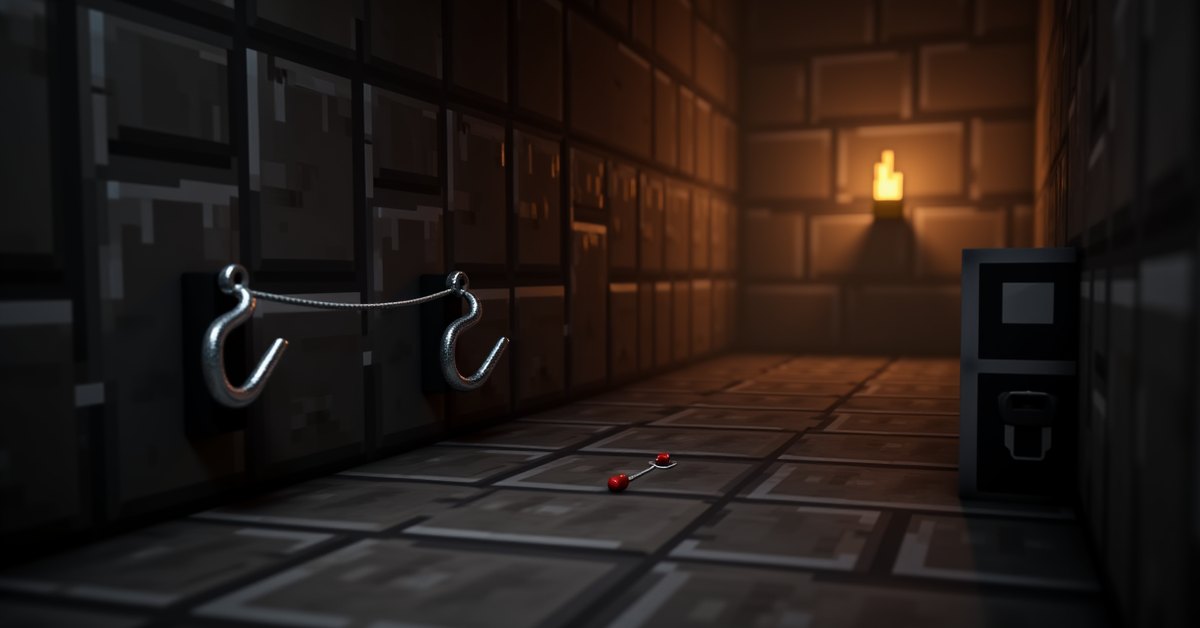
String is one of those items that quietly turns into something else the moment you place it. In your inventory it’s just string. The moment you put it on the ground between two hooks, it becomes a tripwire: a thin, almost-invisible line that fires a redstone signal when something crosses it.
That’s the trick most new players miss. There’s no separate “tripwire” item to craft. You place string between two tripwire hooks, and the string itself does the detecting.
How to get string
String is one of the easier items to stockpile. It drops from spiders, you can break cobwebs to harvest it, and you can fish it up. Some chests also contain it.
- Spiders and cave spiders drop 0 to 2 string per kill. Looting on your sword raises the cap.
- Breaking a cobweb with shears or a sword gives you string. Shears give consistent drops; a sword has a small chance of dropping nothing.
- Fishing pulls string up as junk loot.
- Dungeon, mineshaft, and woodland mansion chests sometimes contain string.
- An adult tamed cat occasionally brings string as a morning gift.
If you need a lot of string and don’t have access to a spider spawner, the cat gift trick and a steady fishing rotation are your best on-demand sources. A spider spawner converted into a farm is the bulk option.
How to set up a tripwire
The full circuit needs three things: two tripwire hooks, a line of string, and somewhere for the redstone signal to go. Here’s the order:
- Place a tripwire hook on a solid block. The arm of the hook points away from the block.
- Place a second tripwire hook on an opposing solid block, facing the first. Both hooks need to face each other.
- Right-click string in the air gap between them. The string fills the gap. You can place up to 40 blocks of string between two hooks.
- Run redstone dust away from either hook. When the string is broken or stepped on, both hooks output a redstone signal.
The hooks click into a “set” state when the line is complete. If the connection is wrong (gap too long, hooks not facing each other, the line broken by a non-air block), the hooks stay loose and the circuit won’t fire.
Quick recipe reminders
The recipes you’ll keep reaching for around tripwire builds:
- Tripwire hook: one iron ingot on top of one stick on top of one plank, in a vertical column on the crafting grid. One craft gives you two hooks.
- Bow: three string and three sticks.
- Lead: four string and one slimeball, gives two leads.
- Crossbow: three sticks, two string, one iron ingot, and one tripwire hook.
- Scaffolding: six bamboo and one string, gives six scaffolding.
- Wool fallback: four string in a 2×2 grid makes one wool block.
How tripwire actually fires
Tripwire fires when any entity crosses it. That includes you, mobs, arrows in flight, and minecarts. The hooks output a redstone signal at full strength for as long as something is touching the string. Step off, and the signal drops back to zero.
A few important behavior notes:
- Breaking the string with anything other than shears also fires the hooks once. If you sprint through your own line, you’ll trigger it and break it at the same time.
- Shears break string silently. The hooks don’t fire when string is cut with shears. That’s how you disarm a circuit without setting it off.
- Sneaking does not let you cross string without triggering it. There’s no stealth option. The line fires on any entity hitbox that touches it.
- You can place certain blocks in the same space as a strung tripwire (like a fence post or stairs), but the line still detects on contact.
- An invisible mob will still trigger tripwire. Detection runs off the hitbox, not the visual.
What you can build with it
Tripwire shows up in a lot of player-made contraptions because it’s cheap and gives you a wide line of detection without taking up much vertical space. A few of the common builds:
Door openers
Run tripwire across a hallway. Wire the hooks to a piston-controlled iron door or a hidden piston wall. The door opens as soon as you walk in and closes when you step off the line. It feels like a smart house and costs almost nothing to build.
Mob traps
Tripwire under a row of dispensers loaded with arrows turns a corridor into a kill zone for any mob that wanders in. Pair it with a one-tick repeater if you want a single arrow burst per crossing instead of a continuous spray.
Alarm systems
Wire tripwire hooks to a note block, a bell, or a row of dispensers full of fireworks. You’ll hear it from across the base when a creeper or another player crosses the line.
Hidden TNT trap
Bury TNT under a path, wire a tripwire line above it, and the first entity through the line lights the fuse. The string is hard to see at a glance, especially in low light, which makes this one of the more reliable PvP traps on multiplayer servers.
Auto-closing crop farms
Run tripwire across the entrance to a wheat or carrot farm. Wire the hooks to a piston that pushes a dirt block into the doorway behind you. The farm seals itself when you walk in, keeping mobs out while you harvest, then opens again when you step back across the line. Cheap and reliable.
Tips and common mistakes
- Always carry shears in your hotbar when you’re laying tripwire. If you snap a line by accident with your fist, you lose the string and trigger the trap.
- String is almost invisible against most floor textures. If you’re hiding tripwire as a trap, that helps. If you’re trying to remember where your own circuit runs, mark the hooks with a torch or a sign.
- You can’t place string in water. The block has to be air for the line to connect.
- Both hooks fire together. You can run redstone off either one (or both) and treat them as a single output.
- If you need a delay between detection and the trap firing, drop a repeater on the redstone line. Tripwire by itself has no built-in delay.
- Pressure plates are simpler if all you need is “did something step here.” Use tripwire when you want a long line of detection across a corridor, not a single tile.
- Don’t run a tripwire line through a doorway you use every day. You will forget, and you will lose your own arrows to your own dispenser.
Java vs. Bedrock differences
String and tripwire work almost identically on both editions. A few small differences worth knowing:
- The maximum line length is 40 string blocks between two hooks on both editions.
- Cat gifts include string on both editions. The full list of possible gifts is slightly different per edition, but string is on both.
- The hook texture and animation are the same, but the visual click into the armed position can render with a one-tick delay on either edition depending on chunk-load state.
- Crossbow loot tables for pillagers vary a bit between editions; if you’re farming string indirectly through pillager kills, results will differ.
Frequently asked questions
Can you break tripwire without triggering it?
Yes, but only with shears. Anything else (fist, sword, pickaxe) fires the connected hooks once before destroying the string.
Does sneaking let you cross tripwire?
No. Sneaking has no effect on tripwire detection. The line fires on any entity hitbox that touches it.
What’s the maximum length of a tripwire?
40 blocks of string between two hooks. Past that, the line doesn’t connect and the hooks stay loose.
Do arrows trigger tripwire?
Yes. An arrow flying through a tripwire counts as an entity contact and fires the hooks. This is occasionally useful for remote triggers, more often annoying when an arrow you shot at a mob takes out your own trap.
Can I use string to craft wool?
Yes. Four string in a 2×2 grid makes one wool block. It’s a slow way to get wool compared to shearing a sheep, but it’s the only fallback if you can’t find sheep nearby.
Do tripwire hooks need redstone dust to work?
Not strictly. The hooks emit a redstone signal on their own when triggered. You only need dust to carry the signal somewhere useful, like a piston, a dispenser, or a note block.
Can cobwebs be turned back into string?
Yes. Break a cobweb with shears or a sword and it drops as string. Shears give consistent drops; a sword has a small chance of dropping nothing.
Final thought
Tripwire is one of the cheapest detection tools in the game and one of the easiest to overlook because pressure plates are more visible. If you’ve never built a hidden alarm or a corridor trap, string and a pair of hooks is a one-evening project that will change how you think about base security.