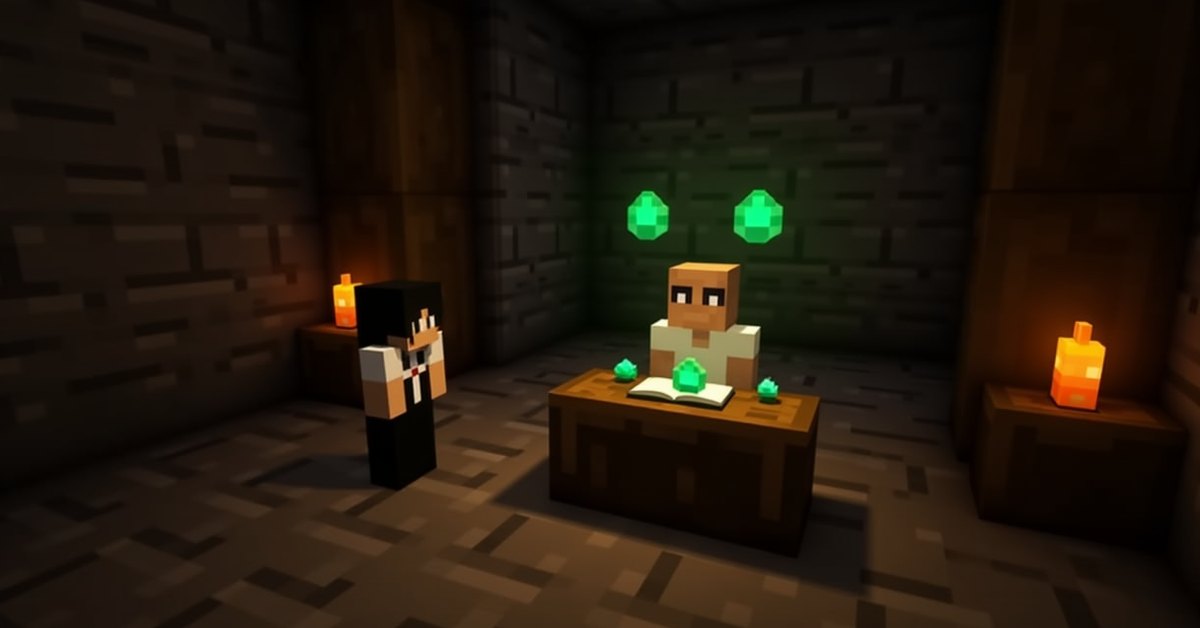
What trading is in Minecraft
Trading is how you turn villagers and wandering traders into a steady supply of useful items. You hand over emeralds (or sometimes raw goods plus emeralds), and you get back things like enchanted books, tools, armor, food, and building blocks. It is one of the few ways to get certain items reliably, including Mending books and bulk stacks of glass or gravel.
Two kinds of mobs trade with you. Villagers live in villages and take on a profession when they claim a job site block. Wandering traders show up on their own, stay for a while, then leave. They work differently, so it helps to understand both.
Emeralds are the currency. You earn them by trading goods, mining emerald ore, or completing trades that pay out in emeralds. Once you have a working villager hall, emeralds stop being rare and start being a tool you spend freely.
How villager trading works
An adult villager with a profession will show a trade menu when you interact with it. A villager only gets a profession after it claims an unclaimed job site block, such as a lectern (librarian), a blast furnace (armorer), or a composter (farmer). Baby villagers, unemployed villagers, and the green-robed nitwit never trade.
Each trade has a cost on the left and a result on the right. Some trades cost only emeralds. Others cost a raw item plus emeralds, or they pay you emeralds in exchange for goods you bring. When you have the input items in your inventory, click the result to complete the trade.
A red X over a trade means it is locked or out of stock. Locked trades open up as the villager gains experience. Out-of-stock trades come back after the villager restocks at its job site.
Professions and job sites
A villager’s profession decides what it sells. Librarians deal in enchanted books and bookshelves. Farmers buy crops and sell bread, cookies, and golden carrots. Toolsmiths, weaponsmiths, and armorers sell gear. Clerics handle redstone, ender pearls, and bottles of enchanting. Cartographers sell maps, including the ones that lead to ocean monuments and woodland mansions.
If a villager has no profession and you want a specific one, place the matching job site block next to it and wait. To reroll a librarian’s book offers, break and replace the lectern until the trade you want appears, but only before you have traded with that villager. Once you complete a trade at a given level, those offers lock in.
Trade levels and experience
Villagers rank up through five tiers: novice, apprentice, journeyman, expert, and master. The badge on their belt changes color as they climb, from stone to iron, gold, emerald, and finally diamond. Trading with a villager gives it experience. Fill the experience bar and the villager levels up, unlocking a fresh set of trades at the new tier.
A brand new villager only shows its novice trades. The strongest offers, like a cheap Mending book or discounted diamond gear, usually sit at journeyman level or higher. You reach those by trading repeatedly, so plan to make a few cheap trades just to push a villager up the ladder.
Restocking and supply
Villagers do not hold infinite stock. Each trade can be used a limited number of times before it shows the red X. To refill, the villager has to return to its job site block and work. A villager that can reach its workstation restocks up to twice per day, normally in the morning and around midday.
This is why your trading hall needs the job site block right next to each villager. If a villager cannot path to its block, it never restocks, and your trades stay empty. A common build keeps the villager in a one-block space with its workstation directly in front of it.
Prices, demand, and how costs change
Trade prices are not fixed. Two systems push them up and down: demand and reputation.
Demand tracks how often a specific trade gets used. Buy the same item many times in a row and its emerald cost creeps up. Leave that trade alone for a while and the price drifts back down. This only affects the item’s primary cost, and it resets over time, so heavy buying is self-correcting rather than permanent.
Reputation works the other way. Your standing with a village, called gossip, changes prices for better or worse. Trade often and villagers like you, nudging costs down a little. Attack or kill villagers and prices climb, and an iron golem may come after you.
Discounts that actually matter
Two discounts are big enough to plan around. The first is curing a zombie villager. If you find or create a zombie villager, weaken it with a Splash Potion of Weakness, feed it a golden apple, and wait for it to convert back, that villager offers steep discounts for the rest of its life. Cure the same villager more than once and the prices drop even further, sometimes to a single emerald for high-tier goods.
The second is the Hero of the Village effect. Defeat a raid by clearing all the waves of pillagers, and every villager in range gives you a temporary price cut. The effect is strongest right after the raid and fades over the following minutes, so spend your emeralds while it lasts.
The wandering trader
The wandering trader is a separate mob that spawns on its own near the player every so often, usually with two trader llamas on leads. It wears a blue robe and carries a small rotating set of trades that refresh each time one appears.
Its stock is random and leans toward things that are otherwise annoying to gather: saplings from biomes you have not visited, coral, flowers, dye, sand, and the occasional useful oddity. It buys nothing and only sells, always for emeralds. After a couple of in-game days it despawns and wanders off.
The trader llamas are worth grabbing. If you kill the wandering trader, or it despawns, the llamas stay and can be tamed and leashed like normal llamas. The trader itself drops a lead when killed, which makes the encounter a small source of leads if you need them.
Building a trading hall
A practical trading hall packs villagers into individual stalls, each with its own job site block. Soul sand or a half-block trick can keep villagers seated and unable to wander. Light the area to stop hostile mobs from spawning and killing your workforce.
Two professions reward the most effort. A librarian hall lets you roll for Mending, Unbreaking III, Efficiency, and other top enchantments at journeyman prices. A farmer or cleric setup gives you renewable emeralds in exchange for crops or rotten flesh. Build the librarian hall first if you want enchanted books, since Mending alone changes how you play.
Java and Bedrock differences
The core loop is the same on both editions, but a few details differ. On Java, the discount from curing a zombie villager is larger and more reliable, and repeated cures stack the discount further. On Bedrock, the cure discount is smaller and behaves less predictably.
Bedrock also handles some trade menus a little differently, and the way reputation and demand resolve can vary between versions. The safe approach is to test prices on your own world rather than assume a number, since both editions get balance tweaks across updates.
Tips and common mistakes
Lock in a librarian’s good trade by completing it once before you break the lectern again. After the first trade, breaking the lectern no longer rerolls that offer.
Keep villagers safe. A zombie that breaks into your hall at night can wipe out hours of leveling, so seal the room and light it well.
Do not over-buy a single trade in one sitting if you care about price. Spread big purchases across a few sessions to keep demand from inflating the cost.
Cure a zombie villager before you set up a big buying run. The discount applies to that villager’s whole trade list, so it pays off most on expensive gear.
Frequently asked questions
Why won’t a villager trade with me?
It probably has no profession. Baby villagers, nitwits, and unemployed villagers cannot trade. Give it a job site block and wait for it to claim the profession.
How do villagers level up?
Trading with a villager gives it experience. Filling the experience bar moves it to the next tier and unlocks new trades. There are five tiers, from novice to master.
Why is a trade showing a red X?
The trade is either locked behind a higher level or temporarily out of stock. Locked trades open as the villager ranks up. Out-of-stock trades return after the villager restocks at its job site.
How do I lower trade prices?
Cure a zombie villager for a lasting discount, or earn the Hero of the Village effect by winning a raid for a temporary one. Trading regularly also improves your reputation and trims prices slightly.
How often do villagers restock?
Up to twice per day, as long as the villager can reach its job site block to work. No path to the block means no restock.
Can I change a villager’s profession after it has traded?
No. Once a villager completes a trade, its profession and offers are locked. Break the workstation before the first trade if you want to reroll.
Does the wandering trader buy anything?
No. It only sells, always for emeralds, and its stock is random. After a day or two it despawns, leaving its llamas behind.
Where to start
If you only build one trading setup, make it a librarian hall and chase a Mending book first. Everything else in trading, from cheap gear to renewable emeralds, gets easier once you understand restocking and the cure discount, so cure a zombie villager early and let the savings compound.