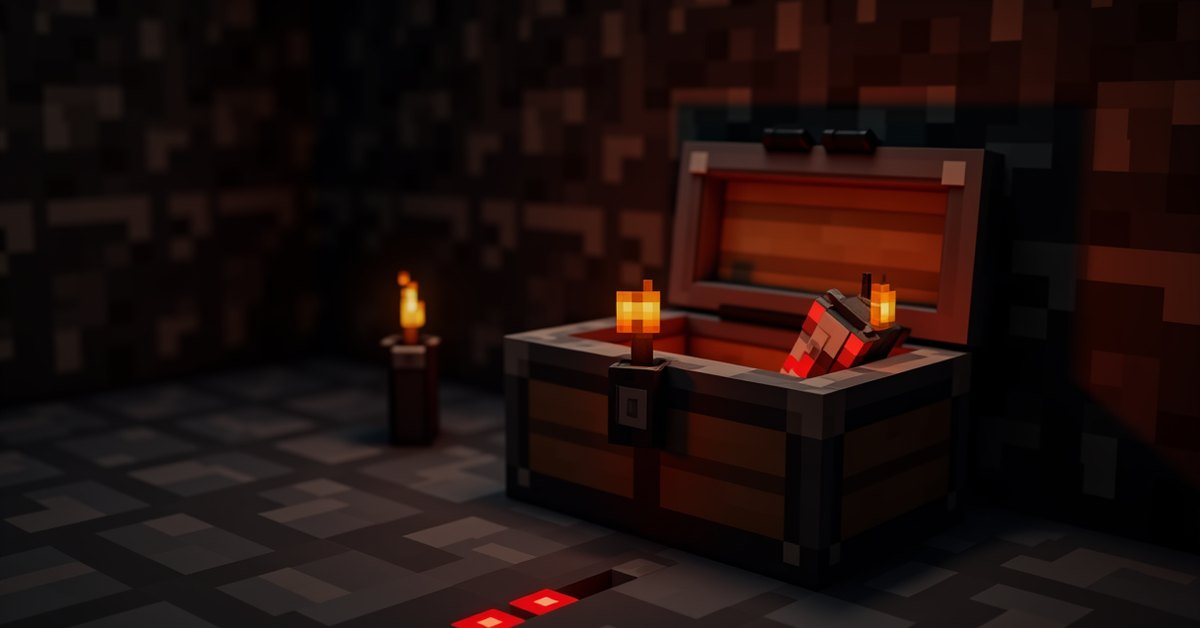
What a trapped chest does
A trapped chest looks almost exactly like a regular chest, holds the same 27 slots of storage, and works the same way when you put items in or take them out. The difference is what happens when someone opens it. A trapped chest fires a redstone signal the moment a player accesses its inventory, which makes it the standard block for hidden detection and trap builds.
You craft it by combining a regular chest with a tripwire hook. The red glow on the latch is the only visual giveaway that it is not a normal chest, and that tint is faint enough that most players walk right past it.
How to craft a trapped chest
The recipe is simple. Place a regular chest in the crafting grid with a tripwire hook on top of it. That gives you one trapped chest.
If you do not have the chest and tripwire hook ready, here are the parts you will need:
- 8 planks (any wood type) for the chest
- 1 iron ingot, 1 stick, and 1 plank for the tripwire hook
So the full cost from scratch is 9 planks, 1 iron ingot, and 1 stick per trapped chest. The chest itself does not care which wood you use, and any plank combination works.
You can also find trapped chests inside woodland mansions, so if you happen to clear one out, save a couple instead of crafting fresh.
Placing it and turning it into a double chest
Place a trapped chest the same way as a regular chest. Right-click any solid block, and the chest faces you when it lands. Like a regular chest, it needs an empty block above it to open. If you put a slab, glass, or any opaque block on top, the lid will not lift.
Two trapped chests placed side by side will merge into a double trapped chest with 54 slots, the same as a regular double chest. A trapped chest will not pair with a regular chest, though. The game treats them as different blocks even though they look the same. If you want a 54-slot trap, both halves have to be trapped.
How the redstone signal works
This is the part that makes the trapped chest useful. When a player opens it, the block emits a redstone signal. The signal strength equals the number of players currently looking inside the chest. One player gives a signal strength of 1, two players give 2, and so on, up to a maximum of 15.
The signal comes out of the block itself, similar to how a button or pressure plate sends power. You can pull power from any side. The most common setup is a redstone dust line running off the back of the chest into whatever the trap should trigger.
The signal stops the moment the last player closes the inventory. There is no delay, no toggle, no latch. Open the chest, signal on. Close it, signal off. If you want a longer pulse, run the output into a redstone repeater set to a delay, or feed it into a redstone torch to invert and hold the state.
What a comparator reads
A redstone comparator placed against a trapped chest reads inventory fullness, the same as it would for a regular chest. The chest contents determine the comparator output, not whether the chest is open. So you have two separate signals to work with at the same time:
- The block itself: how many players are currently looking at the chest
- A comparator against it: how full the chest is
For a classic loot trap, leave the chest empty or stocked with cheap bait and ignore the comparator. For a storage alarm, wire the chest signal into a noteblock and put up a sign next to the unused inventory so you hear it when anyone goes through your stuff.
Common trap and detection builds
A trapped chest is the backbone of most “bait chest” builds. The pattern is always the same: place the chest, wire the output to something noticeable, and put loot inside that looks worth taking. Examples that actually get used:
- TNT under the floor, with the chest signal running into the fuse. Opening the chest blows it up.
- A dropper or dispenser pointed at the floor in front of the chest. The signal triggers an arrow, splash potion, or fire charge.
- A piston ceiling that drops gravel or sand on the player to suffocate them.
- A trapdoor floor leading to a drop, a cactus pit, or a lava room. The chest signal flips the trapdoors open.
The cleaner use case is detection rather than damage. Stick a trapped chest in your storage room and wire it to a noteblock, redstone lamp, or hopper clock. You will know the moment a guest, friend, or player on a shared world has gone digging through your stuff.
Adventure-map builders also use trapped chests as button replacements. The player opens what looks like a normal loot chest, and the act of opening it advances a sequence somewhere else in the build. It is a one-time trigger that feels natural to interact with.
How to spot a trapped chest
The visual difference is a red tint on the latch. If you look closely at the metal clasp on the front of the chest, a trapped chest has a reddish hue, and a regular chest has a darker neutral one. In daylight from a few blocks away it is hard to see. In dim light it disappears completely.
The other tell is context. If you find a chest somewhere you would not expect one (next to a wall in a hallway, hidden under stairs, sitting alone in a corner of a base), and the area looks rigged, trust your instincts. If a chest is sitting on a wool block or surrounded by redstone dust, it is probably trapped.
One safe way to check, if you really want a chest’s contents without setting off the trigger, is to mine the chest with any pickaxe or axe and pick up the dropped block. Breaking the chest drops the contents on the ground and never opens the inventory, so the redstone signal never fires. That said, a smart trap-builder might put pressure plates, tripwires, or observer blocks around the chest itself, so this only beats the chest’s own signal, not the rest of the setup.
Tips and common mistakes
A few things that catch people off guard:
- The signal is a state, not a pulse. If you want a single tick to trigger something like a piston, route the output through a redstone repeater or a monostable circuit. Otherwise the piston stays extended for as long as the chest is open.
- Hoppers feeding into or out of a trapped chest still work normally. You can use a trapped chest as the storage half of an item-sorting system if you want the side benefit of an “inventory accessed” signal.
- Trapped chests stack to 64 in your inventory, so carrying a stack for a build is cheap once you have iron.
- If a chest is not pairing with its neighbor, check that both are trapped chests and that they are facing the same direction. The game pairs them automatically, but only if both halves match.
- You can rename a trapped chest with an anvil before placing it. The custom name shows up on the inventory GUI when a player opens it, but the block in the world still looks the same.
One thing players sometimes try is to lock the chest with a Lock NBT tag tied to a specific named item. That works in command-block setups but is irrelevant for normal survival.
Frequently asked questions
How is a trapped chest different from a regular chest?
It looks almost the same and stores the same number of items, but a trapped chest sends out a redstone signal every time a player opens it. A regular chest does not.
What do you need to craft a trapped chest?
One regular chest plus one tripwire hook. Put them anywhere in the crafting grid together to get one trapped chest. The tripwire hook costs 1 iron ingot, 1 stick, and 1 plank.
Can you combine a trapped chest with a normal chest to make a double?
No. Two trapped chests pair into a double trapped chest, and two regular chests pair into a double regular chest, but the two types never combine.
Why is the redstone signal sometimes stronger than 1?
Because the signal strength equals how many players are looking at the chest at that moment. Two players opening it at the same time on a multiplayer server gives a signal of 2.
Does breaking a trapped chest trigger the signal?
No. Breaking the chest drops its contents as item entities on the ground without ever opening the inventory, so no redstone signal goes out. The chest item itself drops too, so you can pick it up and place it elsewhere.
Can hoppers connect to a trapped chest?
Yes. Hoppers feed items in and pull items out of a trapped chest exactly like a regular chest. The redstone behavior of the trap is independent of hopper logic.
Where can you find trapped chests in the world?
Trapped chests generate naturally inside woodland mansions, usually in some of the dummy rooms. They do not show up in villages, strongholds, or other standard structures, so most of the ones you will use will be ones you craft yourself.
When to reach for a trapped chest instead of a button
A button on a wall does the same job as a trapped chest if all you need is a player-pressed trigger. The reason to pick a trapped chest is misdirection. A chest reads as loot. A player walks up, opens it without thinking, and the trap fires before they realize what hit them. For private storage rooms, the chest is also more useful than a button because it gives you a free intruder alarm on a piece of furniture you would have placed anyway.