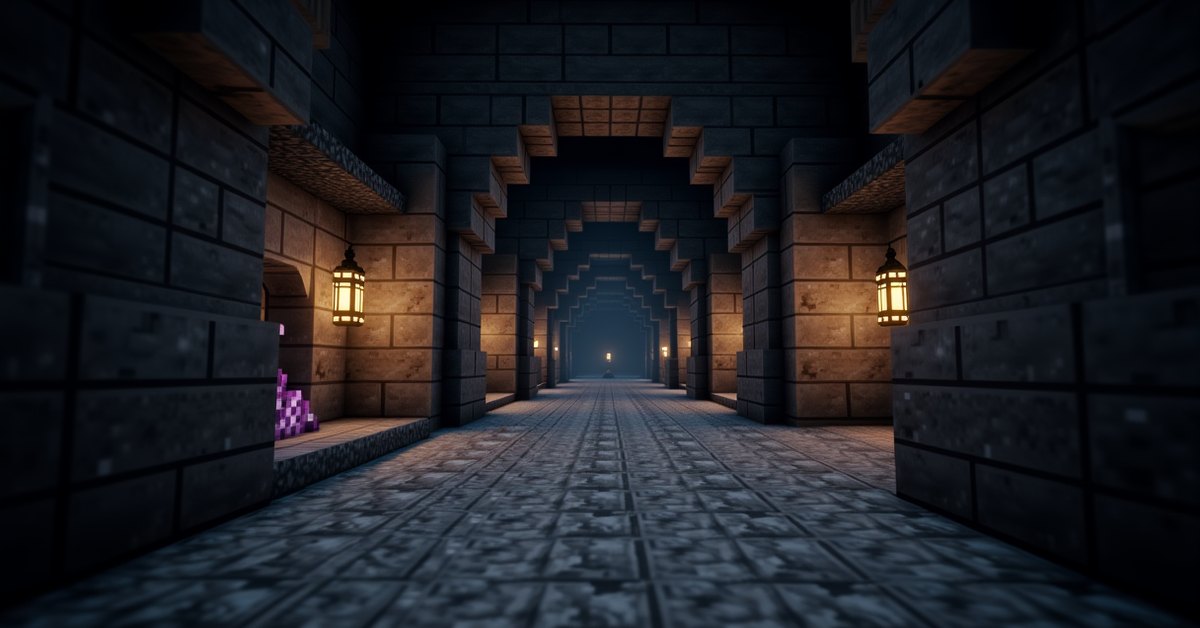
What tuff is in Minecraft
Tuff is a gray, speckled stone block that generates in patches deep underground. It looks volcanic, with chunky dark gray spots over a lighter base. Mojang added the block in the 1.17 Caves and Cliffs update as part of the deeper-world overhaul, then expanded it into a full decorative family in the 1.21 Tricky Trials update with slabs, stairs, walls, polished blocks, bricks, and chiseled variants.
Think of tuff as a darker, more textured cousin to stone. It reads as old, weathered rock at first glance, which makes it useful for grounded, earthy builds. Cave bases, dwarven halls, weathered castles, dungeon levels: anything that wants the look of stone that’s been sitting there a long time pulls something from the tuff family.
Tuff has another job after 1.21. It is the dominant material in trial chambers, the new underground structure added in that update. If you’ve ever stepped into a trial chamber and wondered what the floor and walls were made of, that was almost all tuff in one form or another.
Where to find tuff
Tuff spawns in the overworld in large blob-shaped patches, mostly mixed in with deepslate. The generation range covers roughly Y -30 to Y 16, which means you’ll start running into tuff once you dig past regular stone and start hitting the darker underground layers. The densest spawns sit in the middle of that range, somewhere around Y 0 to Y -16.
Two reliable ways to find tuff in survival:
- Strip mine or branch mine at Y 0 to Y -16. You’ll cross through the densest part of the spawn range and run into tuff blobs alongside the deepslate. Bring a stack of torches, a couple of pickaxes, and an empty inventory; tuff stacks up fast once you find a vein.
- Explore trial chambers. These were added in 1.21 and are built largely out of tuff bricks, polished tuff, and chiseled tuff. You can mine the structure itself for finished blocks instead of crafting them from raw tuff at home.
Caves opened up by Caves and Cliffs generation often expose whole walls of tuff at the right depth, so cave exploring is a low-effort way to grab a few stacks without setting up a proper mine. Look in cave systems that already cut through the deepslate transition zone; tuff blobs sit on the edges of those caves often enough that you can pick them off as you pass through.
Tuff also generates in trial chambers as part of their structure. If you find one and you’re more interested in stocking up on finished blocks than in the loot, the chamber itself is a tuff goldmine. Just don’t leave a chamber half-disassembled; come back for the rest.
How to mine tuff
Tuff needs a pickaxe to drop anything. Any pickaxe tier works, even wood. Hit it with your fist, a shovel, or an axe and the block breaks without dropping itself, which is the most common new-player mistake with this block.
It drops itself directly. No silk touch needed. Fortune does nothing on it; you get one block per mined block no matter what enchantments you have. Hardness is moderate, so a stone or iron pickaxe gets through it at a reasonable pace. Diamond and netherite are faster if you’re farming it in bulk for a big build.
One small tip: if you’re mining at the depths where tuff spawns, you’re also in range of diamonds, redstone, and lapis. Don’t switch to a wooden pickaxe just because tuff doesn’t need a tougher tool. Keep an iron or diamond pickaxe in hand so you don’t waste an ore drop when you accidentally swing through one.
The full tuff family in 1.21
Before 1.21, raw tuff was the only variant. There were no slabs, no stairs, no bricks. Players used it occasionally as an accent block and that was about it. The Tricky Trials update added a complete decorative set, all craftable from raw tuff and reachable through the stonecutter for 1:1 conversions.
Crafting recipes
The recipes follow the standard pattern for stone families. If you’ve crafted a deepslate brick variant before, this will all look familiar:
- Polished tuff: 4 tuff in a 2×2 grid, gives 4 polished tuff.
- Tuff bricks: 4 polished tuff in a 2×2 grid, gives 4 tuff bricks.
- Chiseled tuff: 2 tuff slabs stacked vertically in the crafting grid.
- Chiseled tuff bricks: 2 tuff brick slabs stacked vertically in the crafting grid.
- Slabs, stairs, and walls follow the standard recipe shapes for each base block (tuff, polished tuff, tuff bricks).
A stonecutter takes raw tuff and converts it to any variant at a 1:1 rate. That’s the cheapest way to go from raw tuff to finished blocks without grinding through the intermediate crafting steps. Park a stonecutter near your storage and you can turn a stack of tuff straight into stairs, walls, or chiseled blocks in one click. For most builds, the stonecutter is the only crafting station you need.
The full variant list
Here is the complete tuff family as of 1.21:
- Tuff, tuff slab, tuff stairs, tuff wall
- Polished tuff, polished tuff slab, polished tuff stairs, polished tuff wall
- Tuff bricks, tuff brick slab, tuff brick stairs, tuff brick wall
- Chiseled tuff
- Chiseled tuff bricks
Fourteen blocks from one raw material. That gives the family roughly the same depth as the deepslate or sandstone families, with enough block shapes to handle floors, walls, columns, corners, accents, and stairs without leaving the palette.
What tuff looks like and how to identify it
Raw tuff has a mottled, two-tone texture. Mostly mid-gray with darker gray spots distributed across the surface. It is a touch darker than stone but lighter than deepslate, and the texture is more chaotic than either. Once you’ve seen a few patches you’ll recognize it on sight, even at low light levels.
Polished tuff is smoother and more uniform. The dark spots are still there but they read as flecks against a flat field instead of chunky blobs. Tuff bricks add a regular brick pattern over the polished base, and chiseled tuff shows a vertical motif that works well as a column or accent block in the middle of a wall.
What to build with tuff
Tuff fits well anywhere you’d reach for stone or deepslate but want something with more visible character. A few directions that work in practice:
- Trial chamber expansions. If you find a chamber, build out from the existing walls in the same palette. Polished tuff floors, tuff brick walls, chiseled tuff accents around doorways.
- Cave bases. The mottled gray reads naturally against rough cave walls without looking out of place or overly clean.
- Castle interiors. Tuff bricks come across as old, heavy stonework. Mix them with deepslate bricks for dungeon levels and cracked stone bricks for older sections.
- Roads and paths through forest or mountain biomes. Polished tuff gives a denser, more graphic look than cobblestone.
- Industrial builds. The chiseled tuff variants pair well with copper blocks and iron blocks for a heavy, riveted aesthetic.
Tuff also pairs naturally with copper, deepslate, calcite, and amethyst. Those blocks come from roughly the same depth range, and they share a muted color palette that holds together in cave-themed or geode-themed builds.
Tips and common mistakes
- Always carry a pickaxe when you go deep. New players sometimes try to mine tuff with a shovel because the speckled texture reads as dirt or gravel at a glance, and get nothing for the trouble.
- Use the stonecutter. It saves resources compared to the full crafting tree, especially if you only need slabs or stairs and not the bricks in between.
- Don’t waste silk touch on it. Tuff drops itself with any pickaxe, so silk touch has no effect and Fortune doesn’t increase the yield.
- If you’re building at scale, check trial chambers first. The blocks are already there in finished form, including chiseled variants you’d otherwise have to craft.
- Tuff is treated as a stone-family block. Pistons push and pull it, creepers blow it up, and it can be used as a fuel-free building block in any redstone contraption that needs solid support.
- If you’re prospecting for tuff, look for it alongside deepslate. Where you see one, the other is usually close by.
Java vs. Bedrock differences
Tuff behaves the same way on both editions. Generation, drops, recipes, the stonecutter conversions, and the 1.21 variant family all match between Java and Bedrock. There aren’t any notable splits to flag here. If a build technique works on one edition it will work on the other.
Frequently asked questions
What Y level is best for finding tuff?
Tuff generates from roughly Y -30 to Y 16, with the densest patches in the middle of that range. Branch mining at Y 0 to Y -16 puts you in the sweet spot and crosses the deepslate transition at the same time, so you’ll catch tuff and stock up on iron, redstone, and lapis on the way.
Do you need silk touch to mine tuff?
No. Tuff drops itself with any pickaxe, no enchantment required. Save your silk touch books for blocks that actually need it, like grass blocks, ice, or coral.
What pickaxe do you need for tuff?
Any pickaxe works, including wood. There is no minimum tier. A stone or iron pickaxe is faster if you’re harvesting it in bulk, but you can mine a single tuff block with the cheapest pickaxe in the game.
Can you craft tuff?
You can’t craft raw tuff from other blocks. It only comes from mining naturally generated tuff or from disassembling trial chamber walls. Once you have raw tuff, you can craft every other variant in the family, and a stonecutter gives you the cheapest 1:1 conversion path to any of them.
What version added tuff?
Tuff itself was added in version 1.17 (Caves and Cliffs Part I) in June 2021. The full decorative family of polished tuff, tuff bricks, slabs, stairs, walls, and the two chiseled variants was added in version 1.21 (Tricky Trials) in June 2024.
Is tuff used in any structures?
Yes. Trial chambers, added in 1.21, are built almost entirely from tuff, polished tuff, tuff bricks, and chiseled tuff variants. They’re the easiest in-game example of what the full family looks like at scale.
Does Fortune work on tuff?
No. Tuff drops one block per mined block, no matter the enchantment. Fortune, Unbreaking, and Efficiency don’t change the drop count; Efficiency only changes mining speed.
Is tuff the same as deepslate?
No. Tuff and deepslate are separate blocks with different textures and different hardness. They generate in the same depth range and often touch each other, which can make tuff easy to miss against a deepslate background, but they aren’t variants of each other.
The short version
Tuff is one of the underrated stone blocks in modern Minecraft. The 1.21 update turned it from a niche curiosity into a full decorative palette, and trial chambers gave players a built-in example of what it can look like at scale. Mine it deep, run it through a stonecutter, and you’ve got a flexible family of blocks that works in caves, castles, trial chamber expansions, and any build that wants a weathered, lived-in look.