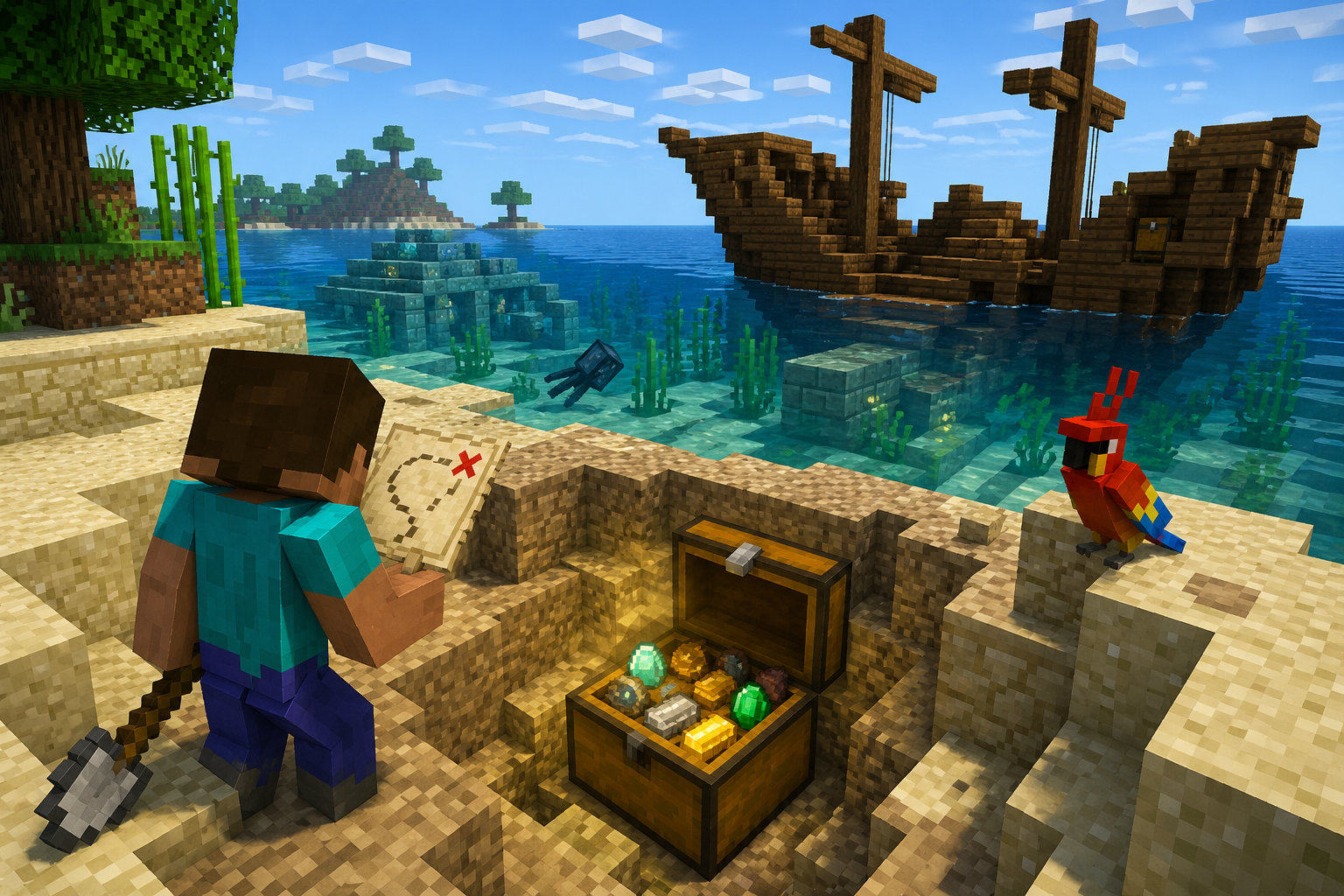
Minecraft buried treasure is one of the most rewarding discoveries you can make while exploring the Overworld. It turns ocean travel into a real adventure: find a shipwreck, grab a treasure map, follow the red X, and dig up a hidden chest packed with useful loot.
But buried treasure is more than a fun pirate-style side quest. It is also the main way to get a Heart of the Sea, the rare item needed to craft a conduit. If you want to build an underwater base, explore ocean monuments, or make ocean travel easier, buried treasure is a major progression step.
This guide explains how to find buried treasure in Minecraft, how treasure maps work, where to dig, what loot to expect, and how to avoid wasting time tearing up an entire beach.
What Is Buried Treasure in Minecraft?
Buried treasure is a hidden loot chest that generates underground, usually near beaches, coastlines, or underwater areas. Unlike villages, temples, or mineshafts, buried treasure is usually found by following a buried treasure map.
The chest is commonly buried beneath blocks such as:
- Sand
- Gravel
- Sandstone
- Stone
- Underwater terrain blocks
The biggest reason players search for buried treasure is the Heart of the Sea. This item is used to craft a conduit, which can give players powerful underwater effects when activated properly.
Buried treasure can also contain valuable survival loot, making it useful even if you are not ready to build a conduit yet.
Why Buried Treasure Is Worth Finding
Buried treasure is especially valuable because it can help at multiple stages of the game.
In the early game, a single buried treasure chest can give you iron, gold, food, emeralds, or even diamonds. That can speed up your survival progress dramatically, especially if you find a treasure map before you have done much mining.
In the mid-game, buried treasure becomes important because of the Heart of the Sea. Once you combine it with Nautilus Shells, you can craft a conduit and make underwater exploration much safer.
In the late game, buried treasure is still useful for ocean builds, conduit networks, and collecting rare or themed items for storage rooms.
How to Find a Buried Treasure Map in Minecraft
To find buried treasure, you usually need a buried treasure map first. These maps are found through ocean exploration.
Search Shipwrecks
Shipwrecks are one of the best places to find buried treasure maps.
They can generate:
- Fully underwater
- Partly underwater
- On beaches
- Near coastlines
- In icy ocean areas
- In warm ocean areas
Shipwrecks may contain multiple chests. If you are looking for a buried treasure map, search the ship carefully. Chests can be hidden in different parts of the wreck, including the stern, bow, or lower sections.
Bring an axe if the shipwreck is above water or partly exposed. If it is underwater, bring a door, water breathing potion, or armor with Respiration so you can search without constantly swimming to the surface.
Search Ocean Ruins
Ocean ruins can also contain treasure maps. These structures generate underwater and may appear as small ruined buildings made from stone brick, sandstone, or other ocean-themed blocks.
Be careful when exploring ocean ruins because drowned often spawn nearby. Some may even carry tridents, which can be dangerous if you are unarmored.
Useful items for ocean ruin exploration include:
- Shield
- Sword or axe
- Boat
- Respiration helmet
- Water breathing potion
- Blocks for quick escape
- Food
Use Dolphins to Find Ocean Structures
Dolphins can help lead you toward ocean structures. Feeding a dolphin raw cod or raw salmon can cause it to swim toward a nearby ocean ruin or shipwreck.
This is not always the most controlled method, but it can be helpful if you are exploring a large ocean and want to find structures faster.
How to Read a Minecraft Buried Treasure Map
Once you find a buried treasure map, hold it in your hand. You will see a map with a red X marking the treasure location.
Your position appears as a small marker on the map.
If your marker is on the edge of the map, you are far away from the treasure area. Travel in the direction that moves your marker closer to the center of the map. As you approach the correct region, the map will begin filling in with terrain.
When your marker overlaps with the red X, you are close enough to start searching.
How to Find Buried Treasure Faster
The biggest mistake players make is digging randomly around the X. That works eventually, but it can waste time and leave a giant ugly crater behind.
Use a more precise method instead.
Step 1: Center Yourself on the Red X
Move slowly until your player marker is centered as closely as possible on the middle of the red X.
Do not start digging when you are merely touching the X. You want your marker lined up with the center.
Step 2: Start With a Small Dig Area
Begin digging in a small area around the center point. A 3×3 space is usually a good start.
Use a shovel for sand and gravel. If you hit sandstone or stone, switch to a pickaxe.
Step 3: Expand in Rings
If you do not find the chest right away, do not panic. Expand your dig area one block at a time in a square or circular pattern.
This is much better than destroying the entire beach.
Step 4: Check Lower Blocks
Buried treasure is often shallow, but not always sitting directly under the top layer of sand. If the terrain is uneven, underwater, or generated near a slope, the chest may be lower than expected.
Dig carefully and keep checking beneath sandstone, stone, or gravel pockets.
Java vs. Bedrock Buried Treasure Tips
Buried treasure can be found in both Java Edition and Bedrock Edition, but players often use slightly different precision tricks.
Java Edition Tip
In Java Edition, many players use chunk coordinates to narrow down the chest location. Open the debug screen with F3 and look at your position within the chunk.
A common Java treasure-hunting trick is to dig near chunk coordinate 9, 9 once you are centered on the X.
This is not required, but it can save time if you are tired of digging around.
Bedrock Edition Tip
In Bedrock Edition, players often use a similar chunk-position trick, commonly digging near 8, 8 within the chunk.
If you do not use coordinates, the traditional method still works: center yourself on the X, dig down, and expand in a small pattern.
What Loot Can You Find in Buried Treasure?
Buried treasure loot can vary, but it is often very useful.
| Item | Why It’s Useful |
|---|---|
| Heart of the Sea | Needed to craft a conduit |
| Iron ingots | Tools, armor, buckets, shields, hoppers |
| Gold ingots | Powered rails, golden apples, Nether bartering |
| Emeralds | Villager trading |
| Diamonds | Tools, armor, enchanting setup |
| TNT | Mining, traps, clearing blocks |
| Prismarine crystals | Sea lantern crafting |
| Cooked fish | Emergency food while exploring |
The most important item is the Heart of the Sea. For many players, buried treasure hunting is really conduit hunting.
What Is the Heart of the Sea Used For?
The Heart of the Sea is used to craft a conduit.
To craft a conduit, you need:
- 1 Heart of the Sea
- 8 Nautilus Shells
Nautilus Shells can be obtained from drowned, fishing, or wandering trader trades.
Once crafted, a conduit must be activated inside a frame made from prismarine-type blocks. When active, it gives nearby players Conduit Power, which helps with underwater breathing, underwater vision, and underwater mining.
A conduit is extremely useful for:
- Ocean bases
- Coral reef builds
- Ocean monument raids
- Underwater mining
- Large aquatic farms
- Long-term survival worlds with coastal bases
Best Gear for Buried Treasure Hunting
You can find buried treasure with very basic gear, but the right items make the hunt much smoother.
Essential Gear
Bring:
- Boat
- Shovel
- Pickaxe
- Sword or axe
- Food
- Torches
- Basic armor
- Blocks
- Treasure map
Helpful Underwater Gear
If the treasure is underwater or the map leads you into ocean terrain, bring:
- Respiration helmet
- Aqua Affinity helmet
- Depth Strider boots
- Water breathing potions
- Doors or magma blocks for air
- Shield for drowned attacks
Best Tool
A shovel is the most important tool for the final dig. Most buried treasure is covered by sand or gravel, so even an iron shovel can save a lot of time.
Common Problems When Finding Buried Treasure
I’m on the X but can’t find the chest. What should I do?
Re-center yourself on the middle of the X and dig a small grid. If that fails, expand outward slowly. The chest may be slightly offset, deeper than expected, or hidden under sandstone or stone.
The treasure is underwater. Is that normal?
Yes. Buried treasure can generate underwater or near underwater slopes. Bring water breathing supplies and watch out for drowned.
The map marker is stuck on the edge. What does that mean?
It means you are outside the mapped area. Keep traveling in the direction that moves your marker inward. Once you are close enough, the terrain will begin appearing on the map.
Can buried treasure be under stone?
Yes. Although many buried treasure chests are under sand or gravel, some can be covered by stone or other terrain blocks depending on where they generate.
Can I find buried treasure without a map?
Technically, yes, but it is not practical unless you are using commands, chunk tricks, or external tools. In normal survival gameplay, a buried treasure map is the intended way to find it.
Best Strategy for Early-Game Buried Treasure
If you want to use buried treasure to boost a new survival world, follow this simple route:
- Craft a boat.
- Travel along coastlines.
- Search for shipwrecks.
- Loot the map chest.
- Follow the buried treasure map.
- Dig carefully at the center of the X.
- Save the Heart of the Sea for a conduit later.
- Use the iron, gold, emeralds, and diamonds to speed up progression.
This can be much faster than mining blindly, especially if you spawn near an ocean.
FAQ
How do you find buried treasure in Minecraft?
Find a buried treasure map in a shipwreck or ocean ruin, follow the red X, center your player marker over the X, then dig carefully in a small area.
Where do buried treasure maps spawn?
Buried treasure maps are commonly found in shipwrecks and ocean ruins.
Is buried treasure always on a beach?
No. It is often near beaches or coastlines, but it can also generate underwater.
Is the Heart of the Sea always useful?
Yes. The Heart of the Sea is required to craft a conduit, one of the best underwater utility blocks in Minecraft.
What is the fastest way to dig up buried treasure?
The fastest method is to center yourself exactly on the X, use a shovel, dig a small 3×3 area, and expand gradually. Java and Bedrock players can also use chunk-coordinate tricks for extra precision.
Can buried treasure be deep underground?
It is usually not extremely deep, but it can be lower than expected depending on terrain generation. Check beneath sand, gravel, sandstone, and stone.
Do you need a diamond shovel?
No. Any shovel works, though iron or better will make digging faster.
Can drowned attack while treasure hunting?
Yes. If the treasure is underwater or near ocean ruins, drowned can attack while you are searching. Bring armor, a shield, and food.
Conclusion
Minecraft buried treasure is one of the best exploration rewards in the game. It gives you a reason to search shipwrecks, dive into ocean ruins, and follow treasure maps across beaches, islands, and underwater terrain.
The loot can be excellent, especially early in survival, but the real prize is the Heart of the Sea. Once you have one, you are on your way to crafting a conduit and making underwater exploration far easier.
The key is to dig smart. Find a map, line up carefully with the red X, start with a small search area, and expand only when needed. Do that, and buried treasure becomes less frustrating, more profitable, and a lot more fun.