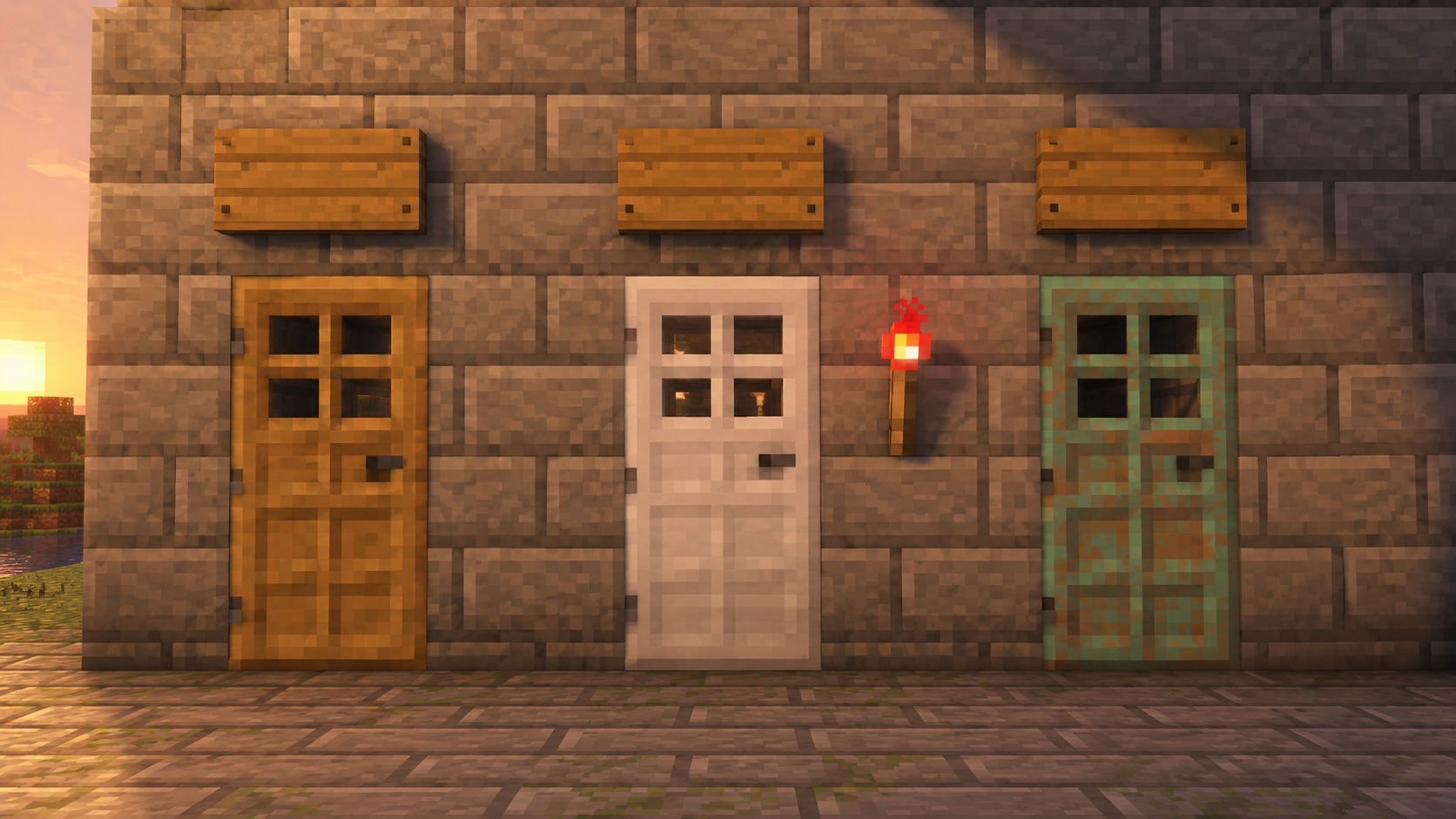
What a door is in Minecraft
A door is a two-block-tall utility block that blocks movement until it is opened. You walk up to it, click, and it swings to the side, letting you (or a mob) pass through. Doors are the workhorse of Minecraft building. They keep zombies out of your starter house, define villages for villager AI, and seal off the parts of your base you don’t want creepers wandering into.
There are three families: wooden, iron, and copper. Each has its own quirks for crafting, opening, and aging. The basics are the same across all of them, so if you know how an oak door works, you are most of the way to knowing how the rest work.
Every door type and where it comes from
Wooden doors are the most common. You can craft one from any of the wood planks in the game. As of recent versions, that includes oak, spruce, birch, jungle, acacia, dark oak, mangrove, cherry, bamboo, crimson, and warped planks. The crimson and warped variants come from the Nether and have a slightly different look, but mechanically they behave like the rest of the wooden doors.
Iron doors are crafted from iron ingots. They look heavier, with a metal panel and rivets, and they refuse to open by hand. You need a redstone signal to use them, which is the whole point: an iron door only opens for you, not for any mob or random villager who wanders past.
Copper doors arrived with the 1.21 Tricky Trials update. They behave a lot like wooden doors (you can open them with a click), but they oxidize over time and pick up a green patina if you leave them exposed. Wax stops the oxidation. There are four oxidation stages: regular, exposed, weathered, and oxidized. Each stage has a separate item, so a fully oxidized copper door is its own block.
How to craft a door
Every door uses the same shape on the crafting table: six of the appropriate material in a 2×3 vertical column, filling the left two columns of the grid. The output is three doors at a time, which is one of the better material-to-item ratios in the game.
- Wooden door: 6 matching planks → 3 doors of that wood type
- Iron door: 6 iron ingots → 3 iron doors
- Copper door: 6 copper ingots → 3 copper doors
You can also find wooden doors as part of generated structures (village houses, woodland mansions, some ruined portals) and pull them off intact with a hand or any tool. Iron doors show up in some strongholds and igloos. Copper doors appear in trial chambers, which is the structure that came with copper doors in 1.21.
How to place a door (and avoid the most common mistake)
To place a door, hold the door item and right-click the bottom of the surface where you want the top of the door to sit. The bottom half of the door snaps to the block below your cursor; the top half takes the block you actually clicked. The door faces the direction you are looking when you place it.
The most common placement mistake is putting a door in a one-block gap and being surprised when light leaks through or mobs can still see you. Doors do not fully seal a 1×2 hole against light from a torch on the other side. They block movement, not light. If you need a light-tight seal, use a trapdoor or a solid block.
Doors also need a solid block underneath. If you mine out the block under a placed door, the door pops off. This catches a lot of new players who build a house, then dig out the floor and lose the front entrance.
Hanging doors and the new placement rules
In modern versions of Java Edition, doors can be placed on the bottom of a block as well as on the top of one. That means you can have a door hanging from a ceiling with empty space below it, which is useful for certain redstone gates and trap designs. Bedrock players have a similar system, though the exact rules drift between updates. If a door place looks like it should work and doesn’t, try sneaking before you click to override the block you are aiming at.
Opening, closing, and double doors
Wooden and copper doors open with a right-click. They also open from a redstone signal: a lever next to the door, a pressure plate in front, a button on the wall, or any redstone-powered block touching the door’s top or bottom half will pop it open as long as the signal is on.
Iron doors do not respond to right-clicks. The only way to open one is with a redstone signal. The standard setup is a pressure plate on each side, or a button you press on the way out. Iron doors are the safer choice if you want a mob-proof entrance, because hostile mobs can’t trigger pressure plates if you use stone pressure plates (which only react to players and certain mobs) instead of wooden ones.
Double doors are two doors placed side by side. In Java Edition, the game pairs them automatically so they open outward as a single unit when one of them is triggered. In Bedrock Edition, each half opens independently, so you may need to wire the two halves to the same redstone signal if you want them to open in sync. This is one of the older Java-Bedrock differences and it still trips people up.
Doors, zombies, and village defense
On hard difficulty, zombies can break down wooden doors. They line up against the door, beat on it, and after enough hits the door is gone. They do not break iron doors. They do not break copper doors. If you are playing on hard and you want a wooden door to survive a horde, you need to either upgrade to iron or block the door with something solid on the inside at night.
One classic trick: place a door so the closed side faces outward. Mobs read the door as open (because of how the closed state aligns from the outside) and walk away or pile up against it without attacking. The exact behavior has been changed and patched a few times across versions, so test it on the version you actually play before betting your seed on it.
Doors also count for village mechanics. A village in Minecraft is defined by a cluster of beds and villager workstations, but historically, doors played a role too. In current versions the bed and the meeting point matter more, but a tidy row of doors still signals a real village to most players, and a village without any doors looks like a campsite. If you are building a village manually, give every house a real door.
Redstone tricks worth knowing
Doors are an underrated redstone component. A few patterns come up over and over:
- Hidden entrance: Use a piston to push an extra block in front of a door, hiding it. Wire the piston and the door to the same signal.
- Hands-free entry: Wooden pressure plate on both sides of a wooden door. You never have to click anything to get in or out.
- Player-only door: Stone pressure plates filter out chickens, rabbits, and items, so they’re the right choice for iron doors near a farm.
- Two-button vault: Wire an iron door to require buttons on both sides of a wall to open. Useful for shared bases where you don’t want strangers walking in.
One thing that catches people: pistons cannot move doors. If you push a piston into a door, the piston extends and the door stays where it is. You can hide doors with pistons, but you can’t slide them around the world.
Copper doors and oxidation
Copper doors are the newest addition and have their own twist. Place one and leave it exposed to open air, and it will slowly cycle through four stages: regular copper, exposed copper, weathered copper, and oxidized copper. Each stage looks more green than the last.
If you like a specific stage, you can wax it. Apply a honeycomb (right-click with one in hand) and the door stops aging at its current stage. You can also use an axe to scrape one stage of oxidation off, which lets you tune the color exactly.
Oxidation only affects appearance. A fully oxidized copper door still opens, closes, and responds to redstone the same way a fresh one does. The look is the only thing that changes.
Tips, common mistakes, and what to skip
A few habits will save you headaches:
- Don’t use a wooden door as your only night defense on hard difficulty. Either upgrade to iron, add a fence gap, or block the inside.
- When you place a double door in Java, both halves orient as a pair if you place them in the right order. If they end up backwards, mine and replace one half.
- Use stone pressure plates with iron doors when you want the door to ignore non-player mobs.
- Don’t try to use a piston to slide a door around. It won’t move.
- If you are building a redstone door (an actual piston-built sliding wall, not a real Minecraft door block), you don’t need any door items at all. The terminology overlaps but they are different things.
Java vs. Bedrock differences worth knowing
The biggest practical difference is double doors. In Java Edition, the game pairs adjacent doors automatically when one is triggered. In Bedrock Edition, each door opens on its own, so you have to wire both halves to the same signal if you want a synchronized double door. There are also small differences in how pressure plates and detection ranges behave between editions, but for a typical home build, the double-door behavior is the one that matters.
Frequently asked questions
Can zombies break iron doors?
No. Zombies cannot break iron doors at any difficulty. They can break wooden doors on hard difficulty. Copper doors are also safe from zombies.
Do I need redstone for a wooden door?
No. Wooden doors open with a right-click. You only need redstone if you want them to open automatically, for example with a pressure plate.
How do I make a double door open as a pair?
In Java Edition, place two doors of the same type next to each other. The game pairs them automatically and they open as a unit. In Bedrock, wire both doors to the same redstone signal (a single lever or pressure plate connecting to both halves works fine).
Why does my copper door look different over time?
Copper doors oxidize. They cycle through four stages over real-world weeks of in-game time. Apply a honeycomb to wax the door and lock its current color. An axe will scrape one stage of oxidation off.
Can pistons move doors?
No. Pistons do not move door blocks. You can use a piston to hide or block a door with a separate solid block, but the door itself stays put.
Will a door stop light from passing through?
No. Doors block movement but not light. A torch on one side of a closed door will still leak some light through, which matters if you are designing a sleep area or a mob spawner.
Can I pick up a placed door?
Yes. Break the door with any tool (an axe is fastest for wood, a pickaxe for iron and copper) and it drops as a single item. Both halves drop from a single break on the lower half.
Where to go from here
If you’ve never wired an iron door with a redstone circuit, that’s the next thing worth trying. It’s the cleanest small-scale redstone project in the game and it teaches you button vs. lever vs. pressure plate logic in about ten minutes. After that, copper doors are a fun aesthetic project: place a row, wax some at different stages, and you’ve got a build that looks aged in exactly the way you want.