What calcite is in Minecraft
Calcite is a smooth, off-white decorative block that arrived in Minecraft 1.17, the Caves and Cliffs update. It’s named after the real-world mineral and looks like a chalky, slightly grainy white stone in-game. It has no functional crafting use, but it shows up in one of the most distinctive structures in the game: the amethyst geode.
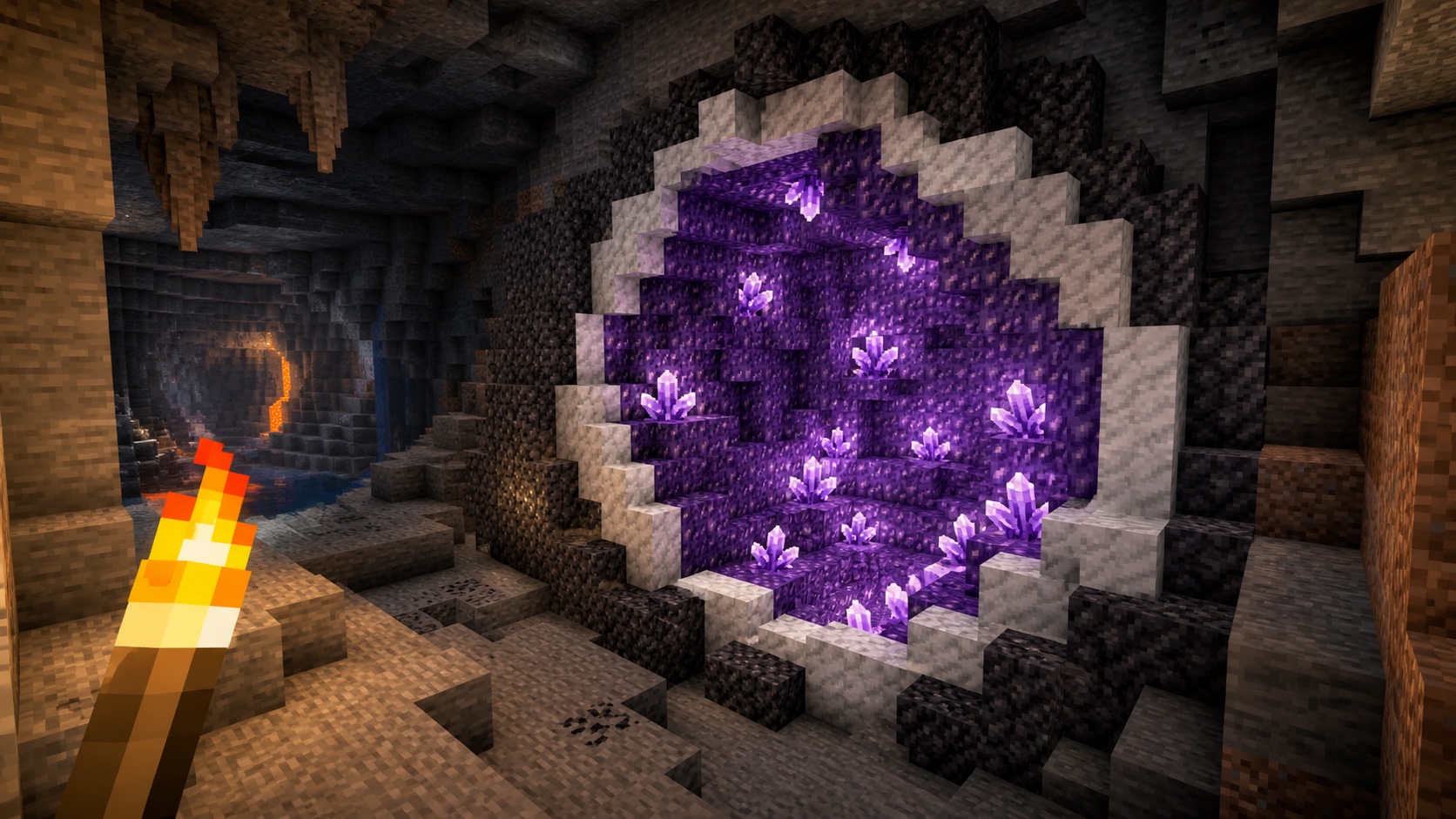
If you’ve ever tunneled into a hollow ball of purple crystals deep underground, you’ve already touched calcite. The bright white shell that wraps around the amethyst is calcite, and finding any of that pale color underground is a strong signal that a geode is right next to you.
Where to find calcite
Calcite generates naturally only inside amethyst geodes. The geodes spawn as roughly spherical pockets between Y level -64 and Y level 30, with the highest concentration in the lower half of that range. They’re a lot more common in some chunks than others, and they often clip through the side of caves or even the surface in the right terrain.
Each geode is built from three layers, from the outside in:
- A bumpy outer shell of smooth basalt.
- A solid middle shell of calcite.
- A hollow interior lined with blocks of amethyst, budding amethyst, and amethyst clusters at various growth stages.
The calcite layer is what you’re after if you just want the block itself. Strip-mining a geode for calcite gives you a few stacks, and the geometry is consistent enough that you can usually predict how much you’ll get just by looking at the size of the pocket.
Spotting a geode while mining
When you’re tunneling and you see a vein of bright white blocks where you’d expect stone or deepslate, stop and check. The contrast is sharp; calcite looks almost out of place against deepslate. Smooth basalt nearby is another giveaway, since the two together rarely show up anywhere else.
You can also find geodes near the edges of dripstone caves, lush caves, and ordinary cave openings where chunk borders cut through the geode. If part of one is exposed, dig through the smooth basalt and calcite to reach the amethyst.
Searching with commands
If you’re playing creative or testing a build, the command /locate structure minecraft:amethyst_geode will point you to the nearest geode. In survival, this command isn’t available unless cheats are enabled.
How to mine calcite
Calcite can be broken with any pickaxe, including a wooden one. It will drop itself when mined with a pickaxe of any tier. Breaking it with anything else, including your fist, gives you nothing.
The block has a low hardness (about 0.75), so it mines quickly. There’s no special tool requirement and no enchantment needed to get the drop. Silk Touch isn’t required because calcite already drops itself by default. Fortune doesn’t increase drops either.
Stacking and storage
Calcite stacks to 64 in the inventory. It doesn’t have any data values that change between visually identical blocks, so a stack is just a stack. No surprises there.
Calcite’s properties at a glance
| Property | Value |
|---|---|
| Hardness | 0.75 |
| Blast resistance | 0.75 |
| Tool required | Any pickaxe |
| Stack size | 64 |
| Renewable | No |
| Flammable | No |
| Light level | 0 |
| Item ID | minecraft:calcite |
The blast resistance is low enough that a single creeper can clear several calcite blocks at once, so don’t rely on it to seal off important rooms.
What calcite is used for
Calcite has no vanilla crafting recipe and no functional uses. Its job is to be a clean, slightly textured white block, and it’s surprisingly good at that.
Decorative builds
Builders reach for calcite when they want a soft white that doesn’t look like quartz. It works well for:
- Modern white facades, ceilings, and floors that need a more natural, weathered look than blocks of quartz provide.
- Cliffs, mountainsides, or rocky terrain where you want a band of pale stone running through gray.
- Sculpture and statue work, where the slightly grainy texture reads better than pure white.
- Lighthouses, towers, and pillars, especially next to other muted blocks like deepslate or polished diorite.
The texture has a slight crystalline pattern that catches certain light angles, so calcite walls don’t look completely flat the way concrete does.
Blocks calcite pairs well with
Calcite plays nicely with smooth basalt, since they already coexist in geodes and look intentional together. It also sits well next to amethyst blocks, again because they’re part of the same structure visually. Quartz pillars and stairs work when you want a layered white-on-white look. Deepslate and tuff give calcite a darker frame to push against.
Calcite vs. similar blocks
Players mix calcite up with diorite and quartz blocks all the time. The differences matter when you’re picking a block for a build.
Compared to quartz, calcite is a touch grayer and has visible grain. Quartz is the cleaner, brighter white. Use quartz for sterile or futuristic builds; use calcite when you want texture and warmth.
Compared to diorite, calcite is plainer. Diorite has those chunky black speckles. Calcite is uniform pale, which makes it easier to use in larger walls without the surface looking busy.
Compared to bone block, calcite is colder and less yellow. Bone block reads as ivory; calcite reads as chalk.
Tips and common mistakes
If you’re mining a geode for calcite specifically, plan to dig through the basalt shell first, then peel off the calcite ring without breaking into the amethyst inside. The amethyst clusters can be valuable later, but they only grow on budding amethyst, which only generates inside geodes. Smashing the budding amethyst with the wrong tool destroys it for good.
Calcite isn’t fireproof in the sense that it stops fire from spreading nearby. It won’t burn, since stone doesn’t burn, but lava can still flow over it normally and any wooden parts of your build will catch fire as usual.
If you want a renewable supply of white stone, calcite isn’t your block. There’s no farm for it. You either mine geodes or you don’t have it. Wandering traders don’t sell it, and villagers don’t trade it. If your build needs a thousand calcite, plan a few geode runs.
Calcite is opaque. It doesn’t conduct redstone signals through itself the way some specialty blocks do, and mobs can spawn on top of it just like any solid stone block. Light it up if you don’t want creepers showing up overnight.
Java vs. Bedrock differences
Calcite behaves the same in both editions for normal play. Geodes generate in the same Y range, follow the same shell pattern, and use the same drop rules. The only practical differences come from edition-wide quirks, not anything specific to calcite. Mob spawning rates, hitboxes, and minor block tick timings can vary, but if you’re just building with calcite or mining it for amethyst, you won’t notice the difference.
Frequently asked questions
Can you craft calcite?
No. Calcite has no crafting recipe in vanilla Minecraft. The only way to get it is to mine it from an amethyst geode (or use creative mode or commands).
What pickaxe do you need to mine calcite?
Any pickaxe works, including wood. You won’t get a drop if you break calcite without a pickaxe.
Can you find calcite without finding a geode?
Not really. Calcite only generates inside amethyst geodes. Some geodes break the surface or intersect cave walls, so you might see calcite first and only realize a geode is attached once you dig in.
Does calcite spread or grow like budding amethyst?
No. Calcite is a static block. It doesn’t tick, doesn’t grow neighbors, and doesn’t change form over time.
Can calcite be made into stairs, slabs, or walls?
No. Calcite has no stair, slab, wall, or polished variant in vanilla. You only get the plain block.
How rare are amethyst geodes?
Common enough to find a few within a couple hundred blocks of most spawn points if you explore caves at the right depth. Their distribution is fairly even, but you can hit dry chunks; if you’ve gone five minutes without seeing any sign of a geode, move a few hundred blocks over and try again.
Is calcite the same as quartz?
No. They look similar at first glance, but calcite is grainier and slightly grayer. Quartz comes from the Nether, smelted from nether quartz ore, and has its own family of stairs, slabs, and pillars. Calcite has none of that.
Can you sneak more quietly on calcite?
Calcite has its own footstep sound that’s a bit higher and chimier than ordinary stone. It doesn’t make you quieter for sneaking purposes, though, so a sculk sensor in the next room will pick up your steps the same way it would on any other solid block.
Worth keeping a stack around
Calcite isn’t going to change your survival run, but a stack or two in your storage room saves you a trip later. The first time you want a clean white wall and quartz feels too plastic, you’ll be glad you grabbed it. Map out your nearest geode and grab the calcite shell on the way to the amethyst inside.