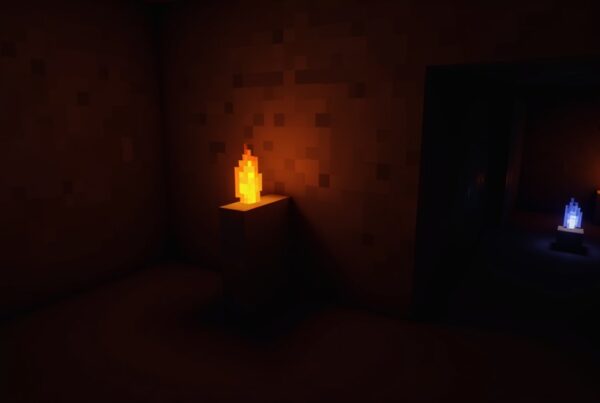
What a calibrated sculk sensor does
A regular sculk sensor reacts to any nearby vibration, which is useful but blunt. The calibrated sculk sensor lets you pick exactly one type of vibration and ignore the rest. Think of it as a sculk sensor with a filter dial on the back.
That makes it the right block for any redstone build that needs to react to one specific action: only footsteps, only chest opens, only block placement. It also doubles the detection range of a regular sculk sensor, so it can pick up vibrations 16 blocks away instead of 8.
This guide covers how to craft one, how the calibration actually works, and the kinds of redstone projects it makes possible.
How to craft a calibrated sculk sensor
You need two ingredients:
- 1 sculk sensor
- 3 amethyst shards
Place the sculk sensor in the center of the crafting grid. Put one amethyst shard directly above it and one on each side, in the left-middle and right-middle slots. The recipe outputs one calibrated sculk sensor.
Where to find sculk sensors
Sculk sensors only generate naturally in the deep dark biome and inside ancient cities. The deep dark sits below Y=-1 in any overworld biome, but it’s most reliably reached by digging straight down from a dripstone or lush cave area until you hit sculk-covered terrain. Bring a wool path and crouch the entire time, because the warden will absolutely answer your noises.
To collect a sculk sensor, mine it with a tool enchanted with Silk Touch. A hoe is the fastest tool for the job, but Silk Touch is the part that matters. Without it, the sensor breaks into 5 experience and nothing else, and you’ll have to find another one.
Where to find amethyst shards
Amethyst shards drop from amethyst clusters, the bright purple spikes that grow on the inside walls of amethyst geodes. Geodes are hollow underground formations made of smooth basalt, calcite, and a layer of amethyst blocks around the inner cavity. They can spawn anywhere from bedrock up to about Y=30, and they’re more common than they look once you know what calcite seams indicate.
Mine fully grown clusters (the largest size) with any pickaxe to get four shards each. Smaller buds will not drop shards even with Silk Touch, so wait for the cluster stage. One geode is usually enough to craft a calibrated sculk sensor and have shards left over for spyglasses, tinted glass, and other amethyst recipes.
How vibration detection works
Every action in Minecraft that makes a sound also emits a vibration with a specific frequency from 1 to 15. A few examples:
- 1: walking footsteps from a player or mob
- 3: swimming and rowing
- 7: a block being broken
- 10: a container being opened
- 15: an explosion or lightning strike
A regular sculk sensor reacts to all of these within 8 blocks. The calibrated version, with no redstone input on its back, behaves the same way and detects everything within 16 blocks.
The output side of the sensor sends a redstone signal whose strength matches the vibration’s frequency. So a chest opening makes the sensor output a signal of 10, an explosion outputs 15, and footsteps output 1. You can read that strength with a comparator and use it to drive different machines off the same sensor.
The redstone input port
The new feature on the calibrated sculk sensor is the input. There’s one specific face of the block (the back, opposite the amethyst-shard side) that accepts a redstone signal from the player.
Apply a steady redstone signal of strength N to that face. The sensor will now ignore every vibration except the one with frequency N. Drop the input back to 0 and it goes back to detecting everything.
For example:
- Power the input with a redstone signal of 1 to make a sensor that only fires on footsteps. Useful for door triggers and parkour timers.
- Power it with 7 to react only to block breaking. Handy for raid alarms or anti-griefing alerts on a server.
- Power it with 10 to react only to containers opening. Great for hidden alarms on bases or for tracking a piglin bartering setup.
- Power it with 15 to react only to explosions. Useful as a creeper alarm or a TNT-trap detector.
You only need one calibrated sensor per filter. Run the redstone input from a comparator on a chest, a redstone block, or any other power source whose strength matches the frequency you want.
Detection range and cooldown
A regular sculk sensor scans a cube of 8 blocks in every direction around itself. The calibrated version scans 16 blocks in every direction. That sounds small, but in practice it covers a full base or a large farm with one sensor.
Both sensors share the same activation cycle:
- A vibration is detected.
- The sensor activates and outputs a redstone signal for about 1 second.
- The sensor enters a short cooldown where it ignores all vibrations.
- It returns to listening.
That cooldown matters. You can’t spam triggers faster than once every couple of seconds, so don’t design a circuit that depends on rapid-fire detection. If you need that, use a different block (a regular pressure plate, a tripwire, or a target block).
Practical builds
The point of the calibrated sensor is filtering, so the best uses involve actions that are easy to confuse with random noise.
Hidden door from footsteps
A regular sculk sensor near a door fires every time anything rustles nearby, like a hopper, a pet, or an ambient mob. A calibrated sensor tuned to frequency 1 only fires on footsteps. Place it in the floor under a doormat block, run the output to a piston door, and it opens for any walker but ignores stationary noise.
Server-wide raid alarm
A calibrated sensor tuned to frequency 15 (explosions) is a reliable creeper-and-TNT detector. Wire its output to a redstone lamp or a noteblock at your spawn so anyone online sees an alert when something goes boom near a key area.
Container alarm for storage rooms
Tune one to frequency 10 and put it inside the wall behind your main storage. Anyone who opens a chest in that room while the sensor is in range trips the alarm. Footsteps, block placement, and ambient mob noise will not.
Trip-only-on-mining detector
Tune one to frequency 7 and place it near an ore vein you want to protect on a multiplayer server. It fires when blocks get broken near it but ignores normal walking and chest activity, which keeps the alarm honest.
Common mistakes
Three things tend to trip players up the first time they wire a calibrated sensor.
First, the input face. The redstone input only works on one specific side of the block. If your filter doesn’t seem to be active, rotate the sensor or move your redstone source.
Second, signal strength has to be exact. A signal of 10 only filters for frequency 10. If the sensor isn’t firing at all, your input strength is probably matching a frequency nothing nearby is producing, or it’s drifting from comparator math you didn’t account for. Check the strength with a redstone dust line and a comparator.
Third, the wool muffling rule still applies. Wool blocks (and carpets to a lesser extent) block vibrations from reaching the sensor at all, regardless of frequency. If a sensor isn’t firing on what you expect, look for wool between the source and the sensor.
Java vs Bedrock
The crafting recipe, redstone input behavior, frequency table, detection range, and cooldown are all the same in Java and Bedrock as of the current versions. The visible differences are minor: particle effects on activation can look slightly different, and Bedrock has historically had small timing variations in redstone updates that can show up in tight contraptions. For most builds, a calibrated sculk sensor circuit you design in one edition will work in the other.
Frequently asked questions
Do I need Silk Touch to mine a calibrated sculk sensor?
Yes. Without Silk Touch, breaking it gives only experience and no item. Use a hoe with Silk Touch for the fastest result.
Can I use a calibrated sculk sensor without redstone input?
Yes. With no signal on the input face, it detects every vibration within 16 blocks, just like a regular sculk sensor with a longer reach. The filter only kicks in when you apply a redstone signal.
Does it warn the warden?
Yes, in the deep dark. Any sculk sensor near sculk catalysts can contribute to warden warnings. If you’re building outside the deep dark, this isn’t a concern, but in or near an ancient city you should still crouch and use wool paths.
Can I change the filter on the fly?
Yes. The frequency the sensor listens for tracks the redstone input strength in real time. Wire the input to a daylight sensor, a comparator, or a player-controlled lever bank, and the sensor will retune as the input changes.
What’s the difference between a sculk shrieker and a sculk sensor?
A sculk shrieker doesn’t output redstone. It plays a warning sound and, in the deep dark with the right conditions, summons a warden. A sculk sensor (calibrated or not) outputs redstone but doesn’t summon anything. They serve different roles in a build.
Can two calibrated sensors interfere with each other?
If both are within range of the same vibration, they can both fire. The output is independent, so this is rarely a problem. The only time it matters is when one sensor’s redstone output ends up powering another sensor’s input by accident, which retunes it. Plan input and output paths separately.
Where to put it in your build
The calibrated sculk sensor’s job is to be a clean, single-purpose trigger. The cleanest setups put one sensor per intent: one for the front-door floor, one inside the storage wall, one near the brewing room. Stacking three different filters into one circuit gets messy, and the cooldown means you’ll occasionally miss one trigger while another is ringing. Build modular and tune each sensor to the action that matters at that location.