What carrots are in Minecraft
Carrots are an orange root vegetable used as food, breeding bait, and a crafting ingredient. You can eat them straight, plant them as a crop, or turn them into something more useful like a golden carrot or a carrot on a stick.
In the inventory they look like a single small carrot. As a planted crop they sit on farmland and grow through eight stages until the orange tops poke out of the soil. Once mature, breaking the crop drops 1 to 4 carrots, with a chance for extras when you use a hoe enchanted with Fortune.
This is one of the most useful crops in the game because it doubles as zombie loot, pig and rabbit food, an emergency hunger fix, a brewing ingredient (via golden carrots), and a way to steer a saddled pig.
Where to find carrots
Carrots don’t spawn wild like sweet berries or bamboo. They come from a few specific places.
Zombie drops
Zombies, husks, and zombified piglins have a small chance to drop a carrot when killed by the player. The base chance is roughly 2.5%, increased by the Looting enchantment on your weapon. This is the most reliable early-game source if you don’t have access to a village.
Village farms
Plains, savanna, and taiga villages often include farm plots with carrots planted in them. You can break the mature crops to harvest them, but taking crops from a village farm counts as theft and lowers your reputation with that village. To stay on good terms, replant whatever you take, or trade with the farmer villager instead.
Pillager outpost chests
Chests inside pillager outposts have a small chance to contain carrots in their loot tables, alongside other crops and crafting items. Worth checking on your way out.
Trades
Farmer villagers sometimes sell carrots in stacks for emeralds. The exact number per emerald varies by version, but if your village rolls the trade it’s a quick way to bulk up before you have a farm running.
How to grow carrots
Once you have at least one carrot, you can farm an unlimited supply.
Setting up the farm
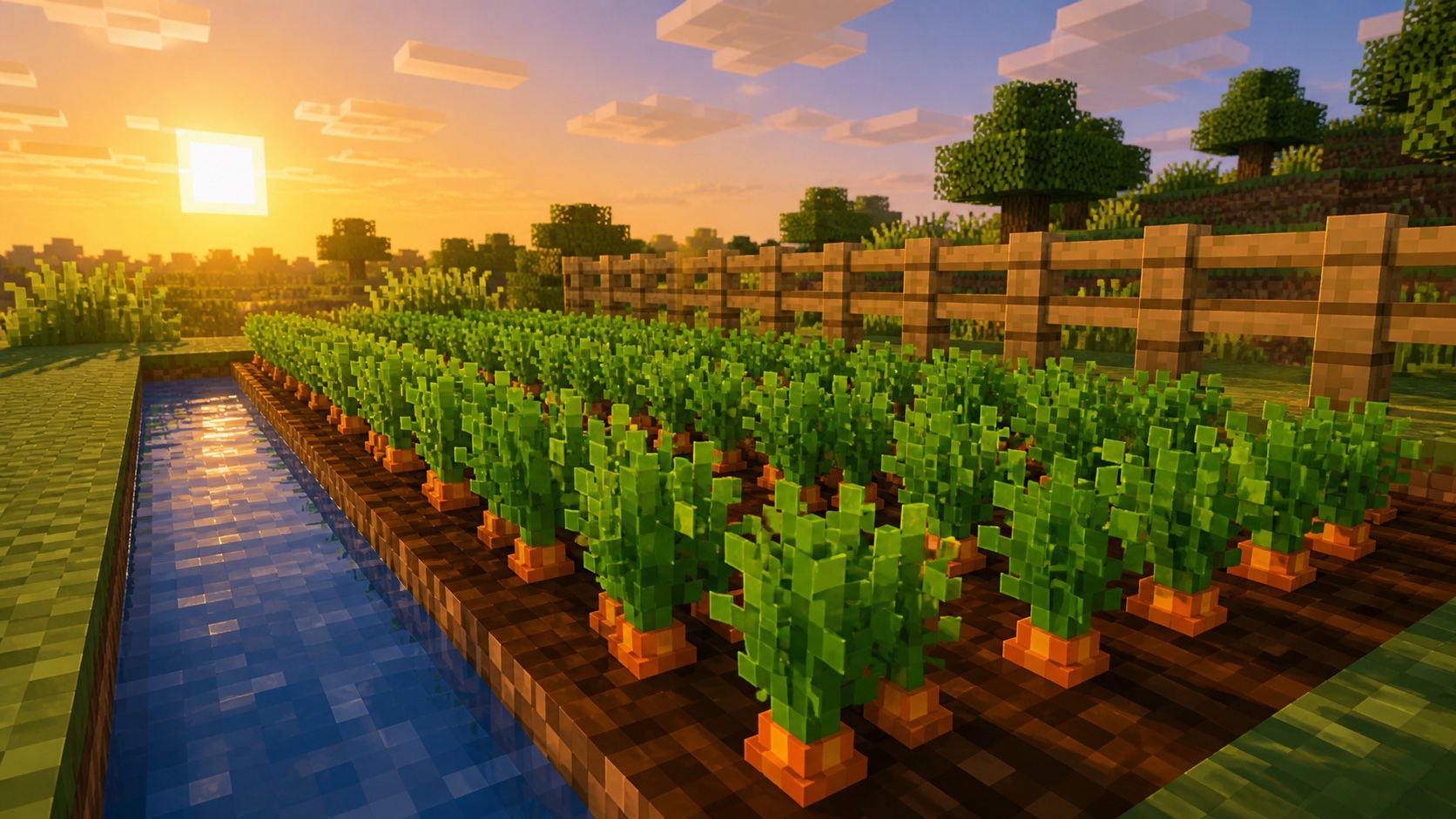
You need farmland (dirt or grass that’s been right-clicked with a hoe), a light level of 9 or higher, and ideally water within four blocks of the soil. Hydrated farmland (the darker variety) grows crops noticeably faster than dry farmland.
To plant, hold a carrot and right-click the farmland. The carrot disappears from your inventory and appears as the first growth stage on the block.
Growth stages
Carrots have eight internal growth stages but only four visible textures, so the crop looks the same for several stages before changing appearance again. It can seem like nothing is happening when it actually is. Mature carrots show their orange tops sticking out of the soil.
Speeding things up
Bone meal is the fastest way to grow carrots. Each application advances the crop by 2 to 5 random growth stages, so a single carrot usually goes from planted to mature in 2 to 4 bone meals. Skeletons and the bottom of any composter are your bone meal sources.
Harvesting
Break the mature crop with anything (your fist works, but a hoe is conventional). Each fully grown carrot crop drops 1 to 4 carrots, with extras possible at higher Fortune levels (averaging close to 7 carrots per crop with Fortune III on the hoe over many harvests). Replant one of the dropped carrots to keep the cycle going.
Common growing mistakes
If your carrots keep popping off the ground, the farmland has reverted to dirt. Farmland reverts when it isn’t hydrated and nothing is planted on it for too long, or when something jumps on the block from above. Keep water within four blocks and put torches around to stop mobs from trampling the field.
What carrots do when you eat them
Eating a carrot restores 3 hunger points (1.5 drumsticks on the hunger bar) and 3.6 hunger saturation. Saturation is the hidden buffer that empties before hunger does, so high-saturation foods keep you full longer.
Compared to other quick foods, carrots sit in the middle. They restore less than steak or cooked porkchop but more than a raw potato or melon slice, and you don’t have to cook them. For early-game survival they’re solid, especially because crop farms scale faster than animal husbandry.
Crafting with carrots
Golden carrot
Place a carrot in the center of the crafting grid and surround it with 8 gold nuggets. The result is a golden carrot. It restores 6 hunger and 14.4 saturation, the highest saturation value of any normal food in the game. Golden carrots are also an ingredient for the Potion of Night Vision, which is why most brewers keep a stack on hand.
Carrot on a stick
Combine a fishing rod and a carrot in a crafting grid, with the rod above and the carrot diagonally below-right of it. The result is a carrot on a stick, used to steer a saddled pig. Right-clicking with it boosts the pig forward, and the item slowly loses durability as you use it. Repair by combining it with a regular fishing rod and carrot in an anvil, or by crafting them together again.
Rabbit stew
One carrot is part of the rabbit stew recipe alongside cooked rabbit, a baked potato, a brown mushroom, and a wooden bowl. Rabbit stew restores 10 hunger and 12 saturation, one of the best foods in the game by raw hunger restored.
Composting
Tossing a carrot into a composter has a 65% chance to add a level. Once filled, the composter outputs one bone meal. Carrots aren’t a great composter input compared to crops you have in surplus, but if you’ve got too many they fill it fairly quickly.
Carrots and animals
Several mobs care about carrots.
Pigs
Pigs follow you when you hold a carrot, golden carrot, beetroot, or potato. Feed two pigs a carrot each to breed them. They produce a piglet after a short cooldown, and the piglet grows into a full pig in about 20 minutes (you can speed that up by feeding it more carrots).
To ride a pig, put a saddle on it (saddles only come from chests, fishing, or trades since you can’t craft them) and hold a carrot on a stick to control its direction.
Rabbits
Rabbits follow you when you hold a carrot, a golden carrot, or a dandelion. Feed two rabbits to breed them. Carrots are also handy for nudging a wild rabbit closer if you’re trying to tame the food preference of a newly bred one.
Horses and donkeys
Horses and donkeys can eat carrots. A regular carrot heals a small amount of health and slightly speeds up taming progress on a wild horse. Golden carrots heal more, raise temper more, and shorten baby horse growth time.
Villager farmers
Farmer villagers will plant, tend, and harvest carrot crops on village farmland. They also pick up dropped carrots and may share them with other villagers, which contributes to villager breeding willingness.
Tips and common mistakes
A few small habits make carrot farming a lot less annoying.
Build the farm one block higher than the surrounding terrain so mobs can’t path onto it and trample the soil. A simple raised plot with water in the middle and a fence around the edge works fine.
Light it up properly. Carrots need light level 9 or higher to grow, and the field needs light at night to keep mobs from spawning and breaking the crops. Torches every 6 to 8 blocks are usually enough.
Don’t bone meal a single crop to maturity if you’re short on bone meal. Each application is random, so spreading bone meal across several crops at once gives you more total mature plants per use than fully bone-mealing one crop at a time.
Keep the farm chunk loaded if you’re using a villager farmer to auto-harvest. Crops outside loaded chunks don’t grow.
If you’re planning to brew Night Vision, set up two pipelines at once: a carrot farm for the golden carrots, and a small gold farm or piglin barter setup for the nuggets.
Java vs. Bedrock differences
Carrots behave the same in both editions for almost everything. Drops, growth stages, recipes, food values, and breeding behavior all match.
The Sniffer mob does not dig up carrot seeds in either edition; it only finds torchflower seeds and pitcher plant seeds. If you’re trying to find carrots specifically, the Sniffer won’t help.
The one practical difference is feel. Bedrock’s mature carrot crop is slightly easier to right-click for replanting, and Bedrock’s Fortune III drops can feel more generous due to how the random rolls land. Across many harvests the averages are close to identical.
Frequently asked questions
Do carrots stack?
Yes, up to 64 per inventory slot. Same in Java and Bedrock.
Are there carrot seeds?
No. The carrot itself is the seed; plant it directly on hydrated or dry farmland.
Are carrots better than wheat for villager breeding?
Bread, carrots, beetroots, and potatoes all work for villager willingness. Bread is usually faster overall because three wheat make one bread, and bread carries the highest willingness weight per item delivered. Carrots work fine, just less efficiently.
Can horses eat carrots?
Yes. Carrots heal a small amount of health and increase temper while taming. Golden carrots are stronger and also speed up baby horse growth.
What happens if I right-click farmland with a carrot already planted?
Nothing. The block is occupied. You’ll only plant on empty hydrated or dry farmland.
Do villagers steal my carrots?
Farmer villagers harvest mature crops and put the carrots into their inventory, then pick up replanting carrots from the ground. If you let a farmer work your field, expect them to claim the harvest. Use a villager-proof field design (a trapdoor over the door, or no path access to the field) if you want a private farm.
Can carrots be used in a beacon pyramid?
No. Beacons take blocks of iron, gold, emerald, diamond, or netherite as the pyramid material (and copper in recent versions). Carrots aren’t a valid input.
One last thing
If you’re early in a world and you’ve got a single carrot, that’s enough. Plant it, bone-meal it once or twice, harvest 4, replant 4, and you’re a few cycles away from a stack. From there, golden carrots open up Night Vision potions, carrot on a stick gets you mounted, and rabbit stew becomes a realistic dinner option. One zombie kill can quietly set up a whole agricultural chain.