What a campfire does in Minecraft
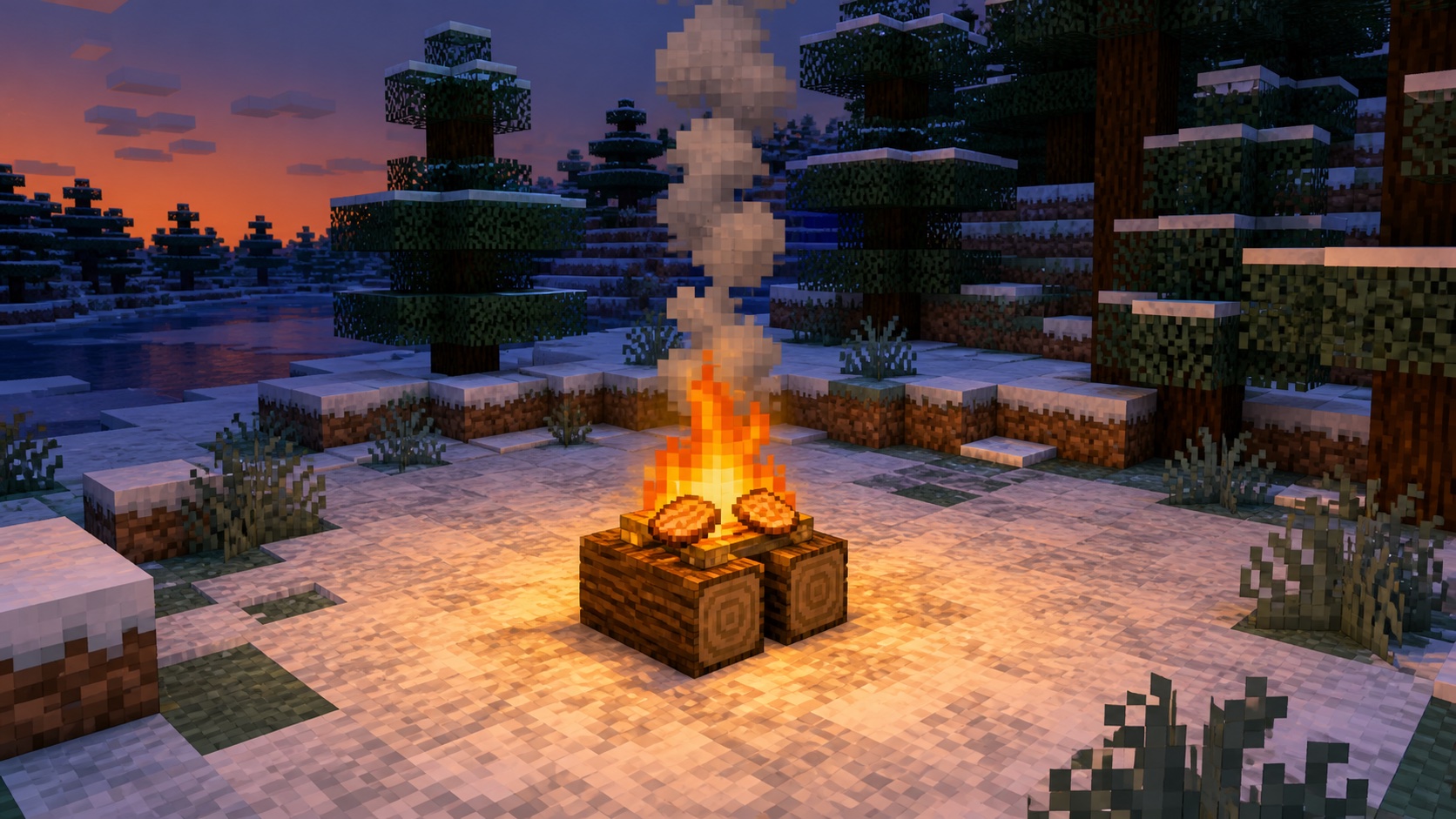
A campfire is a light source you can stand near, cook on, and use to send up a smoke signal. It lights up a 15-block radius, runs forever once lit, and lets you cook four raw foods at the same time without burning fuel. Step on it and it hurts you, so it doubles as a passive trap for hostile mobs that wander too close.
Campfires were added to Java in 1.14 (Village & Pillage) and Bedrock in 1.11. The soul campfire showed up later in the 1.16 Nether Update. Both variants use the same crafting layout, just with different center ingredients.
How to craft a campfire
You need three sticks, one piece of coal or charcoal, and three logs of any wood type. Logs, stripped logs, wood, and stripped wood all work, and you can mix wood types if you want. The recipe is shaped like this:
- Top row: empty, stick, empty
- Middle row: stick, coal or charcoal, stick
- Bottom row: log, log, log
The result is one campfire. To craft a soul campfire, swap the coal for soul sand or soul soil. Soul campfires give off blue flames, light up a smaller area, and hurt anything that stands on them more.
Where to find one without crafting
You can find lit campfires in taiga and snowy taiga villages, usually near the meeting point in the middle of the village. They also show up inside some ancient cities and rarely in plains or savanna villages depending on the version. Mine one with silk touch to take the campfire itself; mine it without silk touch and you get two charcoal (or two soul soil from a soul campfire).
How to light, place, and put out a campfire
Place a campfire like any other block. Crafted campfires come pre-lit, so you can drop one and start using it right away. Use the place key with the campfire item in your hand and aim at the top of a solid block.
If a campfire is unlit, right-click it with flint and steel, a fire charge, or any flaming projectile to relight it. To put one out, do any of the following:
- Right-click it with a shovel
- Pour water on it with a bucket or splash water bottle
- Wait for rain to land on it (works in most biomes; not in deserts and not in the Nether)
- Throw a snowball at it on Bedrock
An unlit campfire still works as a block; it just stops giving off light, smoke, and damage. You can light it again later with no penalty.
Cooking on a campfire
Campfires cook up to four raw foods at once. To cook, right-click the campfire while holding a raw food item. The food appears on top of the block and starts a roughly 30-second timer. When the timer ends, the cooked item pops off the block onto the ground for you to pick up. If you don’t grab it within five minutes it will despawn, so plan your trips back.
Foods that cook on a campfire:
- Raw beef, raw porkchop, raw chicken, raw mutton, raw rabbit
- Raw cod and raw salmon
- Potato (becomes baked potato)
- Kelp (becomes dried kelp)
Things a campfire will not cook: ores, sand, clay, anything that needs furnace-level heat. If you want iron ingots or glass, use a furnace or a blast furnace.
Cooking on a campfire uses no fuel. The trade-off is speed: a regular furnace is about three times faster than a campfire, and a smoker is about six times faster for food. Campfires are best when you’re outdoors, you don’t have a smoker yet, or you want to cook a few things at once without standing in front of a furnace.
Damage and light level
A regular campfire emits light level 15, the same as a torch or jack o’lantern. That’s bright enough to stop hostile mob spawns in a sizable area around it, and it works as a primary base light if you don’t mind the cooking mechanic getting in the way.
Standing on a lit campfire deals 1 damage every half-second on Java (one heart per second). Soul campfires hit harder, dealing 2 damage every half-second. Both variants damage mobs the same way, which is why they make decent trap floors when paired with a trapdoor cover. The damage applies even through full diamond armor; campfire damage isn’t blocked by armor at all.
You don’t take damage if you’re standing on a campfire that isn’t lit. You also don’t take damage if a block is between you and the fire. A trapdoor placed over the top while the campfire is still burning blocks the damage but lets the visual flame and smoke through. That trapdoor trick is how a lot of players turn campfires into a heating decoration without losing health.
The smoke signal
Every lit campfire sends up a thin column of smoke. By default the smoke rises about 10 blocks. Place a campfire on top of a hay bale and the smoke shoots up much higher, around 24 blocks. That taller plume is the standard Minecraft “I’m over here” signal: easy to see across a flat biome, and useful for marking a base, a portal, or a meeting spot in multiplayer.
Soul campfires produce blue smoke instead of gray. The hay-bale boost works the same way for both, so you can color-code locations if you want.
Bees and beehives
Campfires calm bees. If you place a campfire within five blocks below a beehive or bee nest, you can harvest honey or honeycomb with a bottle or shears without the bees getting angry. Without the campfire, harvesting makes every bee in that hive aggro on you, which is a fast way to die or ruin a peaceful afternoon.
The campfire has to be lit for the calming effect to work, and the bees need a clear line of sight down to it, so don’t sandwich the hive between solid blocks. A common setup: hive on a fence post, campfire directly under the fence, trapdoor over the campfire so you don’t burn yourself when you walk up to harvest.
What a campfire drops when you break it
Mining a campfire with no enchantment or with a regular tool drops two pieces of charcoal. A soul campfire drops one piece of soul soil. Use a tool with the Silk Touch enchantment and the block drops itself, ready to place again somewhere else. Campfires don’t drop experience.
If your campfire is on fire when you break it with silk touch, the lit state is preserved. Place it back down and it’s still burning.
Tips and common mistakes
A few things players tend to learn the hard way:
- Don’t try to smelt ores or build a kitchen of stacked campfires for iron production. Campfires only handle food.
- If you keep dying near your base, check whether you’re walking over a campfire on the path to your front door.
- Foxes love campfires and will sleep near them. If you’re trying to keep wild foxes out of your base, don’t leave campfires in obvious spots.
- Four-item cooking is per campfire, not per slot. You can place four different raw items at once and they cook independently.
- Carry flint and steel when you raid a vanilla village; some campfires are unlit and you’ll want to relight them as a temporary base marker.
Java vs. Bedrock differences
Most campfire mechanics are the same across both editions. The differences worth knowing:
- Snowballs put out campfires on Bedrock but not on Java.
- Damage tick rates are slightly different in some Bedrock versions, but the practical effect is the same (one heart per second on a regular campfire, two on a soul campfire).
- Some structure generation (which villages spawn campfires, which biomes get them) varies between editions and patches.
If you’re crossing between editions for a build, the cooking, lighting, and bee-calming behavior will all carry over.
Frequently asked questions
Can you use a campfire as a furnace?
No. Campfires only cook food. You can’t smelt ores, glass, or anything that requires furnace-level heat. Use a regular furnace, a blast furnace, or a smoker for those.
Does a campfire need fuel?
No. Once a campfire is lit it stays lit until you put it out with a shovel, water, a snowball on Bedrock, or rain. The coal in the recipe is consumed during crafting and doesn’t act as a fuel source for cooking.
How do you stop a campfire from hurting you?
Put it out with a shovel or water if you want a permanent fix. If you want it to stay lit but not damage you, place a trapdoor or carpet over the top. The visual flame still shows through and the damage stops.
Can you light a campfire with a fire arrow?
Yes. Any flaming projectile lights a campfire, including arrows enchanted with Flame, arrows shot through lava, and arrows lit by a dispenser pointed at a flame source.
How tall does the smoke from a campfire go?
About 10 blocks normally. Place the campfire on top of a hay bale and the smoke goes up about 24 blocks, which is the version most players use as a long-distance signal.
Will a campfire melt snow?
Yes. Light level 15 from a regular campfire melts snow layers and thin ice within a few blocks, the same way a torch does. Soul campfires give off less light (level 10) and melt a smaller area.
Do mobs avoid campfires?
Most hostile mobs avoid the area because of the light level, not the fire itself. If a hostile mob is forced near one (pushed, summoned, or spawned with a spawner) it will take damage like any other entity. Foxes, on the other hand, are drawn to campfires and will sleep near them.
When to use a campfire
A campfire is the right block when you want a wood-only light source, a no-fuel cooker for the early game, or a calming setup under your beehives. It’s also the cleanest way to send up a long-distance marker without spending iron on a beacon. Skip it for any task that needs furnace heat, and watch where you walk near a base lit with them; the block hurts you as easily as it hurts a zombie.