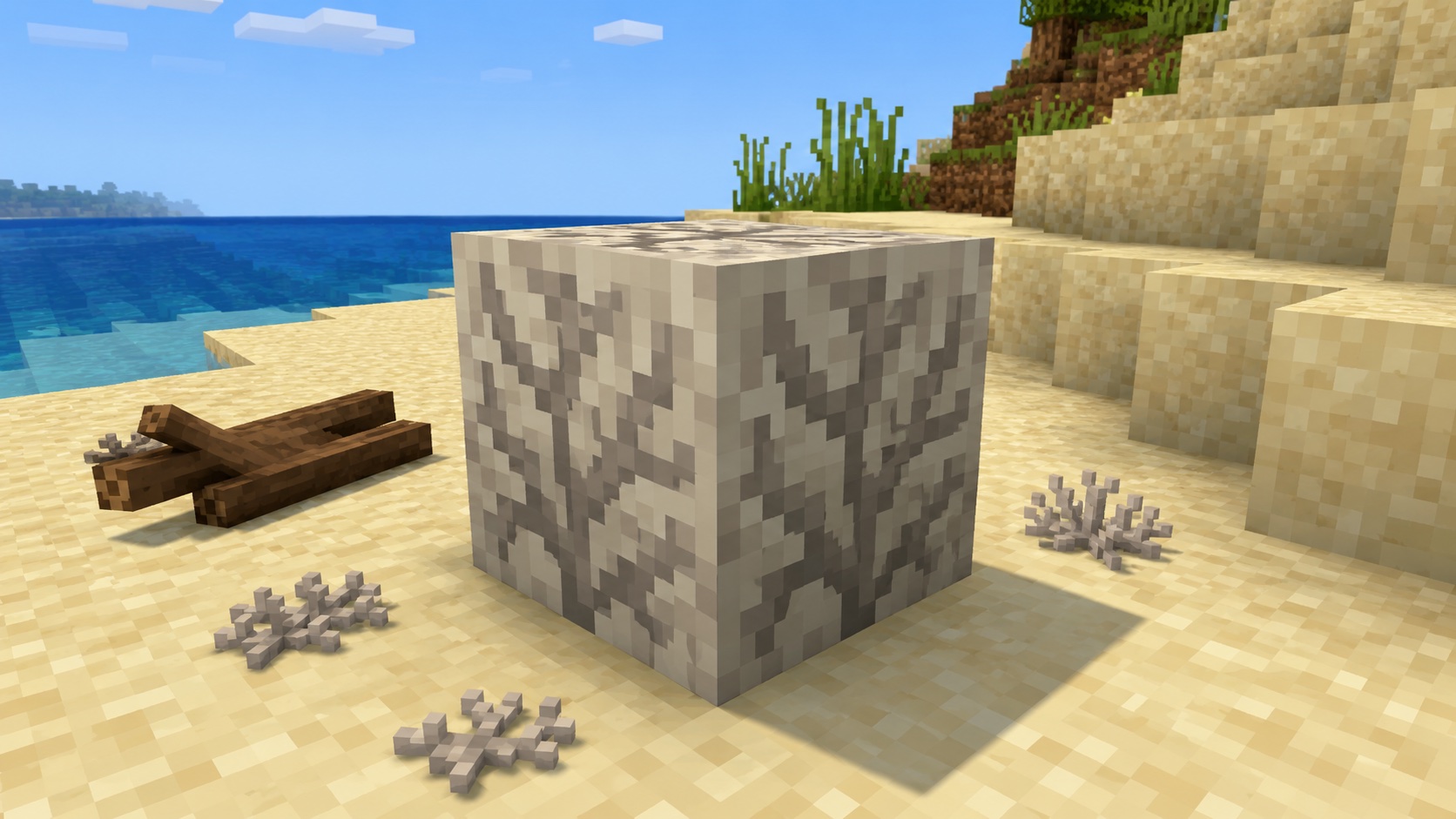
What is dead fire coral block?
A dead fire coral block is the gray, lifeless form of a fire coral block. In a fresh Minecraft world, it shows up in warm ocean reefs where pieces of coral have been damaged or pulled out of water. The block keeps the same shape as a live fire coral block, but the red color is gone.
If you searched for this block, you probably want one of two things: a way to grab it for a build, or a way to stop your live coral from turning into one. This guide covers both, plus the small mechanics that decide whether your block ends up in your inventory or in a pile of dust on the ocean floor.
Where dead fire coral comes from
Live fire coral blocks generate naturally as part of coral reefs in warm ocean biomes. When a live fire coral block is no longer touching at least one water source, it ticks down and dies after a couple of seconds. The result is a dead fire coral block sitting in the same spot.
That single rule explains every dead coral block you have ever seen. Sometimes the death happens because of a player who broke the live block and let it sit on land. Sometimes it happens because of world generation, where reef structures spawned a hair too far from water and the coral died on the first tick. Either way, dead is permanent.
You will not find dead fire coral block in any biome where live fire coral does not also generate. The Nether, the End, snowy biomes, deserts, and freshwater rivers will never have it without a player placing one.
How to get a dead fire coral block
There are three ways to add this block to your inventory.
The first is to mine an existing dead fire coral block. Use any pickaxe: wood, stone, iron, diamond, or netherite. The block has a hardness of 1.5, so a stone pickaxe or better breaks it quickly. If you hit it with bare hands or any other tool, the block breaks but drops nothing.
The second is to break a live fire coral block out of water and let it die. Live coral blocks need silk touch to drop themselves; without silk touch, mining a live block gives you no item. The workaround is simple. Place a live fire coral block on dry land. Within a couple of seconds, it ticks over and turns into a dead fire coral block. Now mine the dead version with any pickaxe and the item drops normally. This is the cheapest way to get dead coral if you have no silk touch and no nearby reef of pre-dead blocks.
The third is silk touch on a dead block, which works exactly the same as a regular pickaxe in this case. Silk touch only matters for the live version of fire coral block. Once a block is dead, the drop is identical with or without silk touch.
Tools and drops at a glance
Use a pickaxe of any tier. The block drops itself when broken with a pickaxe. Without a pickaxe, the block breaks but you get no item. Hardness is 1.5 and blast resistance is low, so creepers and TNT destroy it like a normal stone-tier block.
How dead fire coral behaves
Once a coral block dies, it stops caring about water. You can place it anywhere (a desert, a snow biome, a Nether build, a sky base), and it stays the way you left it. It does not turn back into a live block, even if you submerge it in water.
The block is solid. Mobs can stand on it, items can rest on it, and you can build redstone wiring on top of it. It does not emit light, does not power signals, and does not interact with bone meal or growth mechanics. From a player’s perspective, it is essentially a slightly soft piece of decorative stone.
A few specific behaviors worth knowing:
- It is not flammable. Lava next to a dead fire coral block will not catch it on fire.
- It does not break or change when waterlogged. Water flows around it normally.
- You can waterlog the block by placing water against it like any other full block.
- Bone meal does nothing to it. It cannot be revived.
If you bring a live fire coral block back into the water and place it next to the dead one, the live block stays alive but the dead one stays dead. Death is one-way.
Building with dead fire coral
The reason most players seek out dead fire coral specifically, versus live, is because it is stable. Live coral demands water and dies if you build above sea level. Dead coral works anywhere, which makes it useful for any build that wants a weathered, bone-pale stone look without the upkeep.
Common build uses:
- Dry reef dioramas, where a stack of dead coral on sand reads as a fossilized seabed.
- Ruined temple textures, where dead coral mixed with mossy cobble, sandstone, and skulls feels ancient.
- Underwater ghost reefs, where bleached coral surrounds a sunken ship.
- Coral-tile flooring with dead coral patterns alternating with prismarine or smooth stone.
Because all five dead coral block variants share the same texture, the type you choose does not change how it looks once placed. Pick whichever variant is easiest to source. Fire coral happens to be common in any warm ocean reef, so dead fire coral block is one of the easier ones to stockpile.
Pairing with other blocks
Dead fire coral pairs well with bone block, smooth sandstone, calcite, and tuff for a washed-out palette. For something more dramatic, contrast it with deepslate or polished blackstone to push the bone-pale texture forward.
Tips and common mistakes
- Always carry a pickaxe when you head into a coral reef. Hitting a coral block with a sword is the fastest way to lose it.
- If you do not have silk touch, the cheapest farm is: break a live coral block, sprint to dry land, place it, watch it die, mine the dead version, repeat. It feels janky but works.
- Dead fire coral block does not respawn. Once you mine a reef bare, it stays bare. Treat reefs as renewable only by transplanting live coral and waiting for it to spread, which is slow and unreliable.
- If you accidentally place a live fire coral block on land and walk away, it is dead by the time you remember. Always check your placement before stepping back.
- The block can be picked up by minecarts and chest boats just like any other block, so transport is not a problem once you have a stack.
Java and Bedrock
There are no meaningful gameplay differences between Java and Bedrock for the dead fire coral block. Both editions drop the block when mined with a pickaxe, produce the dead version when a live fire coral block loses water contact, and use the same gray texture across all dead coral block variants.
Death tick timing can feel slightly different between editions because of how each handles random ticks, but the outcome is the same in normal play. If you place a live fire coral block on dry land in either edition, it will be dead before you finish a single inventory rummage.
Frequently asked questions
How do you get dead fire coral block without silk touch?
Mine a live fire coral block with any pickaxe, place the live block on dry land, wait two or three seconds for it to die, then mine the resulting dead block with a pickaxe. You get a dead fire coral block in your inventory. No silk touch needed.
Can dead coral come back to life?
No. Death is one-way. Surrounding the block with water, using bone meal, or any other trick will not revive it. If you want a live reef, plant fresh live coral.
What tool breaks dead fire coral block fastest?
A diamond or netherite pickaxe. It mines in well under a second. Any pickaxe tier works, though, so do not feel pressured to bring your best gear into the ocean.
Why does my dead coral block drop nothing?
You are mining it without a pickaxe. Bare hands, swords, axes, shovels, hoes, and shears all break the block but drop no item. Switch to a pickaxe and try again.
Does dead fire coral block burn?
No. The name is misleading. The dead version has no fire properties at all. You can place it next to lava without any risk of catching fire.
Are all dead coral block textures the same?
Yes. All five dead variants (brain, bubble, fire, horn, tube) share one gray texture in the world. Your inventory remembers which one is which, but the placed block looks the same regardless of type.
Where can I find dead fire coral naturally?
In warm ocean biomes, especially in reefs that have lost water access. Some coral generates dead from the start because of chunk-edge quirks. Otherwise, every dead coral block you see was once a live block that died.
When to stockpile dead fire coral
If you are gathering blocks for a desert temple, a sunken-ship diorama, or any build that needs a bone-pale stone, do the live-and-die trick on a stack of fire coral before you head home from your next reef trip. Twenty dead fire coral blocks travel just as well as twenty stones, and they give you a texture you cannot get any other way without venturing back into the warm ocean.