What a camel is in Minecraft
A camel is a tall passive mob that lives in desert villages. It was added in the 1.20 update, and it fills a role no other mob does: it can carry two players at once. One person steers, the other rides along behind them.
Camels are sandy brown, stand taller than almost every other mob, and move at a relaxed walk most of the time. Their real strength comes from two things. Their height keeps riders out of reach of most ground enemies, and their dash is a forward leap that clears gaps and closes distance fast.
If you spend a lot of time crossing deserts or want a mount you can share with a friend, the camel is worth tracking down.
Where to find a camel
Camels spawn naturally in desert villages. They do not appear out in the open desert the way horses roam plains and savannas, so the village is the place to look. Each desert village usually has one or two camels wandering among the houses.
They spawn in both Java and Bedrock editions. If a desert village has none in sight, check the edges and behind buildings, since they can drift away from the center. Camels are passive and will not attack you, so you can walk right up to one.
There is no taming step. Unlike a horse, you do not need to ride a camel over and over until hearts appear. Once you have a saddle, you can ride it straight away.
How to ride a camel
To control a camel, you need a saddle. Saddles cannot be crafted, so you find them in chests in dungeons, desert temples, Nether fortresses, and similar loot spots, or get them by fishing and trading.
With a saddle in hand, use it on the camel, or open the camel’s inventory and place the saddle in the slot. After that, mounting works like any other rideable mob. Use the mount control on your platform to climb on, then steer with your movement keys. The camel follows where you look.
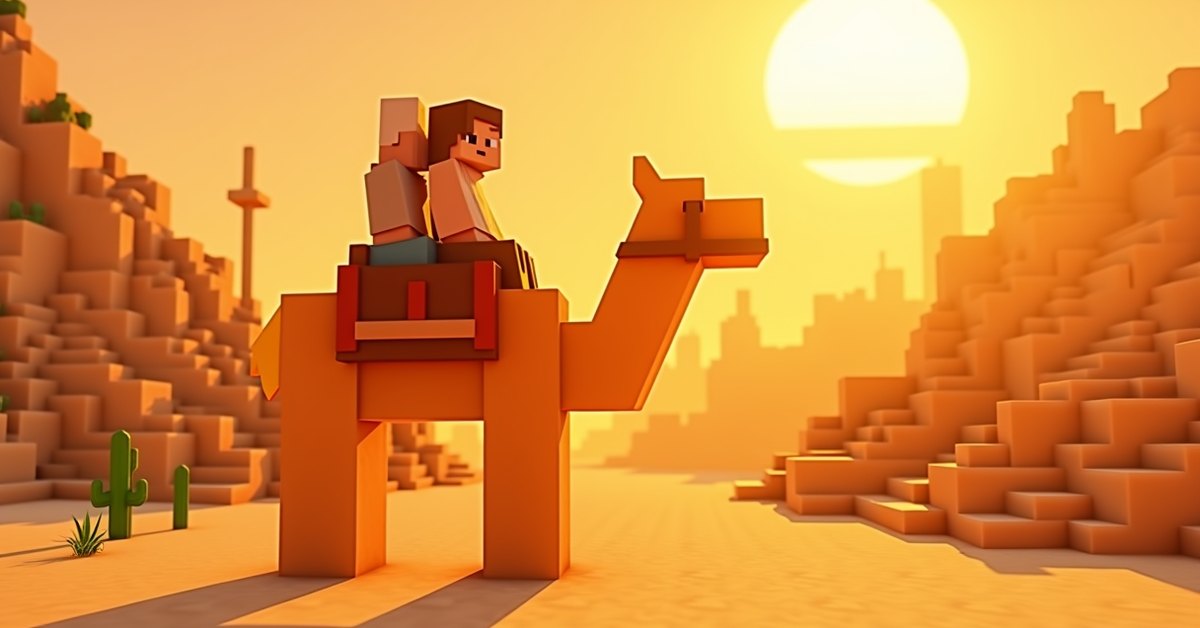
The headline feature is double riding. A second player can mount the same camel and sit behind the first. The front rider drives, and the back rider is a passenger who cannot steer. This makes the camel the only vanilla mob that seats two people, which is handy for traveling together or ferrying a friend across dangerous ground.
The dash move
While riding, press the jump control to make the camel dash. Instead of a normal hop, the camel lunges forward in a long, low leap. The dash covers several blocks of distance and a bit of height, enough to clear small ravines, fence lines, and gaps that would stop a walking mount.
The dash has a cooldown. After one leap you have to wait a few seconds before the camel can dash again, so you cannot chain jumps back to back. Timing matters. Line up the gap, dash once, and let the cooldown reset before the next obstacle.
Used well, the dash turns the camel from a slow walker into a quick way to skip across rough terrain. It is also a clean way to escape a fight, since you can leap over a wall or a creeper and put distance between you and the threat.
Sitting and standing
Left alone, a camel will sit down on its own from time to time, folding its legs under itself. A sitting camel is lower to the ground and will not walk. It stands back up on its own after a while, or right away if you mount it.
You can still climb onto a sitting camel. Mounting one makes it rise to its feet so you can ride off. There is no command to force a camel to sit on demand, so sitting is mostly its own idle behavior.
Why a camel’s height matters
The camel’s best defensive trick is simply how tall it is. When you ride one, you sit well above the ground. Most melee enemies, including zombies, husks, and baby mobs, cannot reach high enough to hit you while you are mounted. They swing and miss at the camel’s legs instead.
That makes a camel a surprisingly safe platform in a fight. You can sit on top, fire arrows or throw potions down at a crowd of mobs, and take little damage in return. Ranged attackers like skeletons can still hit you, and the camel itself can take damage, so this is not total immunity. Against a swarm of melee mobs, though, the height advantage is real.
How to breed camels
Camels breed with cactus. Feed cactus to two adult camels and they enter love mode, then produce a baby camel. The cactus does not hurt them the way it hurts you when you brush against it.
Cactus is easy to farm. Plant it on sand with an empty block beside it so the new cactus breaks off, or just harvest the cactus that grows around any desert. A small cactus farm gives you a steady supply for breeding and healing.
Baby camels are small versions of the adult and follow their parents. They grow into adults over time, and you can speed up the growth by feeding the baby more cactus. Cactus also heals an injured camel, so keep some on hand if you take yours into danger.
Camel stats and behavior
A camel has 32 health points, which is 16 hearts, putting it among the sturdier passive mobs. It walks slowly by default, slower than a horse at a trot, but the dash gives it bursts of speed that a horse cannot match for crossing gaps.
Camels float in water rather than sinking, and you can lead one with a lead like other passive mobs. A camel you find in a village will stay put unless something kills it. Because they are passive, they never turn hostile, even if you hit one by accident.
Tips and common mistakes
Bring a saddle before you go camel hunting. Finding a camel is easy. Finding one with nothing to ride it with is a wasted trip. Saddles do not craft, so stock up whenever you loot one.
Do not expect a camel to outrun a fast horse on flat ground. The camel wins on rough terrain and over gaps, not in a straight sprint. Pick the mount that fits the trip.
Watch the dash cooldown before lining up a big jump. Dashing into a ravine while the dash is still on cooldown means a normal step off the edge and a fall, not a leap. Wait for the cooldown to clear first.
Keep a stack of cactus for longer journeys. It covers breeding, baby growth, and healing all at once, so one farmed item handles every camel need.
Java and Bedrock differences
Camels work almost identically in both editions. They spawn in desert villages, take a saddle, carry two riders, dash on the jump key, and breed with cactus in Java and Bedrock alike. Control schemes differ by platform, since console and touch controls map the dash and mount buttons differently from a keyboard, but the mob itself behaves the same way. If you learn camels on one edition, the knowledge carries straight over to the other.
Frequently asked questions
What do camels eat in Minecraft?
Cactus. It is the only food a camel takes, and it works for breeding, healing, and growing up babies.
How do you get a camel?
Find one in a desert village. Camels spawn there naturally, and you do not have to tame them. With a saddle, you can ride one right away.
Do you need a saddle to ride a camel?
Yes. You can climb onto a camel without one, but you cannot steer it. A saddle is required to control where it goes.
How many players can ride one camel?
Two. The camel is the only vanilla mob that seats two players at once. The front rider drives and the back rider comes along as a passenger.
How does the camel dash work?
Press the jump control while riding and the camel leaps forward in a long, low bound. It clears gaps and obstacles, then needs a few seconds of cooldown before it can dash again.
Can mobs hit you while you ride a camel?
Most melee mobs cannot reach you because of the camel’s height. Ranged attackers like skeletons still can, and the camel itself can be hurt, so you are safer but not invincible.
How much health does a camel have?
32 health points, or 16 hearts. That makes it one of the tougher passive mobs to take down.
Should you keep a camel around?
If you play with a friend or spend real time in desert biomes, a camel earns its keep. The two-seat ride and the gap-clearing dash do things no horse can, and a single stack of cactus covers everything it needs. Track one down in the next desert village you pass, throw a saddle on it, and keep some cactus in your pack for the road.