What carpets are in Minecraft
Carpets are thin decorative blocks made from wool, and they’re one of the easiest ways to dress up a floor in Minecraft. They sit at 1/16 of a block tall, come in 16 colors, and play nicely with redstone, fences, and llamas.
Most players run into carpet for the first time because they want a colored floor that’s not just a slab of solid wool. After that, the building uses pile up: hiding wiring under a thin top layer, walking over a fence pen without a gate, decorating llamas in a caravan, and mob-proofing a base on Java Edition. This guide covers what carpet is, how to make it in any color, where it can go, and the mechanics worth knowing.
What carpet is, exactly
Carpet is a thin block crafted from wool. It occupies 1/16 of a block in height, sits on top of a full block, and doesn’t block movement or line of sight in any meaningful way. Each color is a separate block with its own item ID in the form <color>_carpet, and there are 16 of them, one for each wool color.
Carpet is flammable because wool is flammable. Don’t put it next to lava or a fire block unless you want it to burn away. It can’t be waterlogged, and it can’t carry a redstone signal. For most other interactions, it follows the same rules as the wool block it’s made from.
How to craft carpet
The recipe is two wool blocks of the same color placed side by side horizontally on a crafting table. That gives you three carpets of that color in one craft. The grid only cares about the row, so it doesn’t matter whether the two wool sit in the top, middle, or bottom row of the crafting bench, as long as they’re next to each other in a horizontal pair.
If you have white wool but want a different color, there are two paths. Dye the wool first (one wool plus one dye gives one dyed wool) and craft the carpet from dyed wool. Or craft white carpet first and dye the carpet directly (one carpet plus one dye gives one dyed carpet). Both paths use the same amount of dye, so pick whichever fits your inventory better.
Sheep also drop wool in their natural color. White sheep are the most common, but black, gray, light gray, brown, and rarely pink sheep spawn naturally too. A small flock of mixed-color sheep is the cheapest carpet supply once it’s set up, since you skip the dyeing step entirely for those colors.
The 16 colors
Carpet comes in the same 16 colors as wool: white, light gray, gray, black, brown, red, orange, yellow, lime, green, cyan, light blue, blue, purple, magenta, and pink. Each color is its own block and its own item.
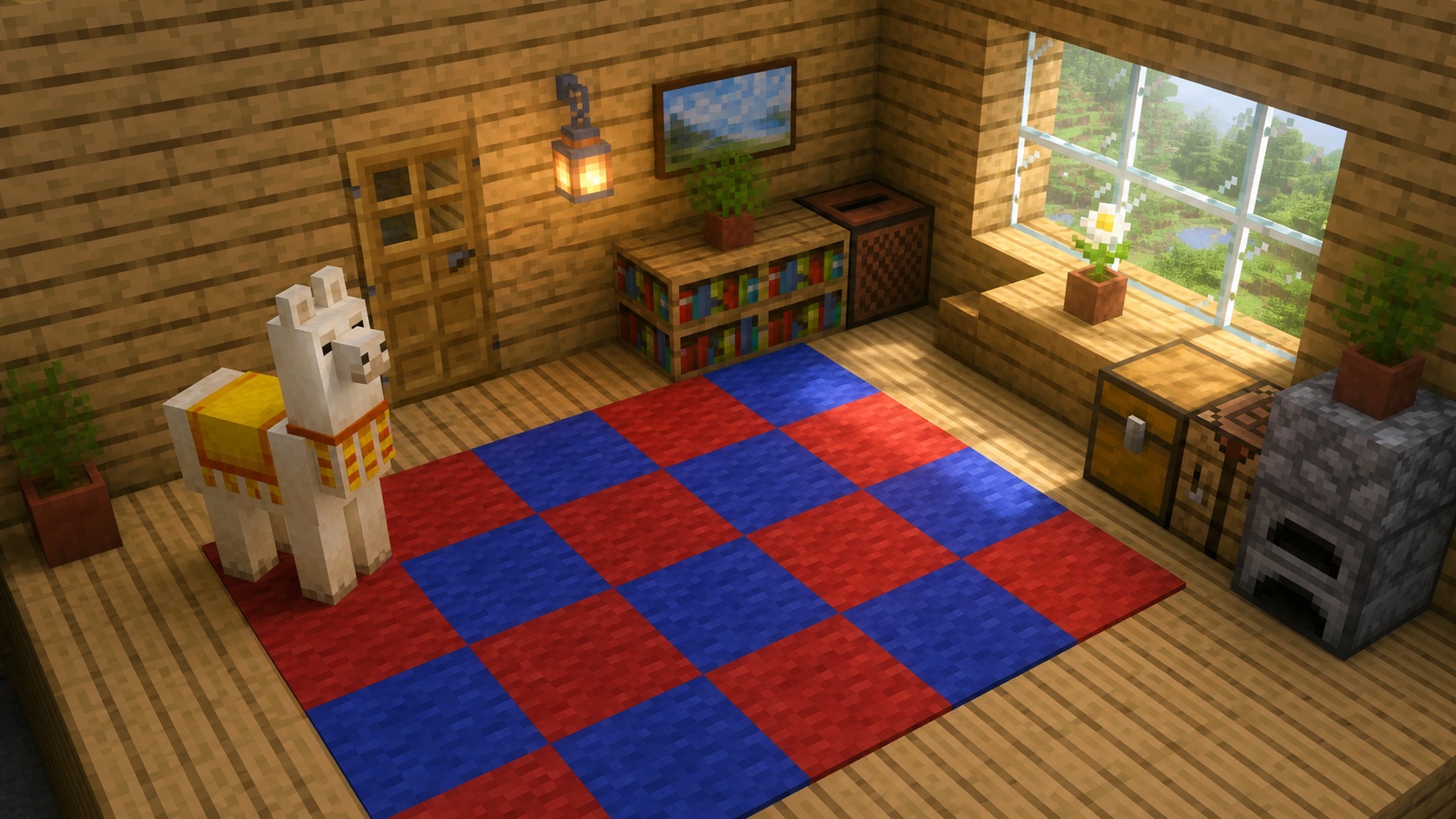
You can’t mix colors inside a single carpet block. There’s no checkerboard or stripe variant. To make a pattern on the floor, place individual carpet blocks side by side. Builders often run alternating bands of two or three colors across a floor to suggest a rug without having to texture it manually.
How to place carpet
Right-click while holding a carpet and it lands on whichever full-block face you targeted that’s facing upward. Carpet needs a solid block beneath it. You can’t place one in midair, on the underside of a block, or on most non-full blocks. Valid placements include any full opaque block, top-half slabs, stairs, full glass blocks, ice, wool, and fences.
The fence placement is the one most players run into early. A regular fence is 1.5 blocks tall in collision terms, just barely too tall for a player to walk over. Drop a carpet on the fence and the visual height bumps up a hair, but the game treats the combined height as something the player can step over by jumping. Mobs can’t jump that high. The result is a one-tile pen entrance that lets you walk in and out without a gate, with animals still contained.
To remove a carpet, hit it once with anything (or nothing). Carpet has minimal hardness, so a bare fist breaks it instantly and drops the carpet item.
Mechanics and behavior
Carpet does not conduct redstone
Carpet is a non-conductive block. Placing a carpet on a powered block doesn’t transmit a signal anywhere, and the carpet itself can’t be turned into a signal source. That makes carpet useful in compact redstone builds where you want a thin top layer that won’t accidentally activate something underneath.
Hostile spawning on carpet
In Java Edition, hostile mobs do not spawn on carpet. The collision box is too small to count as a full block surface, so monsters won’t pick a carpet square as a spawn point. A floor of carpet is one of the cheapest ways to mob-proof an indoor base on Java.
In Bedrock Edition, the spawning rules are different and carpet alone isn’t a reliable mob-proofer. If you’re playing Bedrock and want a hostile-free room, light it to spawn-proof brightness instead of counting on the floor block.
Carpet on llamas
Tamed llamas can wear carpet as a visible blanket. After taming a llama by feeding it wheat or hay bales until hearts appear, right-click to open its inventory and drag a carpet into the saddle-style slot at the top. The carpet shows up as a colored decoration draped over the llama’s sides. It doesn’t change inventory size or stats; it’s purely cosmetic. To remove it, open the llama’s inventory again and pull the carpet back out.
Carpet and burning
Wool catches fire from adjacent flame, and carpet inherits that property. A carpet next to a lava block can ignite and burn away in a few seconds. If you’re decorating a room with a fireplace, leave at least one buffer block of stone, brick, or another non-flammable material between the flame and the carpet.
Common uses
- Floor decoration: colored bands or rugs across a plank or stone floor make a room feel furnished.
- Mob-proofing in Java Edition: a full carpet floor stops hostile spawns indoors.
- Walk-over fence pens: a 1-block fence with a carpet on top lets the player step over while keeping animals contained.
- Llama caravan markers: colored carpets help you tell your llamas apart when you have several on leads.
- Pixel art floors: carpet’s thin profile lets you make patterns on the ground without committing full wool blocks.
- Compact builds: a 1/16-block-thick top layer that won’t conduct redstone or shorten head clearance.
Tips and common mistakes
Don’t put carpet next to open flame. The same fluffy texture that makes wool look cozy in a build makes it flammable. Stone, brick, or any non-wood, non-wool block works as a fireplace surround.
Don’t try to dye a placed carpet by right-clicking it with dye. Carpet can’t be dyed in place. Pick it up, dye it in the crafting grid, and place the new color.
Don’t try to place carpet on the bottom face of a block or on the bottom half of a slab. Carpet only goes on a full block surface or a recognized partial top (top-half slabs, stairs, fences).
Don’t trust carpet alone for mob-proofing on Bedrock. Light the room or add a layer of trapdoors instead of relying on carpet’s transparency the way you would on Java.
Java vs. Bedrock differences
The main difference players notice is the spawn behavior covered above: hostile mobs don’t spawn on carpet in Java, but they can in Bedrock. Crafting, dyeing, llama decoration, and the fence walk-over trick all work the same on both versions. Block IDs differ slightly under the hood (older Bedrock builds used a single carpet block ID with a color data value), but in normal play, you won’t notice.
Frequently asked questions
Can you craft carpet without wool?
No. Wool is the only ingredient. You can get wool by shearing sheep, killing sheep, finding it in village houses or shipwrecks, or trading with shepherd villagers. Two wool of the same color give you three carpets of that color.
Does carpet stack in your inventory?
Yes, up to 64 per stack. Carpets of different colors do not stack with each other; each color is a separate item.
Can mobs walk on carpet?
Yes. Carpet doesn’t slow mobs or block movement. It just sits on the floor like any other thin block. Cats sometimes choose carpet as a sit spot, but they’ll sit on most flat surfaces.
Can carpet be waterlogged?
No. You can’t put a water block in the same space as a carpet. Water flows over a carpet as if it were a normal floor.
Can you place carpet on a llama?
Yes, but only after you tame the llama. Feed it wheat or hay bales until you see hearts, right-click to open the llama’s inventory, and drag a carpet into the saddle-style slot. The carpet appears as a colored blanket on the llama’s sides.
Why doesn’t my fence-and-carpet walk-over trick work?
Two common reasons. First, the fence connects diagonally to another fence, which sometimes alters the walkable height. Use a single straight fence section with no diagonal neighbor. Second, you’re trying to walk over from a block lower than the fence base. You need to be at the same Y level as the bottom of the fence for the jump to clear the carpet.
What’s the difference between carpet and moss carpet?
Wool carpets are crafted from wool and come in 16 colors. Moss carpet is a separate block found in lush caves and crafted from moss blocks. Moss carpet is naturally green, can spread under the right conditions, and reacts to bone meal. The two blocks share a similar thin shape, but they aren’t interchangeable in recipes or behavior.
Where carpet fits in your builds
Once a sheep farm is running and the dye supply is steady, carpet is one of the cheapest decorative blocks in the game. A handful of dyes turns a single white pen into a 16-color rainbow, and the thin profile makes it useful in compact builds where a normal block would take up too much room. Pick a color, keep a stack in the hotbar while you build, and rooms fill out faster than you’d expect.