What chiseled deepslate is
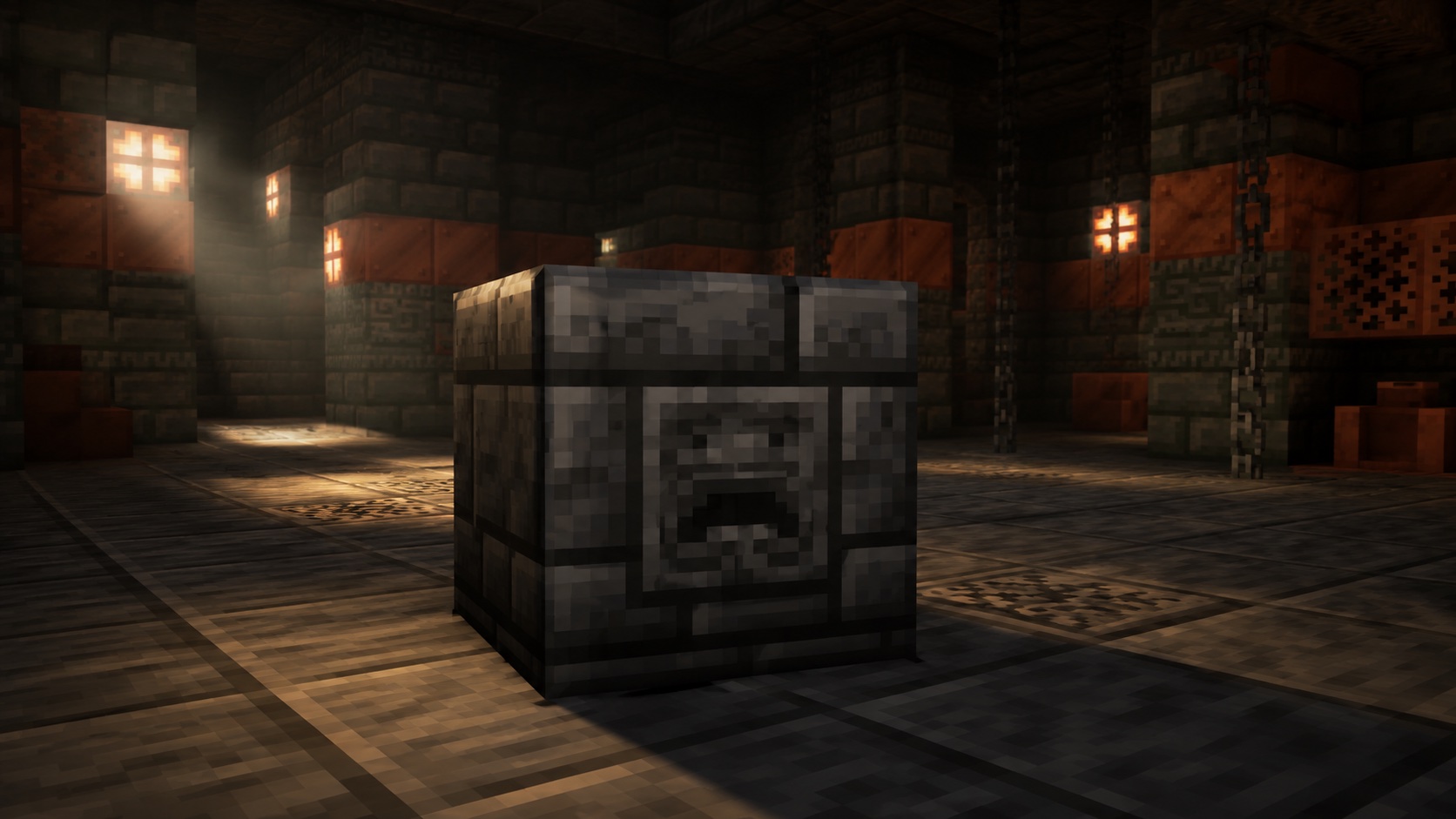
Chiseled deepslate is a decorative variant of deepslate with a carved, mask-like face on its texture. It belongs to the deepslate family, which Mojang added in the Caves & Cliffs update (Java 1.17, Bedrock 1.18) when the deep underground got its dark stone makeover.
The block is purely cosmetic. It does not give off light, does not produce a redstone signal, and has no special interaction with any mob or entity. The only reason to make it is the look. The carved face fits dungeons, brutalist builds, and any spot where you want stone with personality.
You will not find chiseled deepslate while digging through normal cave terrain. It is a player-crafted block in almost every case, and it shows up in only one piece of worldgen: trial chambers, added in the 1.21 Tricky Trials update.
How to craft chiseled deepslate
The recipe is short. Stack two polished deepslate slabs in the crafting grid, one on top of the other, in any single column. That gives you one chiseled deepslate.
To get the slabs, work backward from raw deepslate:
- Mine deepslate in the lower half of the world. The deepslate layer starts around
Y=0and continues down toward bedrock. - If you mine without Silk Touch, you get cobbled deepslate. Smelt cobbled deepslate in a furnace to get plain deepslate. With Silk Touch, you skip the smelt and get plain deepslate directly.
- Run plain deepslate through a stonecutter or crafting table to get polished deepslate.
- Place three polished deepslate blocks in a row, in any row of the crafting grid, to get six polished deepslate slabs.
- Stack two of those slabs vertically in the crafting grid for one chiseled deepslate.
If you have a stonecutter on hand, the workflow is faster. Drop polished deepslate in, scroll to the chiseled deepslate icon, and pull one out per input block. The stonecutter trades the 2-slab cost for a 1-block cost, so it is cheaper if you already have polished deepslate stockpiled. The output is the same block; only the conversion path changes.
Recipe gotcha: slabs, not blocks
The crafting table recipe needs polished deepslate slabs, not the regular polished deepslate block. A common mistake is to put two polished deepslate blocks in the grid and wonder why nothing happens. Chiseled deepslate only forms from slabs. If you skipped slab crafting, you can still use the stonecutter, which accepts the full block.
Where chiseled deepslate generates naturally
Chiseled deepslate generates as part of trial chambers, the underground combat structure introduced in Java 1.21 and Bedrock 1.21. Inside a trial chamber, chiseled deepslate appears around vaults, in pillar bases, and as decorative trim alongside polished deepslate, deepslate bricks, and tuff variants. It is not a rare drop or a random worldgen ore. If you find it underground, you are almost certainly standing in a trial chamber.
To find a trial chamber, explore the deepslate layer (around Y=-30 and below) in the Overworld. Look for chiseled walls, copper bulbs, hanging chains, and trial spawners. Trial chambers tend to sit between Y=-20 and Y=-50, often near regular cave systems. The easier way to scout is to listen for the soft hum of a copper bulb in a chunk where you have been mining; the bulb is part of the chamber and not part of normal cave generation.
Mining chiseled deepslate inside a chamber is allowed. The structure is not protected, and the block drops itself with the right tool. Take what you need, but be aware that mob spawners in the same room will keep firing while you mine, so clear the spawner first or break line of sight.
Mining and tool requirements
Chiseled deepslate requires a pickaxe to drop. Hit it with anything else and the block breaks but gives no item. The minimum tier is wooden, the same as plain deepslate.
The block uses the same physical stats as the rest of the deepslate family:
- Hardness:
3.5(deepslate is roughly 1.75 times as tough to mine as regular stone) - Blast resistance:
6(a small step up from stone at6, much weaker than obsidian) - Mining time with an iron pickaxe: roughly
0.6seconds, faster with diamond or netherite - Drops: one chiseled deepslate, with no Fortune scaling
Silk Touch is not needed for this block. Unlike cobbled deepslate, which only turns back into smooth deepslate when you mine it with Silk Touch, chiseled deepslate drops itself by default. Save Silk Touch for blocks that actually need it. Efficiency on your pickaxe still helps if you are clearing a lot of chiseled deepslate for a build.
Building with chiseled deepslate
Chiseled deepslate has a face engraving in the center of the block. Two of those faces stacked side by side give you a strong vertical pattern, which is why builders use it for pillars, door frames, and accent strips on long walls.
A few uses that come up often in survival builds:
- Pillars and columns. Stack chiseled deepslate vertically between polished deepslate blocks for a temple-style support that reads from far away.
- Trim around doors and arches. The carved face frames an entrance well, especially in dungeon or castle builds where you want a piece of stone that looks important.
- Wall accents. Replace one polished deepslate every few blocks in a long wall to break up the texture without changing the color.
- Boss room flooring. Use it sparingly as a centerpiece tile in a Wither arena or End City landing pad.
- Underground base detailing. Pairs well with deepslate bricks, polished deepslate, and tuff for a heavy, brutalist look.
Chiseled deepslate does not have a stair, slab, or wall variant. If you need angles or half-height pieces, you have to mix in polished deepslate slabs, polished deepslate stairs, or deepslate brick walls. That limits how detailed you can get with chiseled deepslate alone, but the rest of the deepslate family fills the gap.
Color and texture pairing
Chiseled deepslate is a cool, charcoal gray. It pairs cleanly with stone, andesite, polished basalt, blackstone, and dark oak. It looks muddy next to warm tones like sandstone or red nether bricks, so most builders save it for cave bases, witch towers, mob arenas, and end-game megabuilds rather than mixing it into wood-and-grass overworld homes.
Build scale and budget
One full stack of chiseled deepslate (64 blocks) costs 128 polished deepslate slabs in a crafting table, or 64 polished deepslate blocks at a stonecutter. If you are running low on deepslate, save the chiseled variant for visible accent rows and use cobbled deepslate or polished deepslate for the bulk of the structure. The block is too expensive to use as a wall fill.
Tips and common mistakes
A few things that trip up players the first time they try to make chiseled deepslate:
- Putting polished deepslate blocks in the crafting table instead of slabs. Only slabs work for the recipe in the crafting grid. Use a stonecutter if you want to skip the slab step.
- Mining cobbled deepslate and trying to chisel it directly. Cobbled deepslate has its own slab and stair variants, but you cannot polish or chisel it without first smelting it into smooth deepslate.
- Forgetting the stonecutter shortcut. If you already have polished deepslate, the stonecutter is the cheaper conversion. One polished deepslate block in, one chiseled deepslate out.
- Wasting Silk Touch durability on it. Chiseled deepslate drops itself with any pickaxe, so a plain iron pick is fine.
- Trying to use it in redstone builds. The block has no signal-related properties, so it cannot replace observers, redstone blocks, or any active component. It moves with pistons normally and behaves like any solid block.
- Expecting it in ancient cities. Ancient cities use deepslate bricks, deepslate tiles, and reinforced deepslate, but the chiseled variant only generates inside trial chambers.
Java vs. Bedrock differences
Chiseled deepslate behaves the same on Java and Bedrock. Same recipe, same hardness, same generation in trial chambers, same drops, and the same lack of stair, slab, and wall variants. The only meaningful timing difference is that Bedrock added the deepslate family one update later than Java (Bedrock 1.18 vs. Java 1.17), but both editions have full parity now. There is no version-specific quirk worth memorizing for this block.
Frequently asked questions
Can I make chiseled deepslate without a stonecutter?
Yes. Place two polished deepslate slabs in the crafting grid, one above the other, in any column. That gives one chiseled deepslate. The stonecutter is faster and uses fewer items, but it is not required.
What is the difference between chiseled deepslate and deepslate bricks?
Deepslate bricks are a structured masonry pattern that comes with stair, slab, and wall variants. Chiseled deepslate is a single decorative block with a carved face and no stair, slab, or wall versions. Bricks are for walls and floors at scale; chiseled is for accents.
Does chiseled deepslate spawn in normal worldgen?
No, not in caves, ravines, or ancient cities. It only generates in trial chambers (Java and Bedrock 1.21 and later). If you want some without crafting, find a chamber and mine what is there.
Can I make chiseled deepslate at a stonecutter using regular deepslate?
No. The stonecutter only converts polished deepslate into chiseled deepslate. You have to polish the deepslate first, either in a stonecutter or a crafting table, before the chiseled option appears.
Does Fortune affect chiseled deepslate drops?
No. The block drops one of itself per break, and Fortune does not change that. Use Efficiency for speed and skip Fortune for this block.
Can I dye chiseled deepslate or change its color?
No. The block has a fixed gray texture. To get a different color, swap to a different deepslate variant in your build, or use a resource pack to change how the texture renders client-side.
Does chiseled deepslate work in beacon pyramids?
No. Beacon bases only accept iron, gold, diamond, emerald, and netherite blocks. Decorative stone variants like chiseled deepslate are not on the list.
Bottom line
Chiseled deepslate is the cheapest way to add a carved-stone accent to a deepslate-themed build. The recipe takes two polished deepslate slabs, the stonecutter shortcut takes one polished deepslate block, and a trial chamber raid will hand you a stack or two if you would rather skip the crafting altogether. Plan it as trim, not bulk filler, and pair it with the rest of the deepslate family for the best look.